Salt Lake County | Aaron Fortin
TAKEAWAY
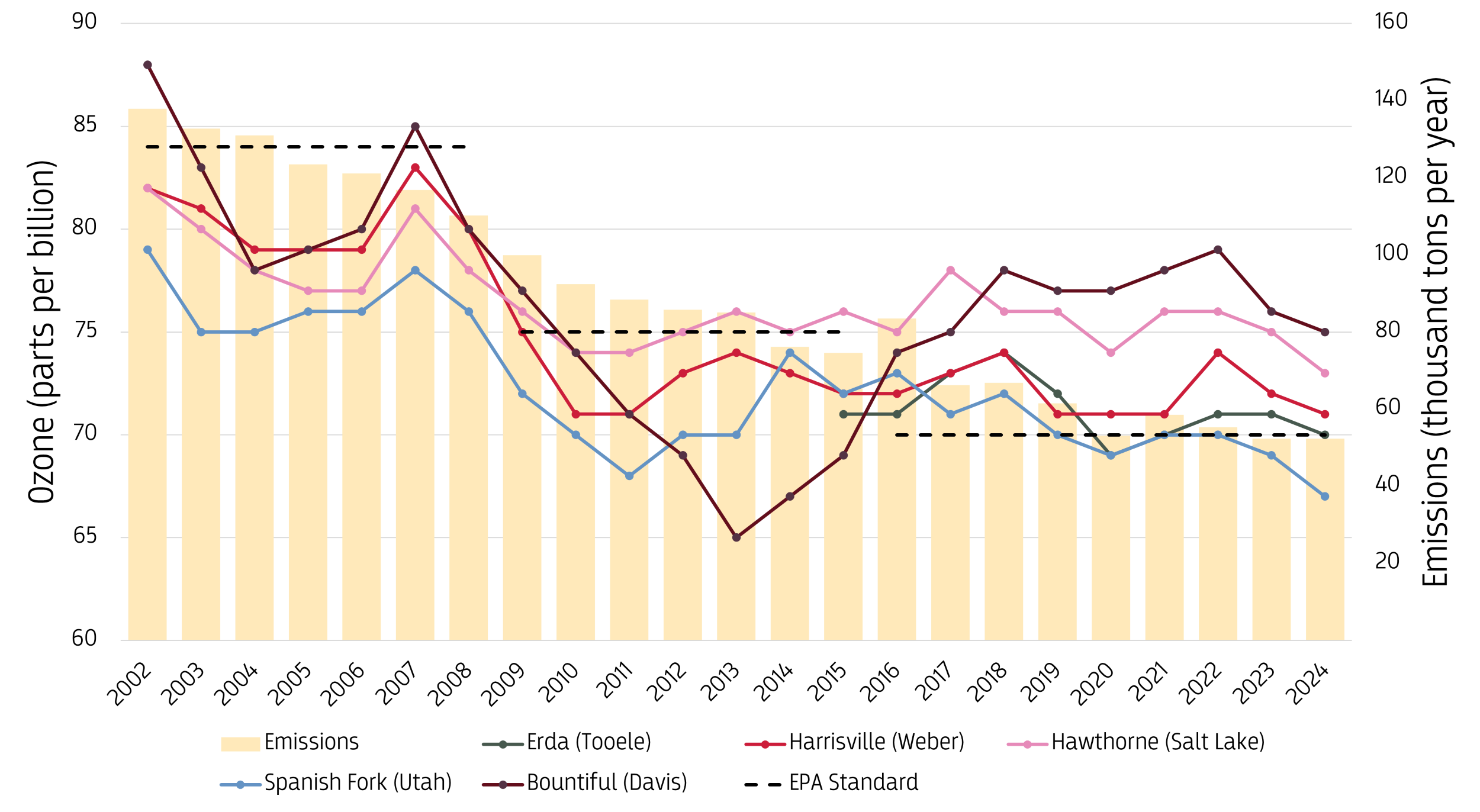
Substantial progress has been made to reduce ozone forming emissions, yet ozone levels remain stagnant. Research is required to identify effective reduction targets for locally caused ozone pollution.
Terms to Know
Precursor: Chemical, like nitrogen oxides or VOCs, that reacts to create ozone
Ozone is a persistent and difficult pollution problem to solve in several metropolitan areas in the Intermountain West, including the Wasatch Front. Ozone is a highly reactive, invisible gas that when inhaled burns and irritates the lungs. Exposure to high concentrations of ozone has negative health impacts, especially for those with preexisting respiratory issues, and those exercising or working outside midday during the summer months.
Ozone is a summertime pollutant of concern for the Wasatch Front, which continues to exceed the health-based standard of 70 parts per billion (ppb), despite significant progress reducing ozone forming emissions. The Wasatch Front is currently designated as moderate nonattainment status under the Clean Air Act, and the state has submitted to the Environmental Protection Agency a State Implementation Plan that includes reasonable strategies to reduce ozone forming emissions.
The state has made substantial progress over the past two decades to reduce ozone forming emissions; however, ozone levels have remained stagnant or increased over the last 10 years. Natural, background, and international emissions also contribute to the problem. To better understand what’s happening in the local airshed and determine what policy options are available to reduce local contributions to ozone, the Division of Air Quality will focus on study data collected at Utah’s Photochemical Assessment Monitors and during the recent Utah Summer Ozone Study. The results of this research will help the state identify and target specific policies to more effectively reduce the local human-caused pollutants responsible for ozone formation.
Figure 3.A.1 Ozone Levels and Precursor Emissions