
Green Canyon Wildfire | Rebecca Ivans
TAKEAWAY
Wildfires bring localized particulate matter pollution during summer months. Its chemical composition varies from typical particulate matter pollution, presenting new health challenges.
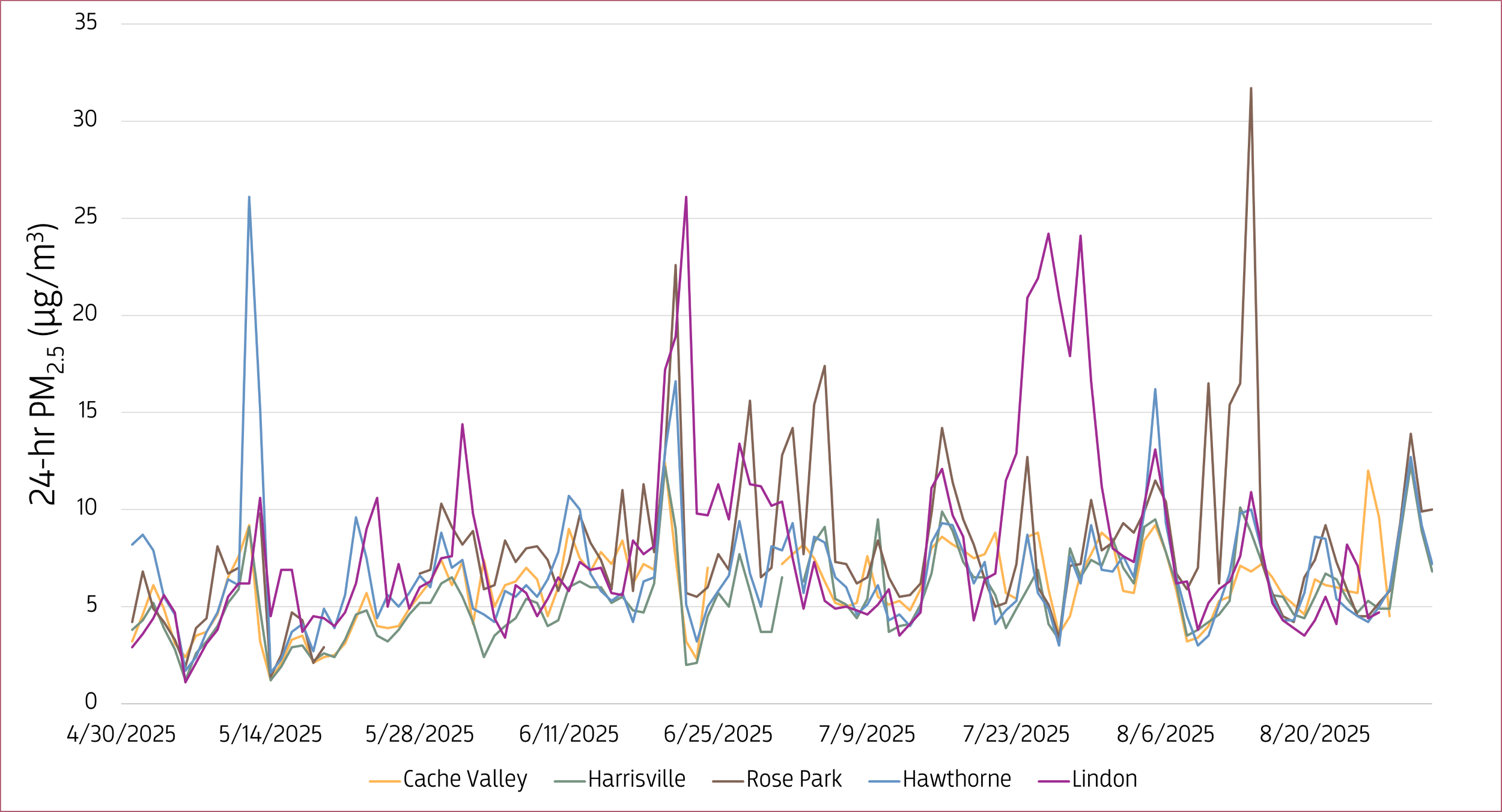
Wildfire season across the western United States often leads to transport of particulate matter and other pollutants across long and local scales. Unlike winter inversions, which tend to be more localized, wildland fire plumes can either cover statewide areas or be more regionally limited depending on the location of the active burns. Wildland fire particulate matter is also compositionally different, being dominated by organic and inorganic carbon species, as opposed to the ammonium nitrate found in Utah’s wintertime particulate. Wildland fires led to decreased air quality in Utah’s urban centers approximately 18 days over the summer of 2024. As can be seen in Figure 3.C.1, Utah’s broader airsheds were not comparatively impacted as frequently, with only two major episodes observed: one in June and a second in late July. NOAA’s Hazard Mapping System Fire and Smoke Product and the U.S. Forest Service’s databases show that the Forsyth fire and the France Canyon fire, both in southern Utah, produced smoke plumes that strongly impacted most of Utah during mid-to-late June. These databases further support more significant impacts towards northeast Utah as measured at the Roosevelt site, but not the as much at the Wasatch Front locations in late July due the Monroe Canyon0 fire and the Arizona fires near the Grand Canyon National Park. The additional PM2.5 peaks, observed at Hawthorne in May and Rose Park in August, are not known to be associated with wildland fire impacts. It is important to point out that even though these episodes can approach regulatory levels, they may be regulatorily “discounted” via exceptional event declarations. Regardless of a discount, the pollution still exists within the local atmosphere and can therefore still create a health burden for residents. Regulators and local governments would do well to watch for these events and recommend personal protective measures where appropriate.
Figure 3.C.1 Summer 2025 PM2.5
References
- 3.C.1. Martin, R. (2024). 3F: The Wasatch Front is Making Progress on PM2.5 Levels. In, 2024 Report to the Governor and Legislature on Utah’s Land, Water, and Air. Utah State University.
https://www.usu.edu/ilwa/reports/2024/air/3f-the-wasatch-front-is-making-progress-on-pm25-levels