
Forge Research Site, Milford, UT | Aaron Fortin
TAKEAWAY
Only a diverse mix of energy generation will effectively meet Utah’s needs. Intermittent resource plus storage are insufficient alone.
Terms to Know
Intermittent energy generation: Energy produced only when resources like sun or wind are available.
Peaking energy generation: Power plants run briefly to meet highest electricity demands.
Baseload energy generation: Power plants that run continuously to supply steady electricity.:
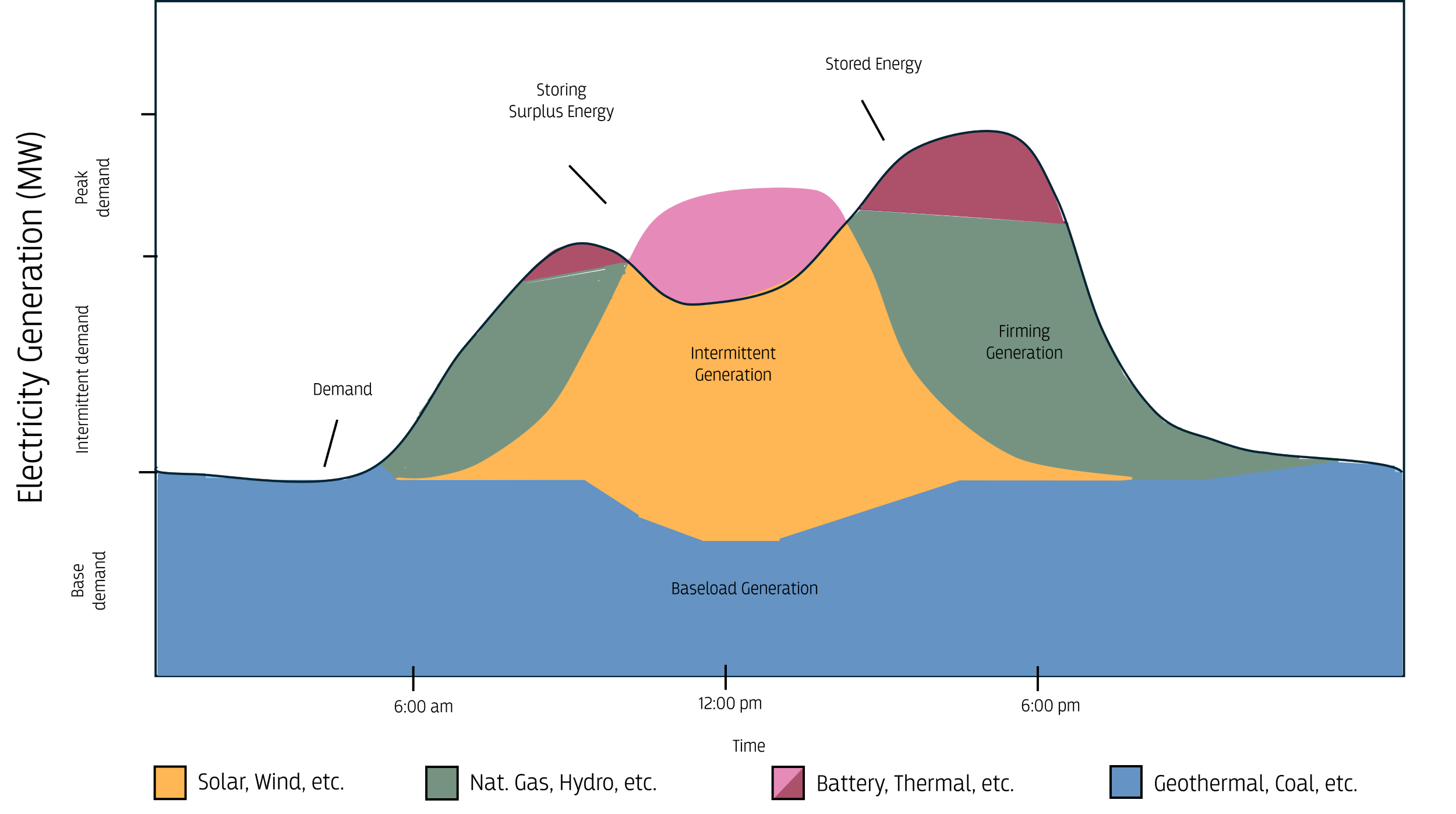
Intermittent electricity resources, such as solar and wind, are essential to Utah’s growing energy portfolio but present unique challenges when considering their contribution to system-wide capacity. Unlike on- demand generation, their output is tied to variable conditions like sunlight availability or wind speed that cannot be controlled to match demand. This means a solar plant rated at 200 megawatts of capacity may only deliver a fraction of that during peak evening hours. Demand won’t wait for morning or sunshine. The entire grid must match demand and generation to operate and must be planned around the greatest predicted demand. The inherent variability of intermittent resources reduces the certainty that installed capacity translates to useable electricity during peak demand.
When properly applied, energy storage, like batteries, can help shift surplus generation from intermittent sources to peak demands. However, implementing storage at the scale required to meaningfully offset intermittency and provide reliability is technically challenging and capital-intensive. Current battery technologies, while rapidly improving, face limitations in duration, lifecycle, and material availability. Long-duration storage options, such as pumped hydro or advanced thermal systems, have their own challenges. This is further complicated by the electricity market, which rewards short duration storage, not long-term reliability.
A diverse generation mix is a healthy generation mix. To meet the growing demand of the future, integrating storage alongside healthy proportions of intermittent, peaking, and baseload generation will be essential. Doing so will require careful planning, diverse technologies, and accompanying transmission investment to ensure that generation is always ready to meet demand.
Properly applied, energy storage, like batteries, can help shift surplus generation from intermittent sources to peak demands.
Figure 4.B.1 Daily Energy Production and Allocation Example
References
- PacifiCorp. (2025). Utah 2025 Integrated Resource Plan. https://www.pacificorp.com/content/dam/pcorp/documents/en/pacificorp/energy/integrated-resource-plan/2025-irp/2025_IRP_Vol_2_Utah.pdf
- Skea, D., Anderson, T., Green, R., Gross, P., Heptonstall, P., & Leach, M. (2008). Intermittent renewable generation and the cost of maintaining power system reliability. IET Generation, Transmission & Distribution, 2(1). https://doi.org/10.1049/iet-gtd:20070023
- De Carne, G., Maroufi, S.M., Beiranvand, H., De Angelis, V., D’Arco, S., Gevorgian, V., Waczowicz, S., Mather, B., Liserre, M., Hagenmeyer, V. (2024). Electric Systems Power Research, 236(110963). https://doi.org/10.1016/j.epsr.2024.110963
- Ziegler, M. S., Mueller, J. M., Pereira, G. D., Song, J., Ferrara, M., Chiang, Y., & Trancik, J. E. (2019). Storage Requirements and Costs of Shaping Renewable Energy Toward Grid Decarbonization. Joule, 3(9): 2134-2153. https://doi.org/10.1016/j.joule.2019.06.012
- 4.B.5. Kittner, N., Schmidt, O., Staffell, I., & Kammen, D. M. (2020). Chapter 8 – Grid- scale energy storage. Technological Learning in the Transition to a Low-Carbon Energy System. In: Technical learning in the transition to a low-carbon energy system. https://doi.org/10.1016/B978-0-12-818762-3.00008-X
- 4.B.6. Denholm, P., Cole, W., & Blair, N. (2023). Moving Beyond 4-Hour Li-Ion Batteries: Challenges and Opportunities for Long(er)-Duration Energy Storage [Technical report]. National Renewable Energy Laboratory. https://docs.nrel.gov/docs/fy23osti/85878.pdf
- 4.B.7. Batra, L., Harris, D., Katsigiannakis, G., Mackovyak, J., Parmar, H., & Scheller, M. (2025). Rising Current: America’s growing electricity demand. ICF.com. https://www.icf.com/insights/energy/impact-rapid-demand-growth-us
- 4.B.8. U.S. Department of Energy. (2023). National Transmission Needs Study. Grid Development Office, U.S. Department of Energy. https://www.energy.gov/sites/default/files/2023-12/National%20Transmission%20Needs%20Study%20-%20Final_2023.12.1.pdf