
Wellington Solar Farm | Aaron Fortin
TAKEAWAY
Customized utility contracts can allow data centers flexible energy options for on-site production systems. The state needs strategies to advance Utah’s tech credentials without compounding existing air quality concerns.
Terms to Know
Tiered Pricing: Charging different rates for different usage levels to encourage conservation.
Rapid increases in demand for digital services pose a pressing energy challenge: how to feed the appetite of data centers and other industrial behemoths without leaving ordinary households and small businesses to foot the bill. Senate Bill 132 aims to address this challenge by allowing industrial-scale customers to be supplied through bespoke utility contracts, customer- owned generation tied to the grid, or closed private on-site systems. The bill is deliberately flexible and resource-neutral, meaning firms may choose renewables, traditional fuels like natural gas, or emerging technologies, provided they carry the full cost of their power.
That neutrality comes with tradeoffs. If new loads turn to low-emission sources, they could bolster northern Utah’s tech sector without worsening existing air pollution problems. If they fall back on emitting sources like natural gas turbines, a more likely scenario in current conditions, the region’s airshed could suffer. A cautionary example from Tennessee, where an AI data center’s on-site turbines pushed up peak nitrogen dioxide concentration levels by 79% in areas immediately surrounding the data center, illustrates the scale of this risk. SB 132 insulates ratepayers but does not by itself safeguard the airshed.
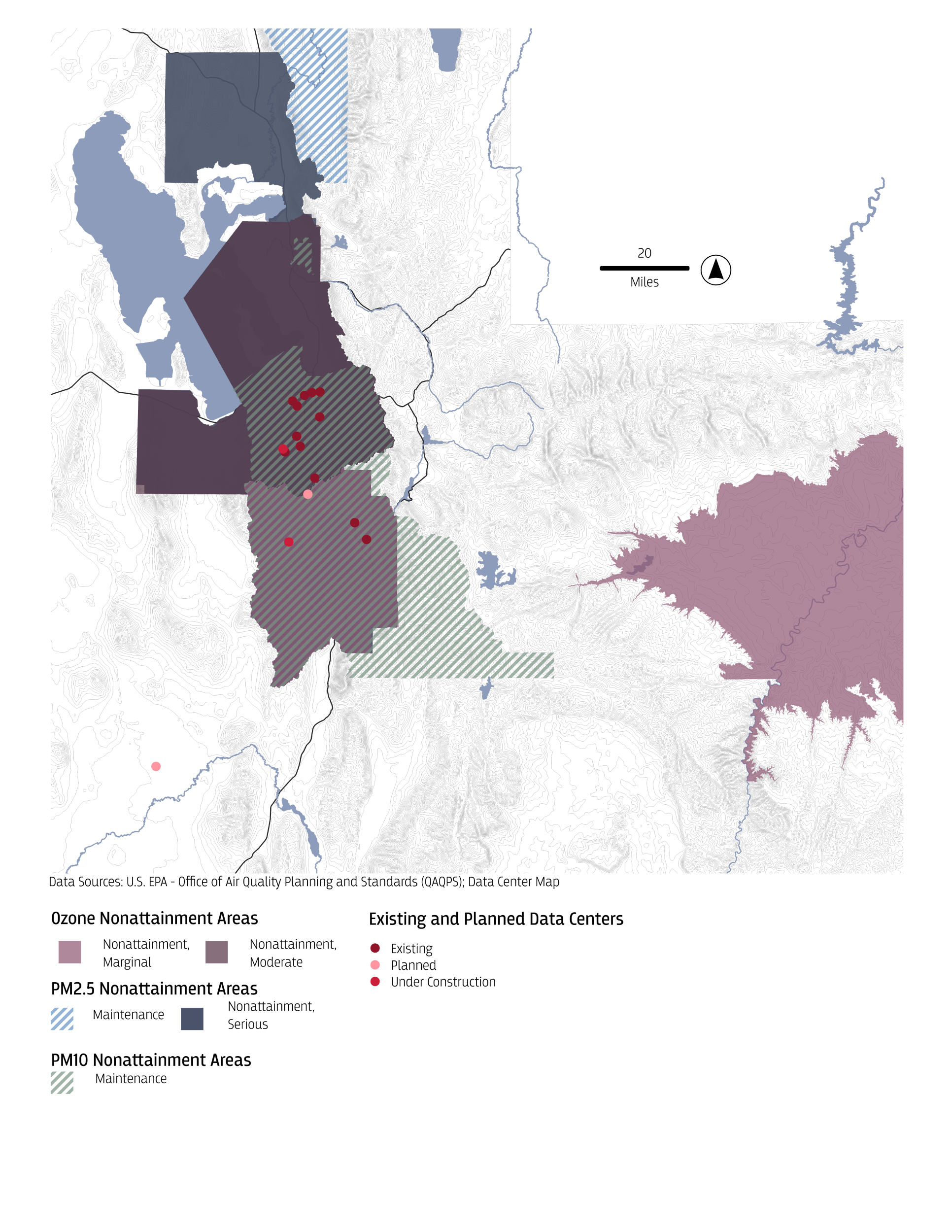
Three strategies could close that gap. First, encourage traditionally fueled facilities to locate outside the Wasatch Front’s national ambient air quality standard non- attainment zones and where dispersion lessens harm, perhaps using localized “good neighbor” provisions. Second, offer streamlined permitting or credits for low-emission mixes inside the valley. Third, consider tiered pricing that makes polluting generation more costly, with the premium reinvested in accelerating low or non-emitting technologies. Part 7 of the bill directing exploration of “large-load flexible tariffs” could be a vehicle for this. Whatever path they choose, Utahns should ensure SB 132 delivers economic growth without reversing progress on air quality.
An AI data center’s on-site turbines pushed up peak nitrogen dioxide concentration levels by 79% in areas immediately surrounding the data center.
Figure 4.C.1 Existing and Planned Data Centers in Air Quality Nonattainment Areas
References
- Morehouse, J., & Rubin, E. (2021). Downwind and Out: The Strategic Dispersion of Power Plants and Their Pollution. The Center for Growth and Opportunity Energy at Utah State University. https://www.thecgo.org/research/downwind-and-out-the-strategic-dispersion-of-power-plants-and-their-pollution/
- Chow, A. (2025, August 13). ‘We are the Last of the Forgotten:’ Inside the Memphis Community Battling Elon Musk’s xAI. Time.com. https://time.com/7308925/elon-musk-memphis-ai-data-center/
- National Caucus of Environmental Legislators. (2025, April 29). Data Centers Issue Brief. https://www.ncelenviro.org/resources/data-centers-issue-brief/
- Morehouse, J. & Rubin, E. (2021, May 19). Downwind and Out: The Strategic Dispersion of Power Plants and Their Pollution. [Working Paper] The Center for Growth and Opportunity, Utah State University. https://www.thecgo.org/research/downwind-and-out-the-strategic-dispersion-of-power-plants-and-their-pollution/
- The Environmental Protection Agency. (2025). Cross-State Air Pollution. EPA. gov. https://www.epa.gov/Cross-State-Air-Pollution/cross-state-air-pollution