
Dimple Dell Regional Park | Aaron Fortin
TAKEAWAY
Urban greenspace helps people live healthier lives—but the shape of spaces and their connectivity matters as much as size.
Terms to Know
Greenspace: Vegetated land in urban spaces including parks, street trees, and green trails.
Utahns often think of parks, trees, and green areas as a way to beautify communities but research increasingly shows that urban greenspace is a powerful public health tool. It can help reduce chronic diseases, improve mental well-being, and even lower the risk of early death.
But here’s the surprising part: it’s not just about having more greenspace. How that greenspace is designed and distributed—its size, shape, and how well it’s connected—can make a big difference. In studies of neighborhoods across the U.S., lower rates of conditions like heart disease, diabetes, and depression were demonstrated in neighborhoods with better access to connected greenspace. These greenspaces support physical activity, reduce exposure to extreme heat and air pollution, and may enhance mental health through access to nature and biodiversity.
This has big implications for growing Utah communities. As city and town leaders plan parks, trails, and green corridors, they have the opportunity to shape the built environment in ways that promote long-term health. Greenspace is more than an amenity—it’s a kind of infrastructure that supports healthier, more resilient neighborhoods.
Investing in well-designed, accessible, and connected greenspaces isn’t just good urban planning—it’s disease prevention. As Utah continues to grow, designing greenspaces with health in mind will help ensure our communities thrive.
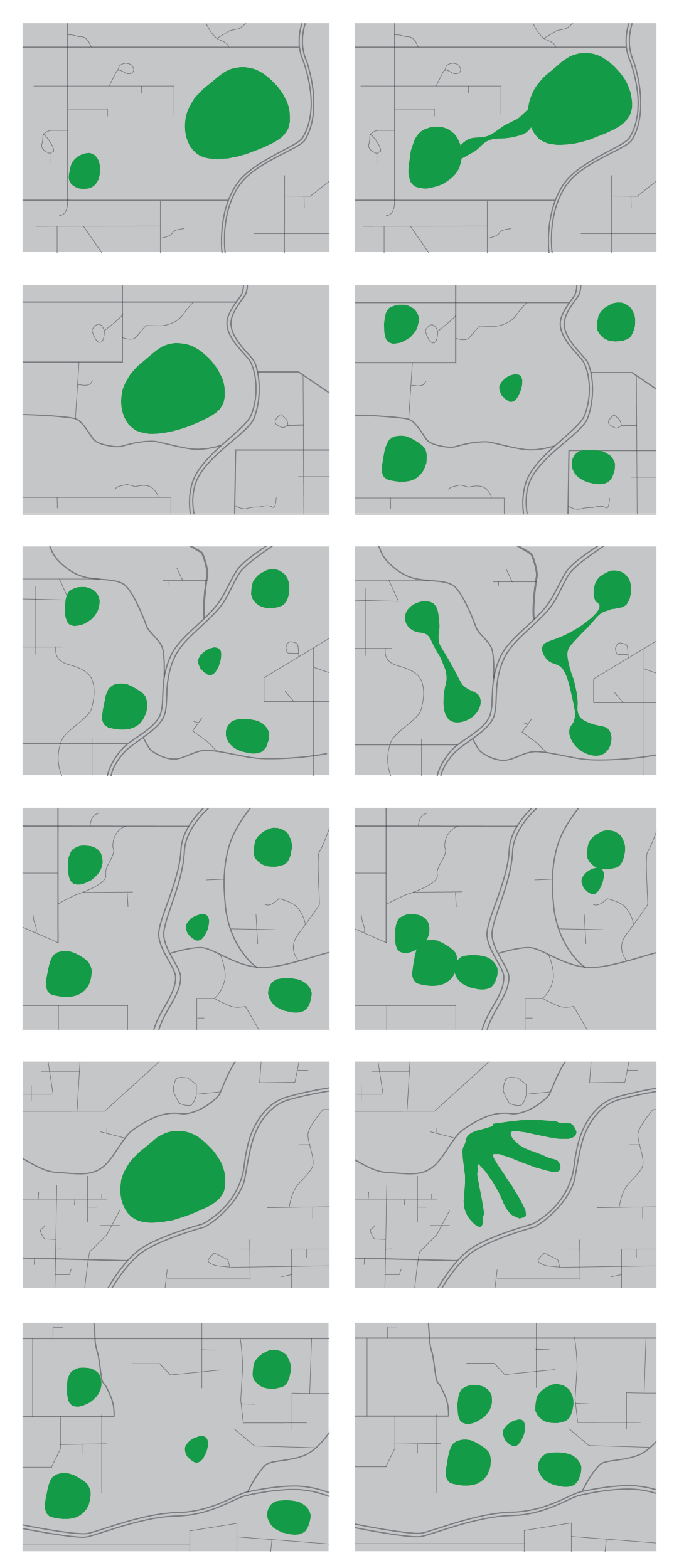
Larger and more connected greenspaces provide more recreational opportunities than smaller, scattered areas.
Greenspaces clustered along neighborhood roads increase passive exposure to vegetation while traveling to and from work.
More complex shapes offer longer boundaries and increased opportunities to stay longer within greenspaces.
Figure 1.E.1 Greenspace Morphology Examples
References
- Wang, H., Huang, X., Hao, H., & Change, H. (2024, December 4). Greenspace Morphology and Preterm Birth: A State-Wide Study in Georgia, United States (2001 – 2016). Environmental Health Perspectives, 132(12). https://doi.org/10.1289/EHP14571
- Wang, H., Gholami, S., Xu, W., Samavatekbatan, A., Sleipness, O., & Tassinary, L. G. (2024). Where and how to invest in greenspace for optimal health benefits: a systematic review of greenspace morphology and human health relationships. The Lancet Planetary
Health, 8(8): E574-E587. https://www.thelancet.com/journals/lanplh/article/PIIS2542-5196(24)00140-2/fulltext - Wang, H. & Tassinary, L.G. (2024). Association between greenspace morphology and prevalence of non- communicable diseases mediated by air pollution and physical activity. Landscape and Urban Planning, 242:104934. https://doi.org/10.1016/j.landurbplan.2023.104934
- Wang, H., Tassinary, L. G., & Newman, G. (2024). Developing the health effect assessment of landscape (HEAL) Tool: Assessing the health effects of community greenspace morphology design on non- communicable diseases. Landscape and Urban Planning, 242(104990). https://doi.org/10.1016/j.landurbplan.2023.104990
- Wang, H., & Tassinary, L. G. (2019). Effects of greenspace morphology on mortality at the neighbourhood level: a cross-sectional ecological study. The Lancet Planetary Health, 3(11): E460-E468. https://www.thelancet.com/journals/lanplh/article/PIIS2542-5196(19)30217-7/fulltext