
Pine Valley, UT | Anna Mcentire
TAKEAWAY
Utah’s diverse watersheds face unique water challenges, requiring regionally contextualized policies and community-specific tools.
Utah’s watersheds differ dramatically in their water sources, stressors, and management needs. Statewide water strategies and conservation goals provide an important foundation, but Utah also needs watershed- and community-specific solutions that reflect local conditions. From the snowmelt-fed Weber River to the terminal Great Salt Lake, and from the desert tributaries of the Virgin River to the aquifers of Cedar City Valley, each watershed presents distinct challenges that require tailored approaches.
The Cedar/Beaver watershed provides a clear example of this need. In Cedar City Valley, decades of monitoring have shown steady declines in groundwater levels as local communities grow. Managing this trend has required careful long-term planning, including conservation programs, aquifer recharge projects, and a groundwater management plan designed to gradually bring withdrawals in line with safe yield. Just to the north, Beaver County is more rural but equally water-dependent. Agriculture and grazing in this area are sensitive to drought cycles and aquifer conditions, making reliable groundwater supplies critical to both livelihoods and the county’s economy.
Recognizing these shared but distinct challenges, the state has supported scientific studies to provide a clearer picture of groundwater availability and water use to guide future policy. These studies bring together hydrologic data, conservation opportunities, and community input to inform decision-making at both the county and regional levels. By aligning science, planning, and local perspectives, the Cedar/Beaver watershed illustrates how Utah can support sustainable growth in both urban and rural communities through watershed-specific strategies.
Taken together, such efforts underscore a central lesson: by clarifying regional goals and tailoring tools to local conditions, Utah can build durable water strategies across all of its diverse watersheds.
Figure 2.A.1 Watershed Councils of Utah
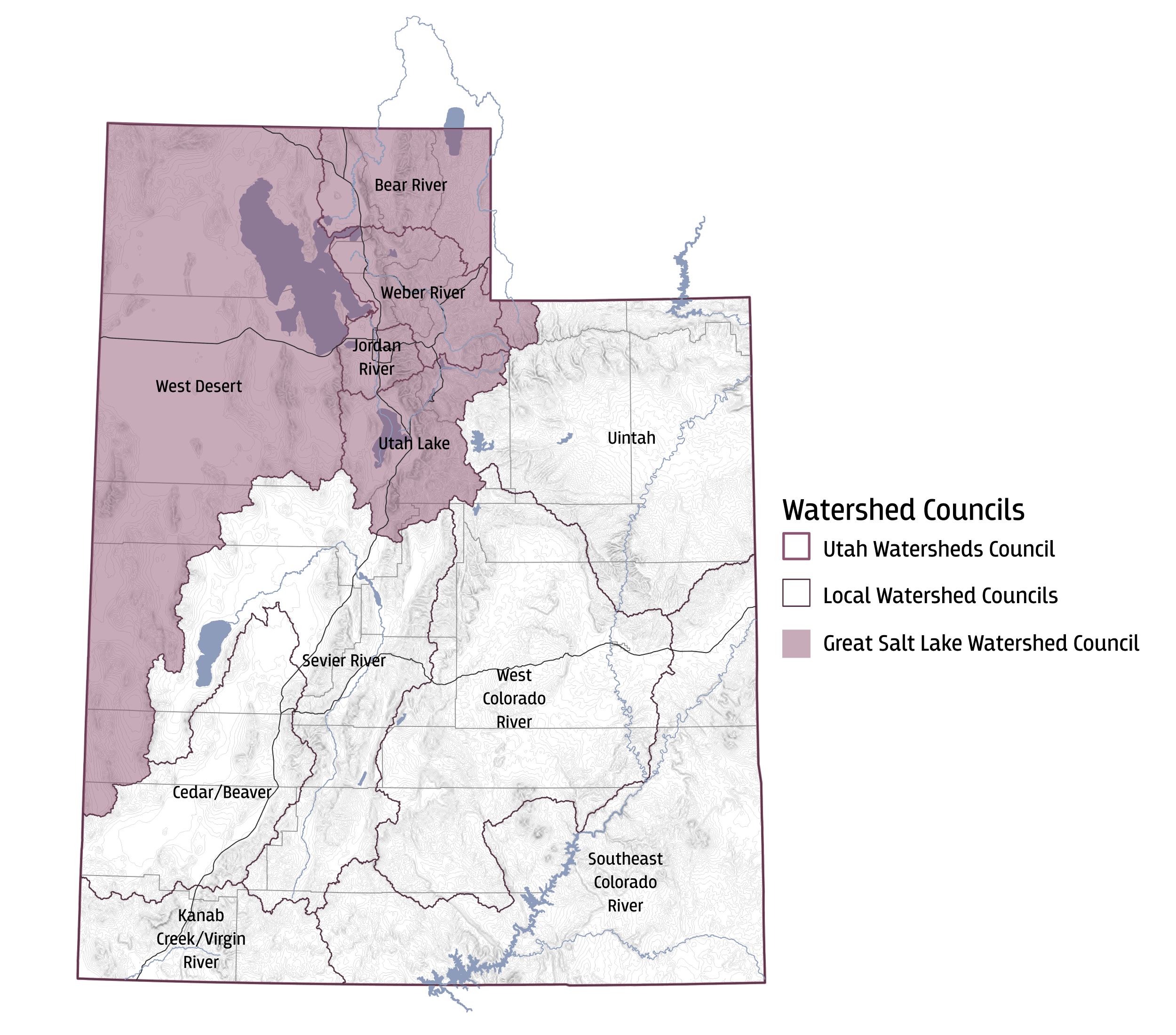
Figure 2.A.2 Watershed Challenges
| Watershed | Selected Challenges |
|---|---|
| Bear River | Balancing agricultural demand with flows to Great Salt Lake |
| Cedar/Beaver | Groundwater declines; population growth in Iron County; sustaining agricultural communities in Beaver County |
| Great Salt Lake | Declining lake elevations with ecosystem and air quality risks |
| Jordan River | Water quality, aging infrastructure, and urban growth pressures |
| Kanab Creek/Virgin River | Rapid population growth; limited local water supply and urgent conservation needs |
| Sevier River | Water over-appropriation, limited supplies |
| Southeastern Utah | Drought vulnerability, interstate Colorado River challenges |
| Uintah | Energy development and water demands; maintaining surface flows for agriculture. |
| Utah Lake | Nutrient pollution; transbasin diversions; rapid population growth |
| Weber River | Urban growth pressures; maintaining streamflows and Great Salt Lake |
| West Colorado River | Colorado River allocation uncertainty; declining storage |
| West Desert | Sparse and variable supplies |