
Utah Lake | Aaron Fortin
TAKEAWAY
Targeted removals of common carp have driven some positive responses in the ecosystem, but other desired changes remain unrealized.
Terms to Know
Endemic: Species naturally found only in a specific region or location.
Invasive: Non-native species that spreads quickly and harms ecosystems or economies.
Common carp were introduced to Utah Lake in the 1870s to supplement overharvested native fish populations. However, as carp root through the lake bottom for food, they stir up sediment and cause substantial changes to the ecosystem. Carp behaviors have negatively impacted water quality, aquatic habitat, and native fishes, including the endemic and threatened June sucker. To improve ecosystem conditions and support June sucker recovery, the June Sucker Recovery Implementation Program (JSRIP) began targeted carp removal efforts in 2009, which have removed over 13,000 metric tons of invasive carp to date. In partnership with JSRIP, researchers at Utah State University have been monitoring the ecosystem response to these carp control efforts. As carp biomass was reduced, several positive ecosystem changes have been observed.
These changes include:
- Increased diversity of aquatic vegetation
- Increased availability of zooplankton and aquatic insects (preferred prey of June sucker and many sport fishes), and
- Improved body condition of these fishes.
Researchers have not yet seen improvements in overall water clarity, aquatic plants, or survival of young June sucker in Utah Lake, even with fewer carp. Achieving long-term ecosystem goals may require larger and sustained reductions in carp, along with other system improvements such as lowering nutrient inputs, stabilizing lake levels, and managing other non-native species. The JSRIP and partner agencies are now exploring additional methods to control carp and support further recovery of Utah Lake.
Figure 2.D.1 Observed and Predicted Changes to the Utah Lake Ecosystem Based on Common Carp Biomass.
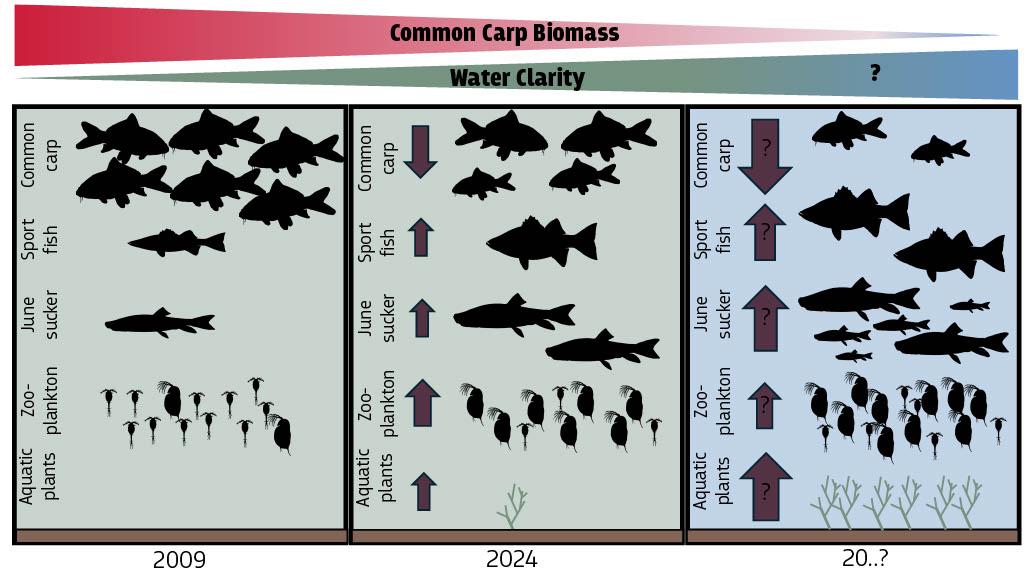
Left panel shows conditions in 2009, with abundant carp, low body condition for sport fish and June sucker, limited June sucker recruitment, a zooplankton community dominated by small-bodied taxa, and extremely limited aquatic vegetation. The center panel shows conditions in 2024, with reduced carp biomass, increased body condition for sport fish and June sucker, a zooplankton community now dominated by large-bodied taxa and increased aquatic plant diversity. The right panel represents a potential future condition with increased water clarity, further reduced carp biomass, further improved condition of other fishes, increased recruitment of wild June sucker, increased abundance of zooplankton still dominated by large-bodied taxa, and increased abundance of aquatic plants. Exactly how low carp biomass would need to be and what other changes to the ecosystem (e.g., reduced nutrient loading, lake level management) would be necessary to achieve these future changes remain uncertain.