
Farm Near Benson, Utah | Aaron Fortin
TAKEAWAY
Water leasing allows for innovative water savings by giving irrigators opportunity to profit from dedicating water to conservation. Ongoing collaboration seeks to increase awareness on the comparative value of different practices.
The Great Salt Lake is maintained by a delicate balance between evaporation and water inflows, primarily from the Bear, Weber, and Jordan Rivers. This balance has been disrupted by human water diversions, primarily for irrigated agriculture. Maintaining a healthy lake supports ecosystem services, including the prevention of air pollution from fine-grained lakebed sediments. The state has passed legislation to enable a voluntary, market-based approach to increase inflows and motivate water right holders to reduce diversions and encourage a healthy lake. Water right leases enable irrigators to receive financial compensation to temporarily allow their water to flow directly to the lake. The irrigators get to determine what price is fair, how much water to transfer, and for how long.
A key benefit of leases over government mandates is flexibility. One irrigator may want to stop watering the corners of her field where the center pivot doesn’t reach; another may want to switch his operation entirely to dryland farming. Irrigators may also have more innovative ways to save water, like improving their canal system or installing precision irrigation. The purchaser of the lease dedicates the saved water to the Lake and the State Engineer ensures it makes it. Because watering the Lake is a legally defined beneficial use, the irrigator retains the full use of their water right after the lease ends.
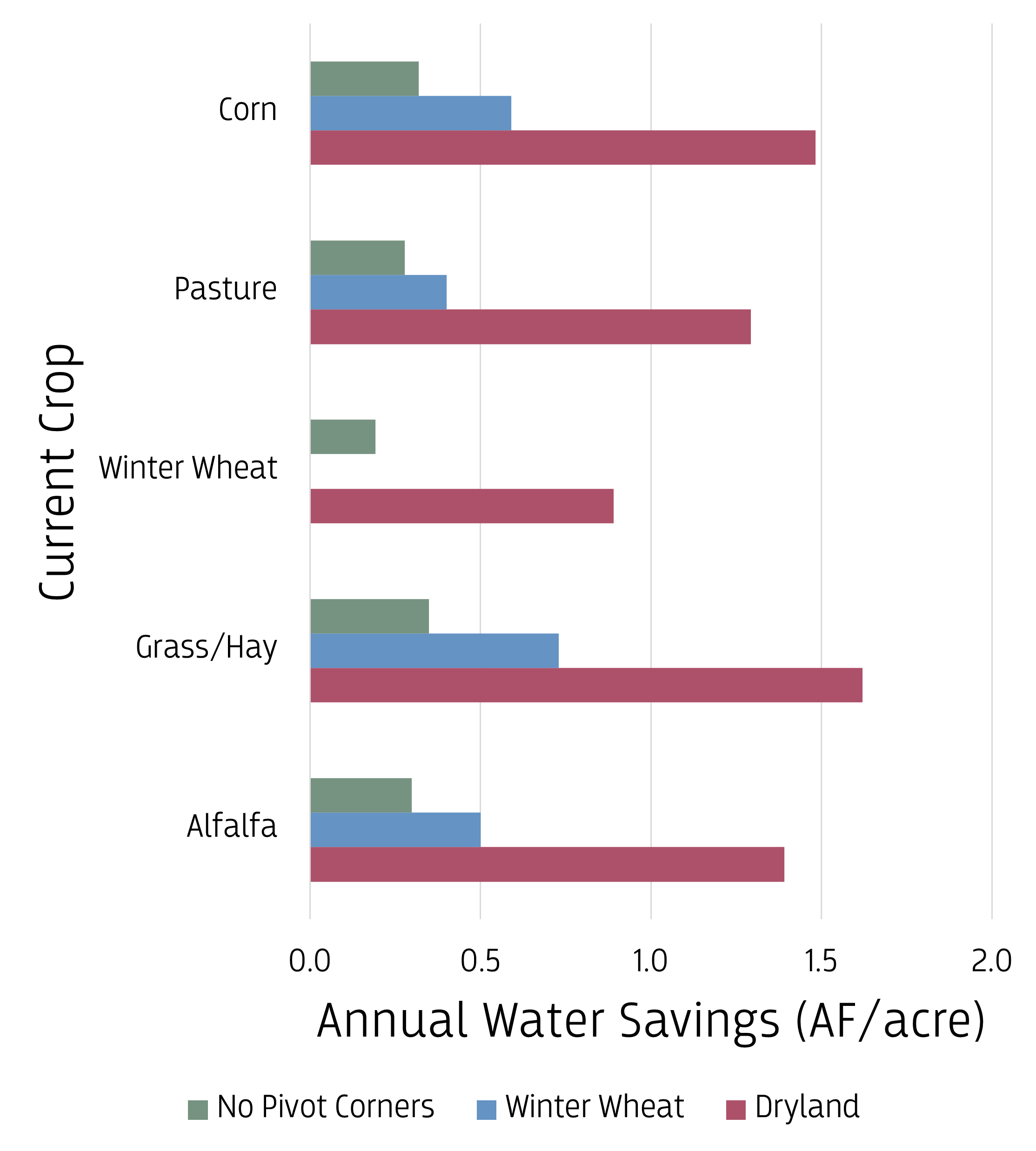
A key constraint facing buyers and sellers is a lack of information on the comparative value of different types of water saving practices at different locations. A collaboration between the Great Salt Lake Commissioners Office and the Property and Environment Research Center through the ILWA Fellows Program aims to create the tools required to facilitate leasing. The approach leverages satellite-based evapotranspiration estimates from satellite imagery to link changes in on-field water depletion to lease valuations. Preliminary results show the depletion savings in Cache County for some example crops and water saving practices. When complete, this transparent, publicly available data, and associated outreach material, will inform irrigators and water leasing organizations and agencies of the anticipated water savings and monetary value of adopting different optimization practices or leasing agreements.
Figure 2.E.1 Annual Water Savings After Irrigation Change
References
- Jacobs Engineering. (2025). Estimated Depletion Reduction Calculation Methodology. [Report]. https://cra.utah.gov/wp-content/uploads/2025/08/Estimated-Depletion-Reduction-Calculation-Method_v1.1_Final.pdf
- Wright, K. (2025, March). Utah’s Moonshot: How Voluntary Water Leasing Can Help Restore the Great Salt Lake. [Report]. PERC. https://www.perc.org/wp-content/uploads/2025/03/PERC-UtahsMoonshot-March2025-Web-1.pdf