Addressing Dependencies
Dependencies, formerly known in Curriculog as the ‘Impact Report’, are an essential step in requesting modifications to courses.
View as PDFDependencies Overview
Addressing course dependencies is a critical step in the process of changing existing course information. This process helps address other entities in the catalog that may be impacted by the proposed modification. Every time a Course Modification proposal is submitted, the submitter is required to address the dependencies before it can be approved by the Catalog Team. If the dependencies are not properly addressed, the catalog editor will send the proposal back for completion.
Part One of this training will define dependencies and the level of impact each modification can potentially have on other listings within the catalog.
Part Two of this training will illustrate the specific proposal actions needed in order to address the dependencies properly.
Part I: Defining dependencies and assessing impact
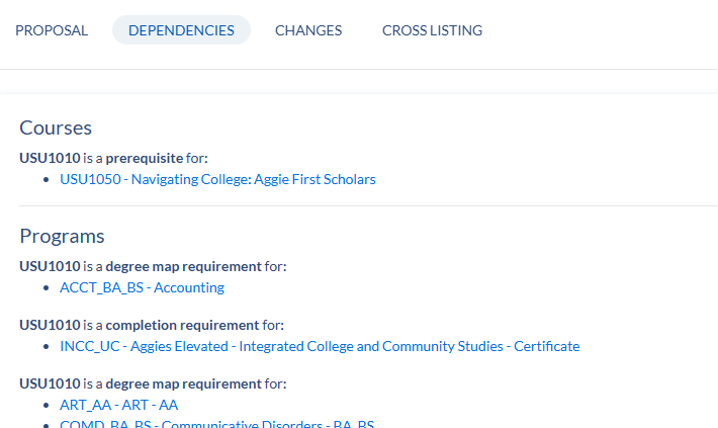
‘Dependencies’ refers to a list that is generated once a proposal is submitted. This is a list of locations in the catalog where the proposed course is linked, including courses and programs. These links are items that may be affected by the proposed change (thus, may be ‘dependent’ on this course), and may need additional action in Curriculum Management.
Different modifications have different impact. These are defined below.
- Impact for ALL courses with dependencies:
- Academic advisors will need to be informed of all changes so they can advise students accordingly.
- All departments of programs and courses listed in the Dependencies both within and outside your own will need to be informed of the requested changes so they can update their own pages as needed.
- If you are changing the TITLE - minor impact to dependencies
- Title change impacts are relatively minor UNLESS the content of the course is changing. If the core content of the course is changing, please submit a New Course request rather than a title change. (This is to support articulation processes, Degree Works programming, advising clarity, and potential repeat issues on a student’s transcript.)
- If you are changing a DESCRIPTION - generally minor impact
- Description change impacts are relatively minor UNLESS the content of the course is changing. If the core content of the course is changing, please submit a New Course request rather than a title change. (This is to support articulation processes, Degree Works programming, advising clarity, and potential repeat issues on a student’s transcript.)
- If you are changing a GRADE MODE - generally minor impact
- This change may impact program GPA requirements. Review programs listed in dependencies and submit proposals to reflect any changes.
- If you are changing a REPEAT STATUS - generally minor impact
- This change may impact program-related credit requirements. Review programs listed in dependencies and submit proposals to reflect any changes
- If you are changing CREDIT HOURS - moderate impact
- Submit proposals to update credit totals in programs listed in the dependencies.
- If you are changing a PREREQUISITE or a COREQUISITE - high impact
- Review programs listed in the dependencies to ensure course lists and Degree Maps are correct, and, if needed, submit program proposals to accommodate this change.
- Departments of programs or courses outside of your own especially will need to be informed of this change so they can update their pages as necessary.
- If you are changing a RECOMMENDATION - minor impact
- There is generally no impact to courses or programs, as this is not programmed as a requirement on this course.
- If you are changing a REGISTRATION RESTRICTION - high impact
- Review programs listed in the dependencies to ensure course lists are still correct in light of this change. Submit program proposals to remove or replace this course as-needed.
- Departments of programs or courses outside of your own especially will need to be informed of this change so they can update their pages as necessary
- If you are changing a SPECIAL APPROVAL - moderate impact
- Ensure the individuals responsible for providing these permissions are informed of this change
- If you are changing a COURSE NUMBER - highest impact
- Review programs listed in the dependencies and submit a program proposal to remove or replace the old course in course lists and Degree Maps. It will not automatically update.
- Departments of programs or courses outside of your own especially will need to be informed of this change so they can update their pages with the new course
- If you are changing a COURSE PREFIX - highest impact
- Review programs listed in the dependencies and submit a program proposal to remove or replace the old course in course lists and Degree Maps. It will not automatically update.
- Departments of programs or courses outside of your own especially will need to be informed of this change so they can update their pages with the new course
- If you are DELETING a course - highest impact
- Submit proposals to remove the course from all programs and courses listed in the dependencies
- Inform other departments of this deletion so they can do the same
- If you are INACTIVATING a course - highest impact
- Submit proposals to remove the course from all programs and courses listed in the dependencies
- Inform other departments of this deletion so they can do the same
Areas of impact that do NOT pull into dependencies
- Cross- and dual-listing: If this course is cross- or dual-listed, a proposal for the other course will need to be submitted reflecting the same change before it can move forward. Changes to cross-listed courses cannot proceed without the approval of both departments involved.
-
Information added as text, notes, or embedded links:
The dependencies list is generated from information built in Simple Requirements only.- Courses embedded through the ‘embed course’ ribbon will not show in dependencies, and will need to be tracked and updated by the department.
- Programs embedded through the ‘embed program’ ribbon will not show in dependencies, and will need to be tracked and updated by the department.
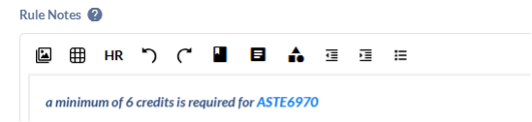
- Information embedded in the Notes or Narrative Text of simple requirements will not show in dependencies, and will need to be tracked and updated by the department.
- Nothing typed as plain text will show in the dependencies, including information listed in course Recommendations and Restriction fields. These instances will need to be maintained and updated by the department.
Departments own their curriculum, and their curriculum pages. Please don’t hesitate to reach out to the catalog team for any questions. We are more than happy to provide guidance on University regulations, Curriculum guidelines, Banner programming, or the proposal process, but submitting, reviewing, updating, and maintaining catalog pages is the responsibility of the department.




Part II: Addressing Dependencies on the Modification Form
No dependencies will generate for new courses or program updates. This step is only needed when modifying a course. (USU 1010 is the example course utilized below)
- The final field in the Modification form is the space to address dependencies. The actual Dependencies list does not generate until after the proposal is submitted, so this field will need to be edited as the final step after you submit the proposal. Fill in the field with what information you already have, and then submit.
- After you have submitted the proposal, select ‘view proposal’ in the confirmation window
- Once the submitted proposal reloads, locate and select the ‘Dependencies’ tab. The generated list contains all courses and programs that have the modified course linked as a prerequisite, corequisite, program requirement, or Degree Map requirement.
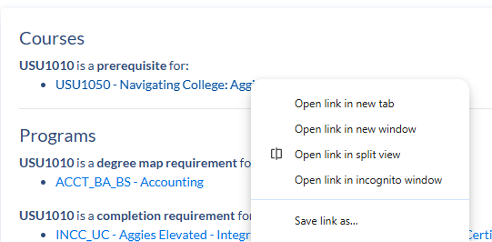
- Open each link to determine if further steps need to be taken.
-
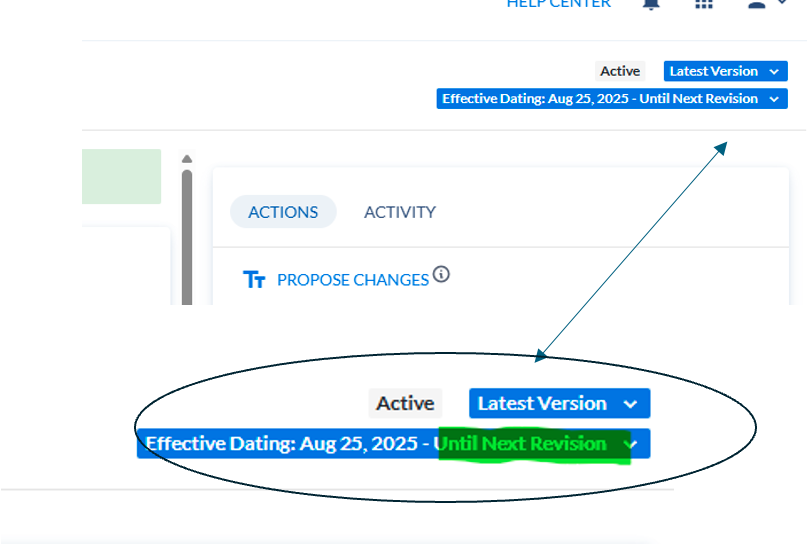
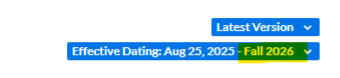
When the course loads in a new tab, check the top right corner of the course and ensure the second blue field ends in the phrase ‘Until Next Revision’
This will indicate that the version listed in the dependencies is the most current version of the entry. As of right now, the Dependencies list is generated from the entire history of the catalog listing, including deleted courses and previous versions of programs. All dependencies that do not end in ‘Until Next Revision’ can be disregarded, as they are no longer the current version of the course and thus not truly dependent. Example of a version to disregard
We currently have a Feature Request submitted to the Coursedog platform to narrow the Dependencies list to only active catalog entities, but we do not know if/when it will be implemented.
Tips for streamlining dependencies reviews:
- If a program is noted as a Degree Map requirement, check the live catalog page to easily navigate the Degree Map
- Skip courses and programs outside your department—just make sure those departments are informed of the change you are making to the proposed course
Any listing ending in a ‘(from the following course set:…)’ phrase can be skipped. The catalog team will address these.
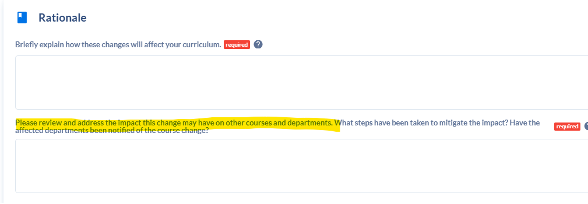
Once the dependencies have been fully reviewed, submitters will need to indicate that on the proposal before it can be approved by the Catalog Team.
- Navigate back to the ‘Proposal’ tab and select ‘Edit proposal’ in the top right-hand corner
-
Scroll down to the Rationale box and update the impact field, briefly describing the steps that will be taken to mitigate the impact based on the Dependencies information.
(See Part 1 for an overview on determining impact of individual changes) - Save your changes.
The catalog editors will then be able to review your proposal. If the impact has not been properly addressed, they will reject the proposal back to you for adjustments.
Sample sentences for completing the impact field
- Course has no dependencies. No impact is anticipated.
- Departments and advisors have been informed of the update and all dependencies have been reviewed. They will not be impacted by this change.
- We plan to submit additional modification proposals to update the prerequisites of courses noted in the Dependencies.
- We plan to submit a program proposal to reflect new total credit requirements.
- We plan to program proposals to remove this course from the requirements and Degree Maps indicated in the Dependencies.
- Dependencies have been reviewed and will require further departmental review. Proposals will be submitted as necessary.
Feel free to reach out to a member of the catalog team with questions or issues. They can walk you through the process, and offer assistance identifying any impact, but Dependencies will not be tracked by the catalog team. Maintaining and addressing impacted courses and programs from the Dependencies list is a responsibility of the department.