Kermit L. Hall: Honoring A Great Voice for Higher Education
Dozens of email condolences to Mrs. Phyllis Hall have already been logged at a special university Web site created for well-wishers to express their sympathy over the untimely death of former Utah State University president Kermit L. Hall. He died Aug. 13 in a swimming accident near his vacation home in Hilton Head, S.C. He was 61.
Hall was 14th president of USU, serving from January 2001 to December 2004.
“A great voice for higher education in America has been silenced with the passing of Kermit L. Hall,” said Utah State University President Stan L. Albrecht. “The news of his untimely death comes as a tremendous shock. Kermit was not only a mentor, but also a friend. I learned a great deal from him and I immensely enjoyed working with him. My love and condolences go out to his wife, Phyllis, and the entire State University of New York family. Kermit had an enormous impact on USU. He helped to elevate our institution’s academic standing and national recognition. He was a tireless advocate for higher education in Utah — a steadfast commitment to educational opportunities that he carried with him to the University at Albany. On behalf of Utah State University, I express our deep sorrow over the loss of an extraordinary leader in education.”
The University at Albany Web site can be found at: www.albany.edu.
Contributions and Remembrances
For those wishing to make contributions in honor of President Hall, they may do so by donating to the Kermit L. and Phyllis A. Hall Inaugural Scholarship. The fund address is 1420 Old Main Hill, Logan, UT 84322-1420. For questions, you may call: 435-797-1158.
For those wishing to send email condolences to his spouse, Phyllis Hall, and remembrances of Kermit Hall, a Web site has been established. Written condolences and cards may be sent to Mrs. Phyllis Hall, care of Office of the President, University Hall, Room 302, University at Albany, State University of New York, 1400 Washington Ave., Albany, N.Y. 12222
USU press release issued January, 2005, following Kermit L. Hall’s announcement of stepping down at USU to take the helm as president of University at Albany.
Kermit L. Hall’s Accomplishments at Utah State Heralded
President Kermit L. Hall’s four years at Utah State University, punctuated by his mantra of “Academics First,” saw the university’s freshmen retention rate jump from 61 to 75 percent and higher standardized test scores and high school grade-point averages of its entering freshmen classes.
These gains and dozens of other significant accomplishments are being heralded with the announcement last week that Hall is stepping down as 14th president of Utah State to take the helm as president of the University at Albany, which is part of the State University of New York.
Hall is credited with re-shaping the university’s former research park and boosting research funding to record levels. Under his watch, research-grant proposals increased by 32 percent and National Science Foundation expenditures rose by 29 percent.
“It’s a big loss for Utah State University,” Stan Albrecht, provost and executive vice president at Utah State, told a New York reporter. “He is without question the most talented senior-level university administrator I’ve worked with in my career.”
That admiration was mirrored in statements issued by members of the State Board of Regents.
“President Hall has been an outstanding president and done much good during his four years at Utah State University,” said State Board of Regents Chair Nolan E. Karras. “We knew when we attracted him to Utah State that he is a scholar and leader with a national reputation, and that at some point he would be going elsewhere.”
The commissioner of higher education in Utah, Richard E. Kendell, said Hall’s leadership “has been felt at Utah State University, but also throughout the Utah System of Higher Education. He will be missed.”
Some of Hall’s more notable accomplishments while at the 23,900-student Utah State, one of only two research universities in Utah (not in order of importance):
- Student Inaugural Scholarships. Took a bold and different step by declining to have a traditional presidential inauguration. Instead pledged $10,000 of his own money to be used toward the establishment of a student inaugural scholarship fund. Result: the university saved $50,000 and created a student scholarship fund now valued at $850,000. In all, more than $4 million has been raised in additional endowed dollars for scholarships and increased resources for graduate fellowships.
- Compact Planning. Instituted a new way of doing university business through a process called Compact Planning. This is a bottom-up approach to funding. It is a process that results in a mutual compact between a department and the university that results in matching funding allocations with departmental objectives. It is a process that requires funding to be allocated based on specific mission-based objectives and not on requests for request sake only.
- Academics First. The university’s academic standing and the academic quality it provides its students has become the rallying cry of the president. This emphasis on placing academics first is already beginning to have an impact. The fall freshman class of 2003 was the best prepared class Utah State ever admitted academically. This feat was repeated by the fall freshman class of 2004. The incoming classes had an average GPA of 3.6, with an average age of 18. The students represent 28 of Utah's 29 counties and come from 44 states. More than 1,000 were international students coming from 80 countries. The incoming freshman classes included approximately 2,700 students. This priority on academic achievement extends to university athletics as well and is underscored frequently by President Hall. Utah State University’s incoming freshmen athletes have an 80 percent graduation rate, ranking the university in the top 10 nationwide, according to USA Today. The new women’s basketball team enjoys a 3.2 GPA average last year in college and high school classrooms.
- Milking Cows in Every County. Two of the first undertakings by President Hall when he arrived at the university in January 2001 were to meet Utah residents in every county and, on another tour, to introduce new faculty to the residents of Utah. He played up the university's agricultural heritage by vowing to milk a cow in all of Utah's 29 counties. It was crazy enough to get people's attention and human enough to win their hearts. He kept his promise by stepping out of the ivory tower and into the milk parlor where he forged new friendships and reintroduced and endeared many hundreds to the state's land-grant institution. During the same summer, Dr. Hall also took a bus load of new faculty on a "Roads Scholar" tour of the northern part of the state to build relationships and understanding.
- Roads Scholar’s Two. Under President Hall’s direction, the university participated this past May in its second Roads Scholars Tour. It showcased Utah State’s new faculty and staff and introduced them to the state of Utah. The theme of the tour was Getting Our Feet Wet in Utah, and each stop was structured to educate the participants and community about Utah State’s contributions to water research and management. Thanks to the support of a private donor, participants traveled to key locations in the northeastern portion of the state in stops that involved alumni and communities all along the way during the four-day journey. Unique to this trip: Utah State had a real Rhodes Scholar on board.
- Rhodes Scholar named at Utah State. President Hall saw Utah State University honored with its first Rhodes Scholar in 22 years. The Rhodes Scholarships are given to 32 U.S. citizens each year to promote international understanding and to provide special educational opportunities to talented students who offer the promise of service during their lifetime.
- Board of Trustees Role Change. President Hall, working closely with Board Chairman and Lt. Gov. Gayle McKeachnie, engineered major changes in the way the university’s top governing board does business. This 10-member body has shifted its modus operandi from merely approving items brought before them to playing a more active role in the development of the university’s operational functions ranging from government relations to university finances and comprehensive campaigns.
- Using Numbers that Make Better Sense. Under President Hall’s urging, the way in which Utah State University measured research productivity was significantly changed, emphasizing the same measuring standards applied by The National Science Foundation and the Carnegie Foundation. The result: more accurate research numbers that make better sense because they are based on valid comparisons with other universities.
- From Watching Enrollment to Managing it. President Hall knew that we could not expect to increase the quality of students entering the university without a system in place that shifts emphasis from guessing outcomes to actually predicting them. This required a new approach to the Admissions process and the manner in which statistics are kept. As a result, new weekly enrollment reports are brought before the president’s Executive Committee that monitors undergraduate enrollment statistics by colleges, average ACT scores, high school GPA’s, out-of-state/international students and their scores, freshmen scholarship students, as well as transfer students and their scores. These detailed statistics pinpoint both strengths and weaknesses and permit essential adjustments to enrollment strategies.
- Decreased Student/Faculty Ratio. Despite historical state budget cuts amounting to some $14 million, President Hall kept his eye on the academic ball by insisting that student tuition dollars earmarked to the university be used, in part, to hire more teachers and advisors. As a result, more than 100 new faculty, advisors and counselors were hired and the student/faculty ratio declined from 27:1 to 21:1.
- President AND Teacher. Despite the demands of a brimming workload, President Hall, who is also a history professor, takes time out of his schedule to teach an advanced class in constitutional history. The class meets once a week around the large conference table in Old Main just off the president's office. Nineteen students, all history and political science majors, gather in this non-traditional setting that looks more like a corporate board room than a classroom.
- Getting our Role Straight. Helped the university to develop a new mission that supports the vision of the State Board of Regents for the university’s place in the state’s system of higher education. Utah State was the first to develop such a mission statement and cited by the State Board of Regents as a model for other institutions to follow. “The mission of Utah State University is to be one of the nation’s premier student-centered land-grant and space-grant universities by fostering the principle that academics come first, by cultivating diversity of thought and culture, and by serving the public through learning, discovery and engagement.”
- 10 University Goals. Helped the university create a role statement and 10 well-defined university goals that are centered on the university’s historical mission as the state’s only land-grant university. These goals play a significant role in the decision-making process at the university. Key decisions are made based on meeting these university goals.
- University Dashboards. Instituted University Dashboards. This is a system that asks university personnel to measure what they value and not value what they measure, as President Hall has repeatedly stated. Dashboards provide a monthly at-a-glance look at progress toward objectives. It involves a very basic and straightforward set of indicators to provide an accurate snapshot of where the university and individual departments are in relation to goals set. It is used in meetings with the Board of Trustees to report on institutional accomplishments and performance. It is also being used to describe the university to other key constituent groups, including alumni, legislators and others.
- New Budget Process. Instituted a new budget distribution process for the university based on competition for resources. It works from a set of principles that govern the relationship between university budgets and the Compact Plans developed by each individual unit. Funding is determined by a university selective committee that evaluates the level of achievement of initiatives as reflected in established measures that were agreed upon in the Compact Plan. On the front-end of the process, resources allocated to units are treated as “investments” and are allocated based on the quality of the initiatives and their promise to advance core institutional goals. It’s a process that forces each unit to think carefully about its objectives, its plan to achieve those objectives, how it will measure its progress and how much in “investment dollars” it needs to succeed. It gives renewed emphasis to the word “accountability.”
- Recognized National and State Leader. Since President Hall arrived four years ago, key decision makers around the state and the nation have come to know and respect Utah State’s 14th president for his vision and insights regarding higher education in Utah and the nation. Nationally, he represents land-grant universities as a board of director for the National Association of State Universities and Land Grant Colleges. He was the keynote speaker for the W.K. Kellogg Foundationaddressing the topic, “The Future of Land-Grant Institutions.” He is the co-chair of the Judiciary Panel of the National Commission on Institutions of Democracy, sponsored by the Annenberg Foundation. In July he was elected president of the Inland Northwest Research Alliance (INRA), a consortium of eight research universities in the northwestern United States. A nonprofit, scientific and educational organization, INRA fosters collaborative research programs to educate America's future scientists and engineers. Since its inception in 1999, the alliance has brought $27 million into the inland northwest region in the form of new innovative research and educational programs.
- Man of Letters. His influence through the written word continues to expand, even while serving as president. During the past year and a half, he has co-edited two books, The Oxford Companion to American Law and Constitutionalism and American Culture: Writing the New Constitutional History. In Utah his influence continues to grow as he has taken an active role in matters before the State Board of Regents as well as with the State Legislature and is much sought after for advice. His is a respected voice that has, in turn, elevated the prominence and status of Utah State University as the “second flagship research institution” in Utah.
- Making Headlines. National media mentions of Utah State University have increased from the hundreds to the thousands during the past three years. Key to this has been President Hall’s expertise on matters of the constitution and laws involving the Supreme Court as well as his expertise on the assassination of John F. Kennedy. He has been quoted extensively in the New York Times, the Washington Post, and the Chronicle of Higher Education. While at Utah State, he was a guest on the McNeal-Lehrer News Hour. His guest editorials have appeared in the Chronicle and in the Los Angeles Times.
- Water Task Force. Commissioned the university’s first Water Initiative Task Force. Utah State has diverse strengths in water sciences, engineering and policy with existing programs in six colleges. President Hall appointed the task force and charged them with recommending ways to strengthen water programs at Utah State that take advantage of this existing diversity and breadth of faculty expertise.
- Environmental Task Force. Commissioned the university’s first environmental task force to develop criteria for “Best Practices in Campus Sustainability, Environmental Education and Research.” Progress continues with the formation this past year of a Sustainability Council.
- Gender Equity Study. Commissioned the first study of women’s and minority equality at Utah State University. The university, with no outside pressure, commissioned a study of pay equity under President Hall. The study found that salary disparities do exist. It created a baseline against which all university salaries can be measured. By so doing, this benchmark study is now helping the university take constructive steps to close the gap.
- Streamlining Bureaucracy. President Hall has helped to reduce administrative costs by collapsing the College of Family Life and dispersing departments among the university’s existing six colleges, and reorganized the president’s executive committee to reduce the number of vice presidents traditionally required of an institution this size. Seven of the 15 members are not executive officers or senior appointees of the university. These members, already working within the university system, are helping to keep bureaucracy to a minimum by flattening the organization at the top. He also eliminated a college and introduced a new plan to limit the tenure of deans and department heads to six years.
- Upward Evaluations. Under President Hall’s direction, the university’s employee evaluation process was revamped and directly linked to salary compensation to financially reward employee productivity. President Hall also instituted a change that takes the evaluation process beyond the traditional top-down method. Employees now also participate in the process by evaluating those who supervise them.
- Department Teaching Excellence Award. President Hall is regularly seen hefting baskets of apples and rewarding university employees and departments for outstanding work. In spring he upped the ante by establishing an annual teaching excellence award that still involves fruit, but financial rewards as well. He established a committee to navigate the challenging task of identifying and honoring good teaching at Utah State University. At the heart of the award is President Hall’s mantra to measure and reward what we value and not value what we measure. The review process for the award is one measure of what the university values: academics and teaching excellence. The annual award encourages all departments across campus to take the opportunity to showcase their commitment to fostering a culture of teaching excellence.
- Moving Students In. President Hall has taken a hands-on approach in welcoming students to the university every year -- literally. Under his urging, university administrators, faculty and staff, are asked to join President Hall, roll up their sleeves and give up a portion of their day to help new students move into their campus housing units.
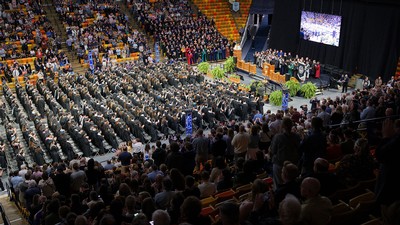
- Commencement Changes. Under President Hall, the university has changed the way it approaches the student’s capstone experience – graduation day. A shift has been made from handing out diplomas at separate college ceremonies, to now receiving diplomas during the university’s main commencement celebration. President Hall is fond of challenging students to take the following pledge: “I promise that the last line I stand in at Utah State will be the line in which President Hall stands to give me my diploma.'"
- Fall Commencement First. Utah State University, under President Hall’s direction, began a new tradition of holding fall commencement exercises. This is a first in the university’s 116-year history.
- Graduate-In-Four Guarantee. Instituted a Graduate-in-Four program that encourages students to graduate in a timely manner by following a pre-prescribed curriculum plan. And the program comes with a guarantee: if a student, who follows the program guide, does not graduate in four years, the university picks up the student’s last year tuition tab.
- From zero athletic conferences to two in two years. Under President Hall’s leadership, the university advanced from not being a member of any conference league to joining the Sunbelt Conference one year ago. Most recently, the university accepted an invitation to join the Western Athletic Conference. President Hall also served as one of five university presidents who are not members of the Bowl Conference Series. He spearheaded efforts to change the established system to make it more equitable for non-BCS conferences. President Kermit L. Hall, along with five other coalition presidents, helped to engineer a fifth bowl game in the Bowl Championship Series, effectively allowing Utah State, for the first time, to become part of the prestigious and lucrative BCS.
- New Athletic Director and Football Coach. President Hall introduced to the university this past year the new Athletic Director, Randall W. Spetman, who was formerly A.D. at Air Force. He also welcomed Brent Guy, former defensive coach at Arizona State, as the university’s newest head football coach. Guy was coaching at Utah State when the football team won its first bowl game, the Las Vegas Bowl.
- Re-introduction of Women’s Basketball. In his quest to increase opportunities for female athletes at Utah State University, President Hall championed the re-establishment of women’s basketball. In March of 2002, he announced the reestablishment of an NCAA Division I women’s basketball program. Coaching the team is Raegan Scott-Pebley, a starter with the WNBA’s Utah Starzz.
- New Exercise Facility for Students. President Hall played a major role in pushing through a student initiative for improving exercise facilities. As a result, a $400,000 student project became a reality in the Summer of 2002 that included renovation of the old Nelson Field House. The new fitness center contains 144 new pieces of cardio and weightlifting equipment. This new center saw the completion of its second of three phases this past summer. It involved extending the second level the length of the Field House.
- New Scoreboard and Equipment. President Hall played a pivotal role in talks and an eventual contract with soft drink giant Coca-Cola. This lucrative contract enabled the university to install a new $1.4 million scoreboard for the Dee Glen Smith Spectrum.
- Helping People Understand Utah State. Under President Hall’s direction, the university initiated a comprehensive image study. The findings showed that most people don’t fully understand Utah State University’s value and economic impact. University marketing messages, based on our core strengths, have been developed and are now being used to help brand a university image. An important first step in this process has been to bring greater continuity to disparate university web sites and publications both in content and visuals. The early result has been the first-ever “family” of recruitment publications utilizing the new “Think Utah State” concept. These publications instantly identify themselves as being from Utah State and include a university search piece, 38-page View Book, College Companion Pieces, and an assortment of supporting departmental pieces. The university in now engaged in a Visual Identity Program.
- Presidential Lecture Series. President Hall began two years ago a Presidential Lecture Series in Washington, D.C. The purpose of the series is to establish stronger ties between the university and legislators, alumni, and national media.
- Child Care Development Center. Under President Hall’s direction, a Child Care Development Center will become a reality at Utah State University – the first of its kind in its 116-year history. It will be built at Innovation Campus and will provide services for children of students, faculty, staff and community members.
- Early College High School. President Hall announced at a recent press conference that Utah's sixth and final “New Century” early college high school (ECHS) will open its doors Fall 2006. The new charter school, to be located on the university's Innovation Campus, will be the state's first ECHS located on the campus of a research park and university. Faculty and doctoral students from the College of Engineering 's National Science Foundation Center for Engineering and Technology will help prepare the new school's curricula. In addition, the department of English will provide consultation in integrating reading, writing and research throughout the school's course offerings.
- Carnegie Professors of the Year. This month President Hall was able to once again honor a Utah State University professor for being named Utah’s Carnegie Professor of the Year. During President Hall’s four-year tenure at Utah State, he celebrated three professors receiving this honor. Utah State has received the professor of the year award seven of the past 10 years.
- Recital Hall. President Hall honored two sisters this year for their $8 million private gift to the university, the largest such private donation in the university’s history. The money is being used to build a new world-class recital hall. Construction is now under way.
- Comprehensive Campaign. President Hall has laid the groundwork for the university to commence its first fund-raising campaign. Key to this effort was his establishing in Salt Lake City a permanent office in downtown’s Wells Fargo Center. This office will house the new vice president for university advancement, M. Scott Mietchen. Hall said this new arrangement was done to take the university’s advancement mission to the next level. “Utah State University's future remains clear," Hall said. "We are first and foremost an institution where academics come first. And, as a great public institution, we are branching out and reaching out to the public sector. It is our purpose to create and develop a deep base of private sector support for Utah State."
- Campus-wide Construction. President Hall has been at the helm during a period in which the university has seen tremendous growth in campus construction including a new $40 million heat plant, phase one of a new engineering building (featured recently in the Chronicle of Higher Education), and a new laboratory school for elementary students. Construction or plans now under way include a $40 million library, a state-of-the-art recital hall, a $40 million student learning/living center, a child care center, an early college high school, and major football stadium improvements.
- Constitutional Awareness. President Hall helped to establish at Utah State a week-long seminar on We the People: the Citizen and the Constitution. President Kermit Hall, along with fellow presenters, worked with public and private school teachers from across the nation in this program to help raise constitutional awareness.
- Innovation Campus Honored. Utah State University’s Innovation Campus, which took a new direction under President Hall’s guidance, was honored over the summer by the U.S. Department of Commerce. Innovation Campus was named winner of the 2004 Economic Development Award for successfully starting 53 new companies since its inception 18 years ago, companies that now generates more than $75 million in annual revenues. Just this past week, Innovation Campus received a $2.4 million grant for infrastructure improvements.
- Research Productivity at New Record. Utah State University, under President Hall’s direction, has seen its research funding increase to record amounts. This past summer, Gov. Olene Walker joined the presidents of Utah’s two flagship research universities to announce combined record research funding revenues of nearly a half billion dollars. Utah State University earned a record $186 million, an 18 percent jump from the previous year.
- President for the Day. President Hall established a new university program that involves a university student tagging him for the day as “president.” During his time at Utah State he has mentored several dozen students and given them an inside look at what a university president does and how the university operates on a day-to-day basis.
- Leadership Briefings. President Kermit Hall held a series of Leadership Briefings at selected locations throughout the country. The briefings were designed as small gatherings with loyal Aggies to discuss the future of Utah State University and to share his vision for that future.
- Walking Tours. President Hall has regularly taken walking tours across campus. These walks vary from wishing faculty and staff holiday wishes to awarding departments with apples and budget increases. Utilizing a walking tour of campus, he is able to talk about the changes occurring on campus. He is also able to focus on the different methods needed to develop a campus for its students — state and federal funding, foundation support, public/private partnerships, and private philanthropic support.
- Benchmark Summit. This past fall the university, under President Hall’s direction, engaged the university and community in a first benchmark summit that focused on combining university expertise with community know-how to get at important life issues. The summit focused on environmental sustainability, economic growth and demographic diversity. "The university offers extraordinary expertise in each of the three areas of the Benchmark Summit's focus," he told participants. "Our goal is to make Cache Valley better and even a more rewarding place to live, work and study. This summit is one of several steps we need to take to realize these goals."
- Openness, Accessibility, Transparency. President Hall has always been a champion of the open process. This could not be better demonstrated than when he took before the student body a controversial recommendation of increasing tuition 43 percent over the next three years. Instead of keeping this proposal close to his chest, President Hall chose to engage the students in discussion behind the rationale for the increase. During a November meeting with students, attended by more than 100, he spent some two hours with them, including a 45-minute question and answer session. While other universities in the state are faced with the same challenges, President Hall took the lead in starting a discussion on the topic. Normally tuition increases are broached with students during the spring. He chose to involve the students in the process and got a six-month head start in so doing.
- Inaugural Professor Lecture Series. In an effort to increase the visibility of outstanding scholarship on campus, President Hall and the Provost initiated the Inaugural Professor Lecture series at Utah State. The series recognizes and honors recently promoted full professors. This is the second year of the series.

SHARE
Comments and questions regarding this article may be directed to the contact person listed on this page.