$2.1M Initiative Expands Early Learning Opportunities for Young Children in Rural Utah
By Jennifer Payne |

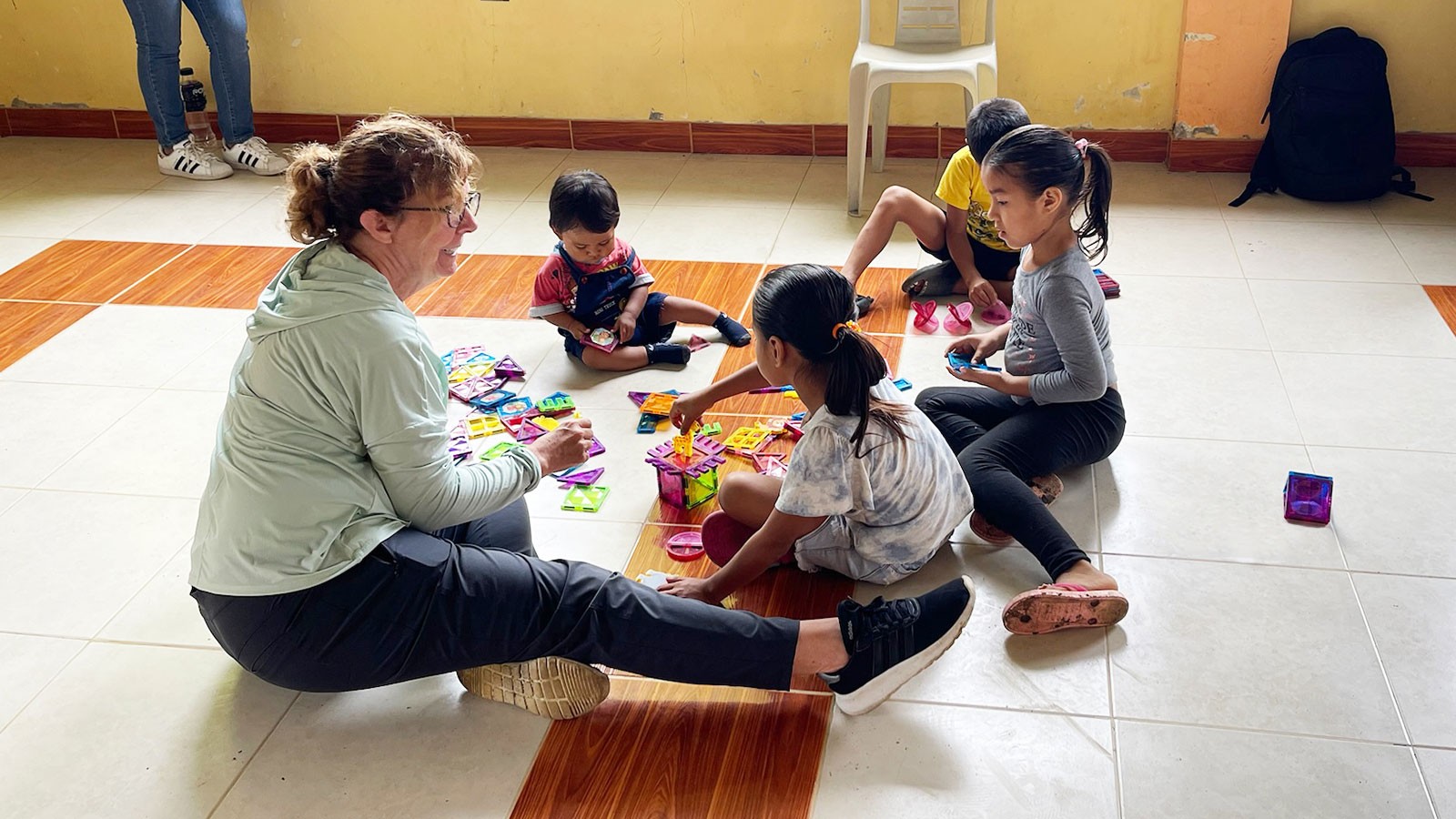
Lisa Boyce works with young children during an ongoing collaborative research project in Ecuador.
A $2.1 million investment from the Utah Department of Health and Human Services is helping experts expand early childhood education and STEM opportunities in some of Utah’s most rural communities.
Led by Lisa Boyce, professor in Human Development and Family Studies and executive director of the Dolores Doré Eccles Center for Early Care and Education at Utah State University, the one-year grant, “Utah Preschool Development Grant B-5,” focuses on improving preschool classrooms, expanding summer STEM camps, and strengthening family engagement to address student attendance — all with a specific emphasis on rural Utah, where access to educational resources can be limited.
“We are thrilled by the Utah Department of Health and Human Services’ commitment to expanding high-quality STEM education across childhood,” said Shawn Whiteman, executive associate dean of CEHS. “Dr. Boyce and her team have developed an ambitious, visionary project to transform learning opportunities for children across Utah, especially in rural communities. This new investment and bold programming underscore the impact of research and services in the Emma Eccles Jones College of Education and Human Services. They further reflect pride in extending our reach, strengthening communities, and enriching the lives of children and families throughout the state.”
The initiative builds on ongoing collaborative projects designed to support children from preschool through early elementary school in rural school districts, including San Juan, Duchesne, Morgan and Uintah counties, as well as Rural Utah Child Development Head Start. It is led by a team that includes Boyce, program manager Anne Brown, faculty members Diana Meter and Sophia D’Agostino, and a group of USU graduate students who will play a key role in implementation and evaluation.
“This funding allows us to bring resources directly to those communities and build on partnerships that are already in place,” Boyce said. “It is a true team effort. Our faculty, graduate students and community partners are all working together to support children and families in meaningful, practical ways.”
One of the project’s primary focuses is improving preschool learning experiences. Rather than emphasizing memorization of letter sounds, the project centers on developing executive functioning — skills like memory, attention and flexible thinking that are critical for long-term learning.
“Those early years are when the brain is developing most rapidly,” Boyce said. “If we focus only on rote skills, we miss the opportunity to build the cognitive foundation that supports all future learning.”
In practice, that approach often looks like guided, play-based learning, according to Boyce. In a classroom, children might gather around a set of wooden blocks. At first glance, they appear to be simply building towers or roads. But with teacher support, the activity can become a rich learning experience.
A teacher might ask, “What do you think will happen if we make the base wider?” or “How could we make this bridge strong enough to hold a toy truck?” As children test their ideas, they begin to plan, solve problems, and adjust their thinking. At the same time, they are learning how to take turns, communicate with peers, and navigate social situations.
“From the child’s perspective, they’re playing,” Boyce said. “But they’re actually learning how to think, solve problems and work with others.”
To support this kind of learning, the team will provide classrooms with high-quality, open-ended materials — such as building sets, dramatic play items and hands-on science tools — along with professional development to help teachers engage with children in meaningful ways and use the new resources effectively.
Sophia D’Agostino, assistant professor in Special Education and Rehabilitation Counseling, will lead the coaching efforts, working with teachers to translate research-based strategies into everyday classroom practice. Graduate students will also work alongside educators, offering support and providing evaluations.
Beyond the classroom, the project expands summer STEM camps in rural communities that offer hands-on learning opportunities for elementary students. In these camps, students might build solar ovens to make s’mores, experiment with making ice cream to learn about states of matter, or explore engineering concepts through simple machines. Activities are designed and led by local teachers the children are familiar with, making learning both relevant and engaging.
“Teachers know their communities best,” Boyce said. “They’re able to design experiences that really resonate with their students.”
A connection between home and school is the focus of another component of the project led by Diana Meter, assistant professor in Human Development and Family Studies. Meter will address student attendance, which is an ongoing challenge in many rural areas, particularly since the pandemic.
In some communities, logistical barriers such as long bus routes or limited transportation options can make consistent attendance difficult. The project will pilot supportive strategies — such as family outreach and home visits — to better understand those challenges and help families find solutions.
A defining feature of the project is its community-based approach. Rather than implementing a one-size-fits-all model, the team will work closely with each partner and tailor support where it is most needed.
The work is grounded in evidence from previous and ongoing projects, which have demonstrated measurable improvements in teaching practices and student learning. That track record helped the team secure the award from DHHS and is guiding its expansion into new communities.
“This funding allows us to take what we know works and bring it to more places,” Boyce said. “We’re building on success, not starting over.”
Ultimately, the goal is to create stronger, more connected support systems for young children and their families in rural Utah — ensuring that where children live does not limit their access to high-quality early learning opportunities.
Disclaimer: This project was made possible by grant number 90TP0152 from the United States Department of Health and Human Services. Its contents are solely the responsibility of the authors and do not necessarily represent the official views of the United States Department of Health and Human Services, Administration for Children and Families, or the Utah Department of Health and Human Services.
WRITER
Jennifer Payne
Emma Eccles Jones College of Education and Human Services
Public Relations Specialist
jen.payne@usu.edu
CONTACT
Alicia Richmond
Director of Public Relations & Marketing
Emma Eccles Jones College of Education & Human Services
alicia.richmond@usu.edu
TOPICS
Utah 493stories Hands-on Learning 323stories Grants 281stories Teaching 208stories K-12 127storiesSHARE
Comments and questions regarding this article may be directed to the contact person listed on this page.