Administrator Training Provides Insight into University Needs
An assessment of management, supervisory and leadership training needs at Utah State University revealed that administrators need and desire training. To be of value to the participants however, the training needs to be specific to their challenges and applicable to the needs and demands placed on them.
“As a direct response to our study we have made significant efforts to give university employees opportunities to receive quality and useful training,” said Sarah Phillips, of Utah State’s Employee Development and Relations office. “In October, the Human Resources office launched a pilot program that brought in experienced trainers to facilitate a training program. We invited university administrators to attend the training and we have been assessing the participants’ feedback, which indicates they had a positive experience.”
“I am delighted to see that the university is moving forward with this,” said Steven Hanks, assistant dean of Continuing Education, who helped lead the study and was present at the training. “The training is good and down to earth, and the skills learned are practical and critical.”
The training was facilitated by seasoned instructors Bill Downs and Sue Petty who work at the Utah Dispute Resolution Center as professional mediators. The presentation is more than a two-day lecture – it is an interactive process where participants are asked to role play through difficult conversations and other challenging scenarios.
“We had some activities that centered on having difficult conversations,” said Weldon Sleight, vice president for University Extension. “This was very important to us because as administrators we have to deal with students, colleagues and others who have different perceptions about how certain policies and procedures should be conducted.”
Through offering this formal training, the university is strengthening its commitment to investing in employees and allowing them to obtain skills and practices that will enable them to be successful in their many dynamic roles, said Phillips. The training provides an in-depth look into areas where university employees have interest and concerns.
“We want whole departments and university leaders to have a chance to adopt principle-centered tactics rather than quick fix solutions to their jobs,” said Phillips.
The study’s executive summary reported that, overall, employees expressed definite interest in training if it had strong support from upper management and if sufficient efforts are made to ensure it added value to the administrative function.
“We hope this pilot program is adopted by other academic units on campus,” said Jack Payne, vice president and dean of University Extension at Utah State. Extension personnel participated in the first session, held in Salt Lake City.
The study that prompted the new training has provided valuable insights into the university’s needs in seven areas. These areas include personal issues (hiring, interviewing, disciplining, terminating and promoting), relationship issues (conflict resolution, treating employees fairly), communication skills, organizational skills, financial and budgeting skills, leadership skills and university policies (knowing who to go to or what to do to address specific situations). The training is designed to directly address these issues in a substantive manner.
“This is not a cotton candy training where the impact and skills will evaporate and melt away after they are used once,” said Phillips. “The training is significant and can become a concrete building block in establishing proactive communication and developmental practices when implemented by the participants.”

The two day intensive workshop covered a lot of material including “Getting to Yes” and “Difficult Conversations.”
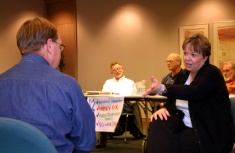
Steve Hanks and Sarah Phillips role play on how to have one of those “difficult conversations”
SHARE
Comments and questions regarding this article may be directed to the contact person listed on this page.