Approachable Math: USU Peak Undergrad Research Fellow Aims to Reduce Learning Barriers
Applied mathematics major Emily Nielson, with faculty mentor Sindura Kularajan, is evaluating the effectiveness of a modeling-based calculus course for life science majors pursuing careers in medicine, public health, teaching, engineering, agriculture, natural resources and more.
By Mary-Ann Muffoletto |
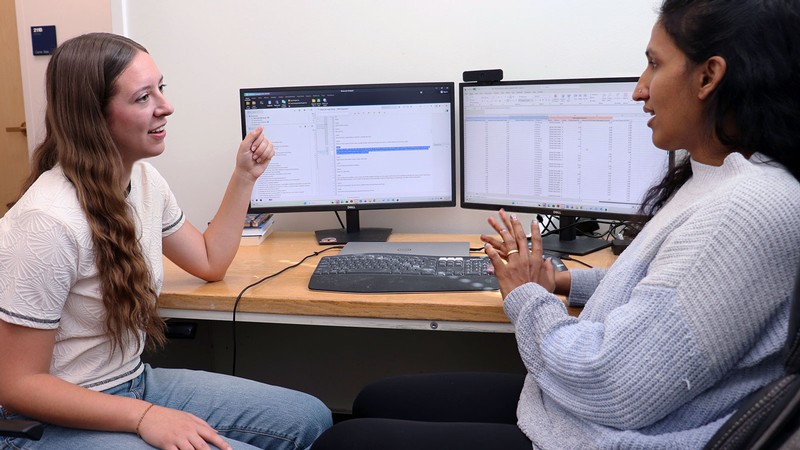
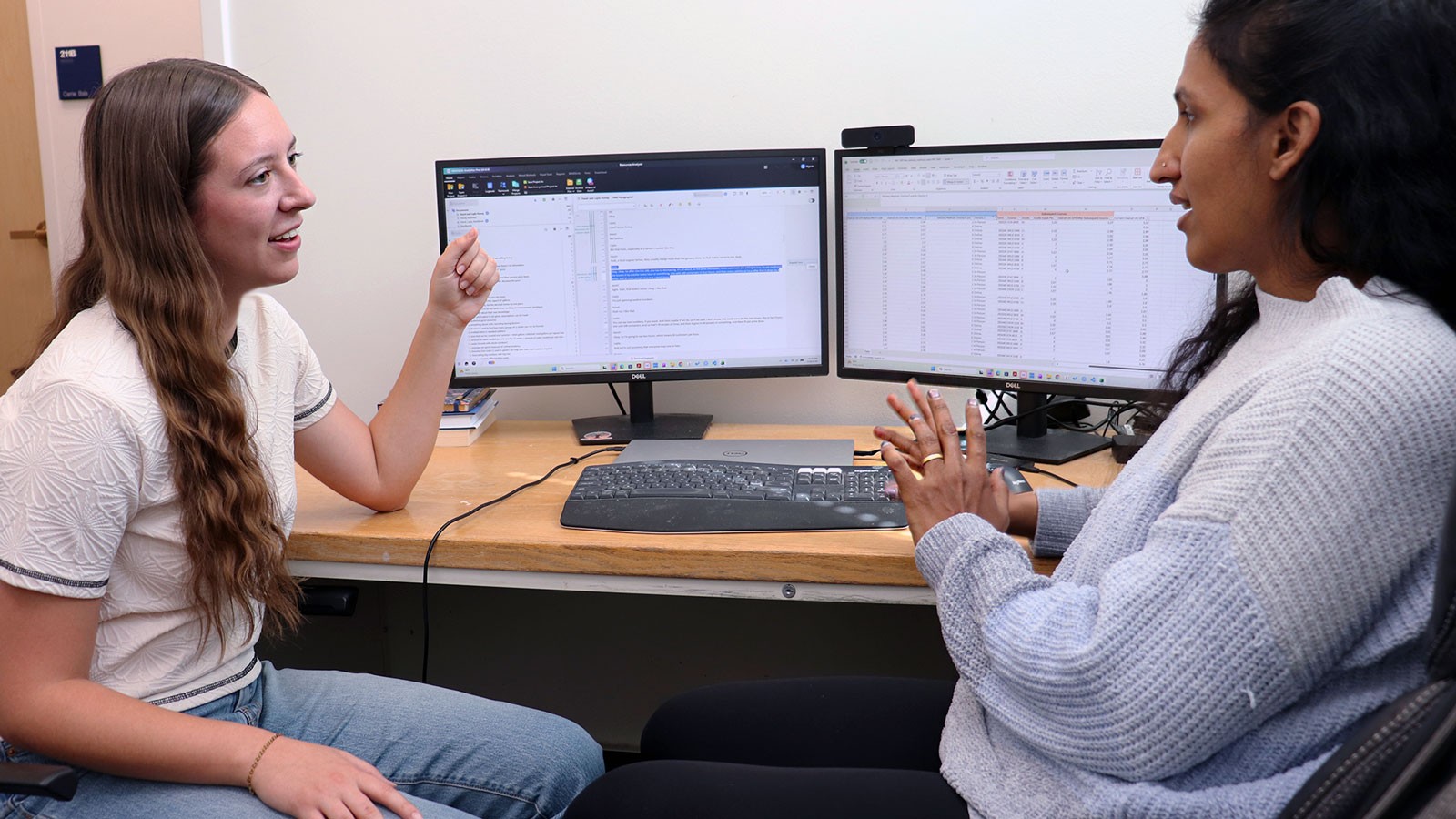
Emily Nielson, left, a USU Peak Undergraduate Summer Research Fellow, and her faculty mentor Sindura Kularajan, assistant professor in the Department of Mathematics and Statistics, are evaluating the effectiveness of a modeling-based calculus course geared to students pursuing life sciences careers. (Photo credit: USU/M. Muffoletto)
For many university students, required math courses can be a daunting hurdle.
“Calculus is a gatekeeper course,” says Utah State University undergraduate Emily Nielson. “If you can’t pass calculus, you can’t move on in a wide range of majors and fulfill career dreams.”
Nielson, who is majoring in applied mathematics and was named a 2026 Peak Undergraduate Summer Research Fellow, aims to reduce learning barriers that discourage aspiring scientists, engineers, physicians and others from forging ahead in occupational pathways.
With USU Department of Mathematics and Statistics faculty mentor Sindura Kularajan, Nielson is evaluating the effectiveness of a modeling-based calculus course for life science majors initiated by Kularajan and faculty colleague Brynja Kohler, professor and associate dean.
“Sindura and Brynja took me under their wing last fall as I joined them in examining the effectiveness of MATH 1100 — Calculus Techniques,” Nielson says. “The intent of the course’s modeling emphasis is to bridge the gap between people and their future careers.”
Calculus, she says, is often a difficult first course for college students.
“Our goal is to make this alternative course a very approachable course,” Nielson says. “Sometimes in math class, you feel like you’re staring at a wall of equations and none of it makes sense, because it’s all so abstract. The idea of a modeling-based course is to remind everyone that we use math every day in the everyday world and to give students practical experience in applying mathematical concepts.”
Kularajan, assistant professor, says she and Kohler collaborated with life science faculty members throughout the university whose degree programs require calculus as a prerequisite.
“We spoke with faculty in biology, ecology, engineering, public health, agricultural sciences, natural resources, watershed science, wildlife science and others,” she says. “From those conversations, we were able to develop models and example-based learning relevant to those disciplines.”
Nielson, who has served as a college algebra recitation leader for several semesters, says the modeling approach appeals to many students.
“Some students in mathematics and engineering enjoy immersion in abstract math, but people planning to pursue careers like nursing, wildlife management, industrial hygiene or other fields tend to appreciate application-driven examples,” she says. “They benefit from experiential learning — understanding how to estimate things, how to perform analyses — where they can clearly see the benefits of application of mathematical knowledge.”
Nielson, who graduated from Utah’s Layton High School in 2021 and received a USU Presidential Scholarship, says she’s grateful for the Peak Fellowship, which is allowing her, over the summer, to pursue research full-time.
“I’ve enjoyed my teaching experiences, but I wanted to gain more experience in research as well,” she says. “The financial support from the Peak Fellowship allows me to do that. Plus, I get to work with Sindura, who is an amazing mentor.”
As a bonus, Nielson will travel to the Society of Industrial and Applied Mathematics Conference on Applied Mathematics Education in July in Cleveland, Ohio, where she’ll present her research and network with other scholars in her field.
“Among my goals is to pursue graduate studies and secure a National Science Foundation Graduate Research Fellowship,” Nielson says. “I love research and teaching. I want to be able to impact students and the greater community and to help people fall in love with math.”
Quantitative literacy is important, she says, because it helps people understand the world around them.
“We have a lot of facts and figures constantly thrown at us, and if you don’t know how to interpret them, you might be misled,” Nielson says. “Take personal finance, for example. You need to understand exponential growth, and you need to be able to perform cost-benefit analyses to make sound decisions. The better you can problem-solve, the better answers you can come up with. Understanding math helps you do this.”
USU professors David Peak (Physics) and Terry Peak (School of Social Sciences) initiated and endowed the Peak Summer Undergraduate Research Fellowship program in 2019.
WRITER
Mary-Ann Muffoletto
Communications Specialist
College of Arts & Sciences
435-797-3517
maryann.muffoletto@usu.edu
CONTACT
Emily Nielson
Peak Undergraduate Summer Research Fellow
Department of Mathematics and Statistics
A02352671@usu.edu
Sindura Kularajan
Assistant Professor
Department of Mathematics and Statistics
435-797-1953
sindura.kularajan@usu.edu
SHARE
Comments and questions regarding this article may be directed to the contact person listed on this page.