Chem Professor Receives Fulbright Grant
While attending a conference earlier this summer in the eastern cuff of Italy's boot, USU chemistry professor Stephen Bialkowski decided to bike into the countryside of nearby Slovenia where he hoped to conduct future research. Cycling past vineyards he stopped behind a line of auto traffic waiting for the passage of a worker wearing a motorized backpack sprayer and spewing pesticide into the roadway. The worker paused to allow traffic to pass but resumed the mist before Bialkowski cleared the gauntlet.
"I actually got doused with the stuff," said Bialkowksi, who explained that organophosphate pesticides, widely used in agriculture and food production applications throughout the world, are closely related to chemical warfare nerve gas agents.
This week, Bialkowski was awarded a Fulbright Scholar grant to research and lecture at Nova Gorica Polytechnic in Slovenia. In January, he'll travel to the small European country, a part of the former Yugoslavia, where he'll spend six months teaching at the school's college of environmental sciences and conducting research with colleague Mladen Franko, a professor at the institute.
"We're seeking a more rapid and cost-effective means of analyzing human exposure to organophosphate pesticides," said Bialkowski, who joined Utah State's faculty in 1983.
Bialkowksi noted a recent study that indicates more than 50 percent of school-age children residing in Washington's Yakima Valley have pesticide in their urine during growing season. A similar study in Tuscany, Italy, found that more than 80 percent of children in that region tested positive for pesticides.
Pesticides are applied in spray form and drift indiscriminately into schoolyards, residence areas and water supplies. Long-term exposure to such substances can impede sensory and cognitive development, said Bialkowski. Yet their toxic effects can be reversed if correctly diagnosed. Current testing methods, however, involve repeated blood tests and are invasive and expensive.
"It costs about $200 to test each person," said Bialkowski. "If a local health department is planning to test, say, 2,000 children, that's cost-prohibitive."
By developing a technique to test urine samples using photothermal spectroscopy, Bialkowski believes the cost per measurement can be slashed to $2 per person.
"Then we'll have the means to perform widespread testing and identify people in need of treatment," he said.
During his stay in Slovenia, Bialkowski will also instruct graduate students majoring in environmental chemistry in the use of photothermal spectroscopy for environmental analysis. He said he looks forward to comparing environmental problems found in Europe to those in the United States and incorporating this information into lectures when he returns to Utah State.
"This is an interesting time to visit Slovenia because the country has just joined the European Union," said Bialkowski. "The E.U. is more receptive to environmental research than the United States."
He'll take not one bike, but two, on his trans-Atlantic journey and hopes to avoid further close encounters with walking crop dusters.
"The cycling community shares a universal language, and it's a great way to meet people when traveling," said Bialkowski, an active member of Logan's Cache Veloists cycling club.
Bialkowski is one of approximately 800 faculty and professionals from the United States who will travel abroad to some 140 counties for the 2005-06 academic year through the Fulbright Scholar Program. Established in 1946 under legislation introduced by the late Sen. J. William Fulbright of Arkansas, the program's purpose is to build mutual understanding between the people of the United States and other countries.

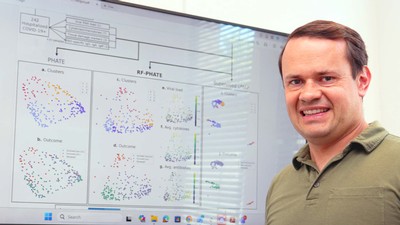
USU chemistry professor Stephen Bialkowski was awarded a Fulbright Scholar grant.
SHARE
Comments and questions regarding this article may be directed to the contact person listed on this page.