Disagreement and Compromise: President's Forum Holds Discourse on Political Polarization, Unity
By Marcus Jensen |
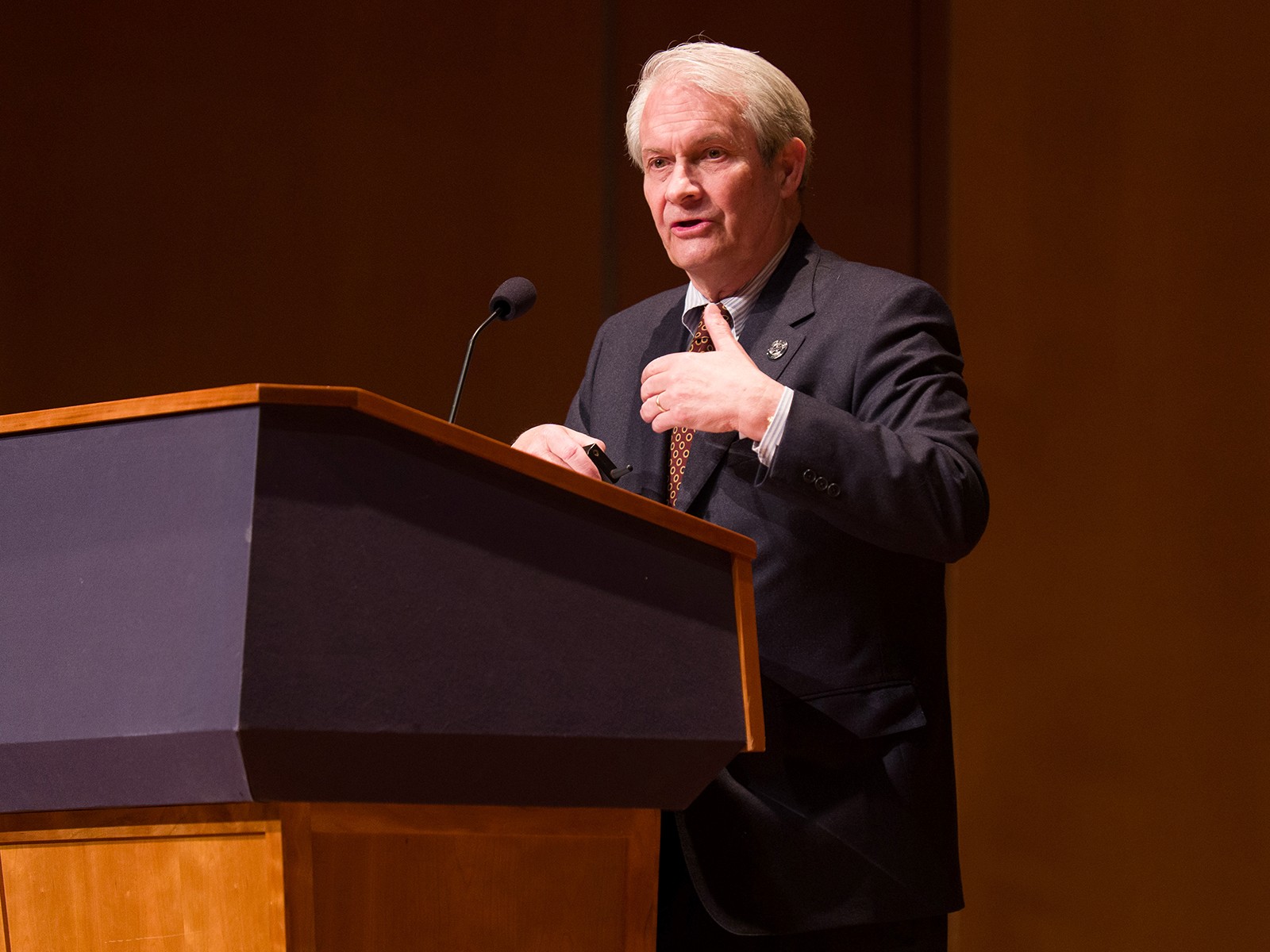
LOGAN, Utah — On March 25, Utah State University welcomed the Honorable Judge Thomas B. Griffith as keynote speaker at the second annual President's Forum on Conflict & Conflict Transformation. Judge Griffith discussed the current climate of political polarization in the U.S., as well as the erosion of trust within our democracy.
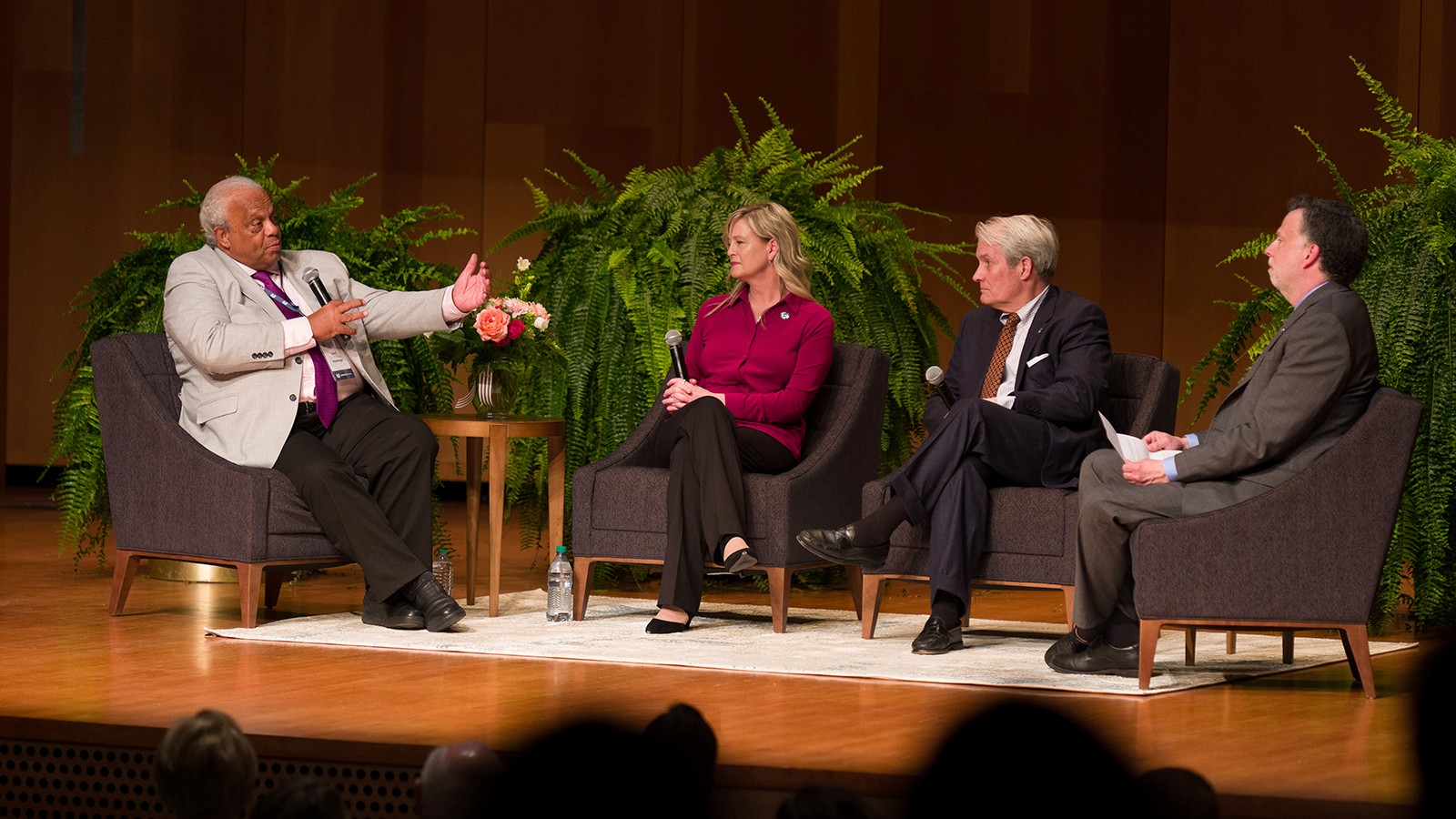
The forum also featured a panel discussion, where Griffith was joined by USU professors Lord Michael Hastings and Jeannie L. Johnson, furthering the discourse. The discussion was moderated by Joseph Ward, dean of the College of Humanities and Social Sciences.
Beginning the keynote address, Griffith spoke on the existential crisis of political polarization, which scholars agree is the highest since the Civil War. Yet, Griffith describe the country being polarized in ways it never has been before, in what political scientists call “affective polarization.” Griffith shared his definition of this phenomena.
“Your hatred for the other side is what really animates your political involvement,” he said. “It's not just that you think that the other side has bad policies, but you actually hate them. That level of contempt in our American politics is new.”
Griffith went on to say that disagreement is not a bad thing. In fact, he stated that the American Constitution was a product of disagreement and compromise. However, he said the way disagreement is happening today is new and that this contempt is a cancer to politics that is eroding the people’s trust in democracy. Griffith gave three ways people can do to rebuild trust in U.S. democracy:
- Build trust in the transparency and trustworthiness of election administration.
- Build confidence in the judicial system and its commitment to impartial justice.
- Remember that the U.S. Constitution was only created based on compromise in the face of disagreement for the sake of unity.
Griffith closed his remarks with his hope that civility and discourse can prevail in politics, especially among those who disagree.
“The way to preserve and defend the constitution is to work on our ‘bonds of affection,’” he said, drawing inspiration from Abraham Lincoln’s first inaugural address. “Can it be done? I hope so. It's my hope for all of us that we will strive in a good cause. And the good cause is to preserve the Constitution by nurturing and strengthening our bonds of affection for those who see the world differently than we do.”
Griffith, Johnson and Hastings then held an insightful and enlightening discussion on several topics related to restoring faith in democracy. These included discussions on:
- The role of the judiciary in restoring public confidence in the rule of law in our system of government.
- How to realign political discourse to balance competing interest through negotiation and compromise.
- How can universities and institutions of higher learning contribute to depolarization and encourage civil discourse grounded in constitutional principles?
The President’s Forum seeks to foster a culture of respect, open-minded inquiry, and thoughtful dialogue, empowering participants to navigate conflicts as opportunities for academic and personal growth.
Quotes in Judge Griffith’s Keynote
George Washington: “The Constitution is the result of that spirit of amity and that mutual deference and concession which the peculiarity of our political circumstances rendered indispensable.”
Arthur Brooks: “The outrage industrial complex in American media profits handsomely from our addiction to contempt.”
Jonathan Haidt: “There is a very good chance that we will have a catastrophic failure of American democracy. We just don't know what a democracy looks like when you drain all trust out of the system.”
Abraham Lincoln: “We are not enemies, but friends. We must not be enemies. Though passion may have strained, it must not break our bonds of affection.”
Václav Havel: “Anyone who claims that I am a dreamer who expects to transform hell into heaven is wrong. I have few illusions, but I feel a responsibility to work towards the things I consider good and right. I don't know whether I'll be able to change certain things for the better or not at all. Both outcomes are possible. There is only one thing I will not concede– that it might be meaningless to strive in a good cause.”
Reading List
A World in Disarray: American Foreign Policy and the Crisis of the Old Order by Richard Haass.
- Quoted by Judge Griffith during his speech. Griffith read an excerpt, stating “the greatest threat to American foreign policy today is not Putin or China– it this contempt that we have. It's an existential crisis.”
- Judge Griffith and two other former federal judges do a deep dive into the 2020 presidential election and the accusation of election fraud
American Covenant: How the Constitution Unified Our Nation and Could Again by Yuval Levin.
- Quoted in Judge Griffith’s keynote: “According to Levin, the most important function of the Constitution is not to protect our rights. He points out that the most important function of the Constitution is that it creates a structure of government that tells us how to act together when we disagree. It creates a framework for dealing with our differences.” Griffith calls the book “the most significant book on the United States Constitution that I've ever read.”
Dallin H. Oaks: Defending Our Divinely Inspired Constitution.
- A speech given in General Conference for the Church of Jesus Christ of Latter-day Saints in May 2021. Quoted in Griffith’s keynote: “On contested issues, we should seek to moderate and to unify.”
The Original Meaning of Civility: Democratic Deliberation at the Philadelphia Constitutional Convention by Derek Webb.
- Judge Griffith summarizes the story of the constitutional convention and how delegates worked together to find common ground, compromise and even cede position to accomplish unity.
The Pursuit of Happiness by Jeff Rosen.
- Judge Griffith brings up this book answering a question in the panel discussion about modern politics and balancing compromise and negotiations.
Judge Learned Hand: The Spirit of Liberty.
- A speech quoted during Judge Griffith’s answer about modern politics and balancing compromise and negotiations. “I beseech ye… think that ye may be mistaken.”
Dangerous Love: Transforming Fear and Conflict at Home, at Work, and in the World by Chad Ford.
- Book discussed by Professor Johnson during her closing remarks in the panel discussion.
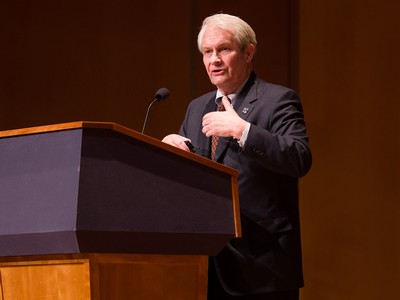
Retired judge Thomas Griffith gives an address during the second annual President's Forum on Conflict & Conflict Transformation. (Credit: Andrew Diamond/USU).
Lord Michael Hastings, Jeannie Johnson, Judge Thomas Griffith and Dean Joseph Ward have a conversation during the 2nd Annual President's Forum. (Credit: Andrew Diamond/USU)
WRITER
Marcus Jensen
News Coordinator
University Marketing and Communications
marcus.jensen@usu.edu
CONTACT
Logan Wilber
News Director
University Marketing & Communications
(845)667-0213
logan.wilber@usu.edu
TOPICS
Politics 94storiesSHARE
Comments and questions regarding this article may be directed to the contact person listed on this page.