'Everyone Deserves Access to Education': USU Graduate Student Advocates for Science Outreach
Gavin Munson, named Graduate Student Instructor of the Year by the College of Arts & Sciences, recounts his journey to entomological studies and his passion for teaching others.
By Sydney Dahle |
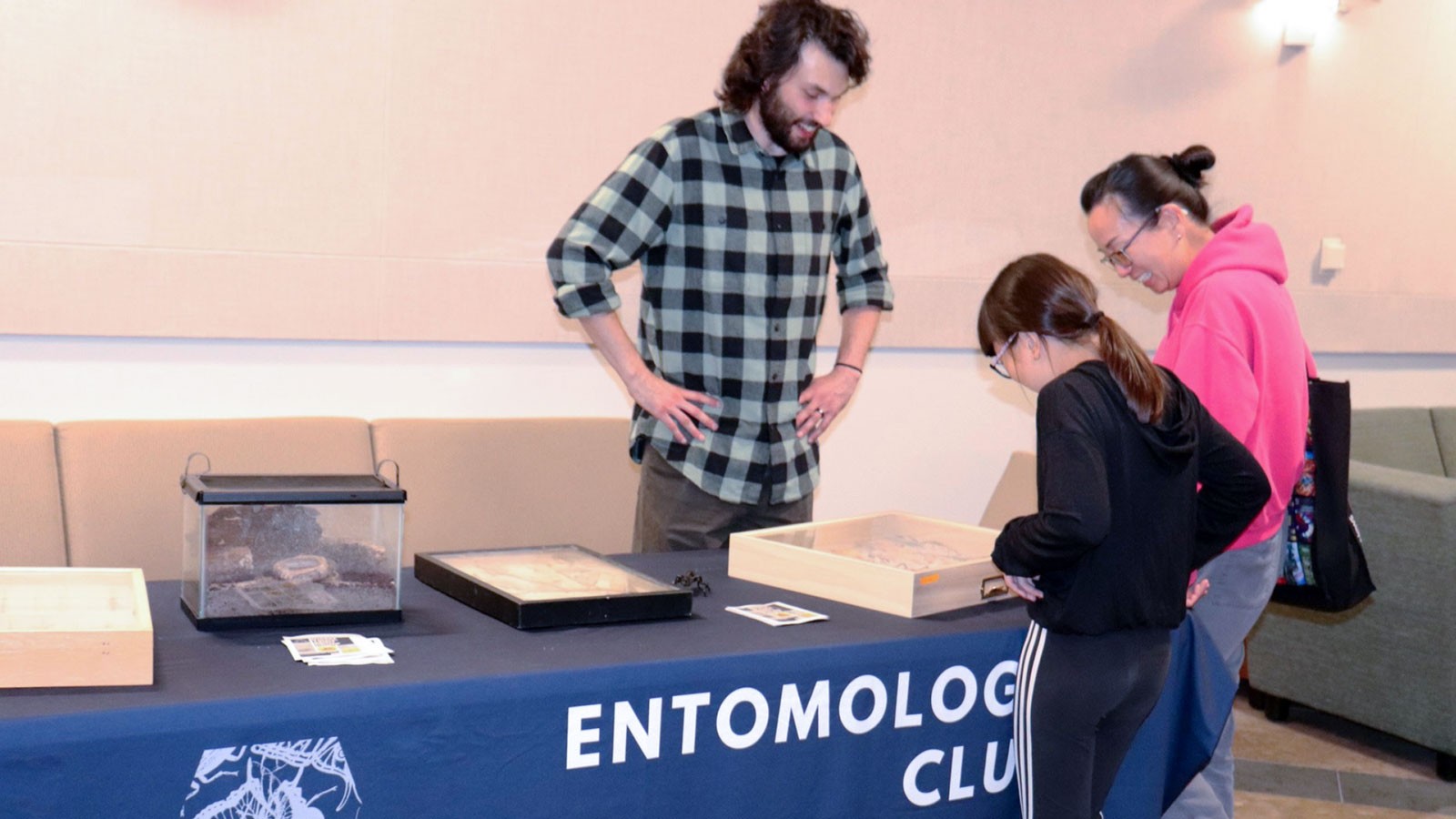
Gavin Munson, left, a graduate student in the Department of Biology and the USU Ecology Center, volunteers at USU's Science Unwrapped public outreach program. Munson, named a Graduate Instructor of the Year in the College of Arts and Sciences, is a passionate advocate for education and science outreach. (Photo credit: USU/M. Muffoletto)
At Utah State University, graduate student Gavin Munson believes education should extend far beyond the classroom.
Munson, who is pursuing a master’s degree in biology with an emphasis in ecology and evolution, says his goal has always been to help others learn and see the world differently. While many graduate students focus primarily on research, Munson says teaching has long been his driving force.
“I’m here because I want to be a teacher,” he said. “Research is important, but for me it’s part of becoming the best educator I can be.”
Munson grew up in Cedar City, Utah, and graduated from high school early in 2015 after completing three years. He enrolled at Southern Utah University, initially majoring in accounting before switching to pre-med with plans to pursue radiology. It was not until his final year, when he enrolled in an entomology course, that his path changed.
A field trip spent catching insects with a butterfly net sparked what he described as an immediate connection to the natural world. While at SUU, mentorship from Professor William Heyborne, dean of the College of Natural Resources, solidified his interest in ecology and organismal biology. Munson shifted away from medicine and immersed himself in field research, including turtle ecology projects and insect studies.
“I realized I cared more about helping people understand the world than chasing a paycheck,” he said.
Now at USU, Munson studies a specific group of aphids with faculty mentor Carol von Dohlen, using genetics, morphology and ecology to examine whether what is currently classified as a single species may in fact represent two distinct species. He hopes to publish findings that could formally recognize a new species and revive a historical scientific name previously set aside.
Outside the lab, Munson is deeply involved in campus leadership and outreach. He serves as president of the Biology Graduate Student Association and previously worked as outreach coordinator for the university’s entomology club. With fellow students, Munson frequently travels with insect specimens to local schools and community events. He volunteers regularly with USU’s Science Unwrapped public outreach program.
He is also an advocate for the Center for Empowering Teaching Excellence, known as ETE, where he participates in pedagogy workshops and learning circles focused on improving instruction.
For Munson, outreach is a form of public education. He said not everyone has access to higher education, and he believes scientific knowledge should be shared widely, especially with underserved communities.
“Everyone deserves access to education,” he said. “College isn’t feasible for everyone, but that doesn’t mean they shouldn’t have access to knowledge.”
Munson also brings a personal perspective to his work. A father of a 3-year-old son, he says parenting reshaped how he thinks about curiosity, learning and resilience. Whether catching insects together or navigating the challenges of raising a toddler, he sees daily reminders of why education matters.
After completing his master’s degree, Munson plans to pursue a doctorate and follow the traditional professorship route, with a focus on teaching undergraduate students. He said he is also open to teaching at the high school level if that is where he can make the greatest impact.
His advice to future graduate students is simple: Pursue what makes you genuinely happy and lean into challenges rather than avoiding them.
“Attack the hard things,” he said. “That’s where the growth happens.”
WRITER
Sydney Dahle
Web & Social Media Specialist
College of Arts & Sciences
435-797-2985
sydney.dahle@usu.edu
CONTACT
Gavin Munson
Master’s Student
Department of Biology and USU Ecology Center
gavin.munson@usu.edu
SHARE
Comments and questions regarding this article may be directed to the contact person listed on this page.