Fostering Community: Conflict Transformation Professional Joins USU's Heravi Peace Institute
James Patton, Peace Corps and USAID veteran, former CEO of the International Center for Religion & Diplomacy, founding partner of Lead Integrity Consulting and lifetime member of the Council of Foreign Relations, joins the Department of History, Cultures & Ideas as an associate professor of professional practice in the Religious Studies program
By Mary-Ann Muffoletto |
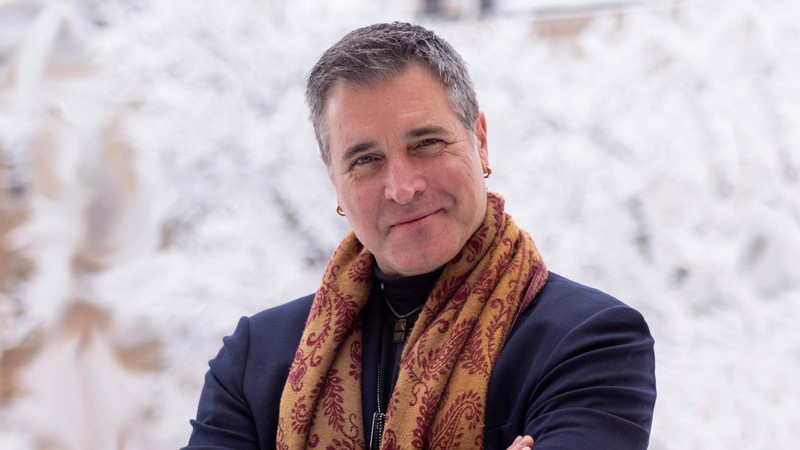
James Patton, associate professor of professional practice in the Religious Studies program for the Department of History, Culture & Ideas, along with the Heravi Peace Institute, arrives at Utah State with a decades-long career in international affairs and conflict transformation.
Observing current events feels like a cloud of déjà vu, as efforts toward reconciliation and consensus break down and simmering hostilities erupt again and again. Where does one start to shift course toward community and peace?
“Dealing with identity conflict requires specialized understanding and specific tools to mitigate conflict drivers and rebuild relationships,” says Utah State University conflict transformation professional James Patton. “Violence prevention, violent conflict interventio and recovery each call for distinct approaches. Unfortunately, cycles of conflict can shift from pre-conflict or post-conflict to violent conflict very easily. The capacities that an effective peacebuilder must develop are complex and nuanced.”
Patton, who has pursued a decades-long career in international relations and conflict transformation, recently joined the faculty of the Religious Studies program of USU’s Department of History, Cultures and Ideas, along with the Heravi Peace Institute, as an associate professor of professional practice.
“I’m excited to join USU’s faculty and become involved in a nascent peace institute brimming with expertise in theory and practice,” he says. “Dr. Mehdi Heravi’s hopeful vision provides an excellent and timely opportunity for addressing critical needs in our local, state and national communities, and within the broader world. I’m grateful to be a part of this promising and innovative USU-led initiative.”
Patton’s passion for peace and interest in international relations grew out of an early career experience in South America.
“My undergraduate studies were in studio art and neuroscience, and I worked as a beekeeping extensionist in the Peace Corps,” he says. “After working in Paraguay and spending time in other Latin American countries, I developed language skills and cultural knowledge. During that time, I built relationships with Jesuit liberation theologians and Quaker peacebuilders, which fueled my decision to enter Harvard Divinity School to study the role of religion in social justice.”
Patton decided not to pursue professional ministry but instead headed to the Fletcher School at Tufts University to earn a master’s degree in law and diplomacy.
“I combined knowledge and insights I gained in theological seminary with graduate studies in diplomacy to carve out a career in international relations,” he says.
Patton spent more than 20 years working in governmental and non-governmental leadership roles, including with the U.S. Department of State, USAID and global peacebuilding organizations. His career has included working on critical issues in more than 40 countries across the globe.
During that time, Patton became acquainted and worked with USU faculty members Ravi Gupta and Chad Ford in various capacities.
“They encouraged me to explore an opportunity to join USU and, seeing the developments here, I jumped at the chance to start a new chapter in academia,” he says. “I look forward to diving into compelling issues with students and working with dialogue and interfaith engagement efforts in the local community, as well as drawing in national and international partners.”
All conflict transformation, Patton says, starts with dialogue.
“Dialogue is not ‘talking at,’” he says. “It’s an exchange of needs and understandings that gives us a grounding from which to build something that better serves those from all sides of a conflict. The peacebuilder’s role is to find a way to facilitate a safe and effective dialogue that moves relationships away from harm.”
Quoting renowned Mennonite scholar and peacebuilder John Paul Lederach, Patton says conflict is a natural part of all interpersonal relationships and impossible to eradicate.
“It’s what we do with conflict that makes it constructive or destructive,” he says. “Conflict points us to where we must share insights and experiences that will allow us to deepen understanding and community and develop new and better institutions and relationships around inevitable differences.”
WRITER
Mary-Ann Muffoletto
Communications Specialist
College of Arts & Sciences
435-797-3517
maryann.muffoletto@usu.edu
CONTACT
James Patton
Professor of Practice
Religious Studies, Department of History, Cultures and Ideas and Heravi Peace Institute
james.patton@usu.edu
TOPICS
Society 617stories Humanities 190stories World 130stories Communication 94stories Solutions 91stories Social Sciences 42storiesSHARE
Comments and questions regarding this article may be directed to the contact person listed on this page.