Hands-On Research Leads USU Senior to Probe Enzymes Behind Human Disease
By Emma Shelite |

Brooklyn Larsen.
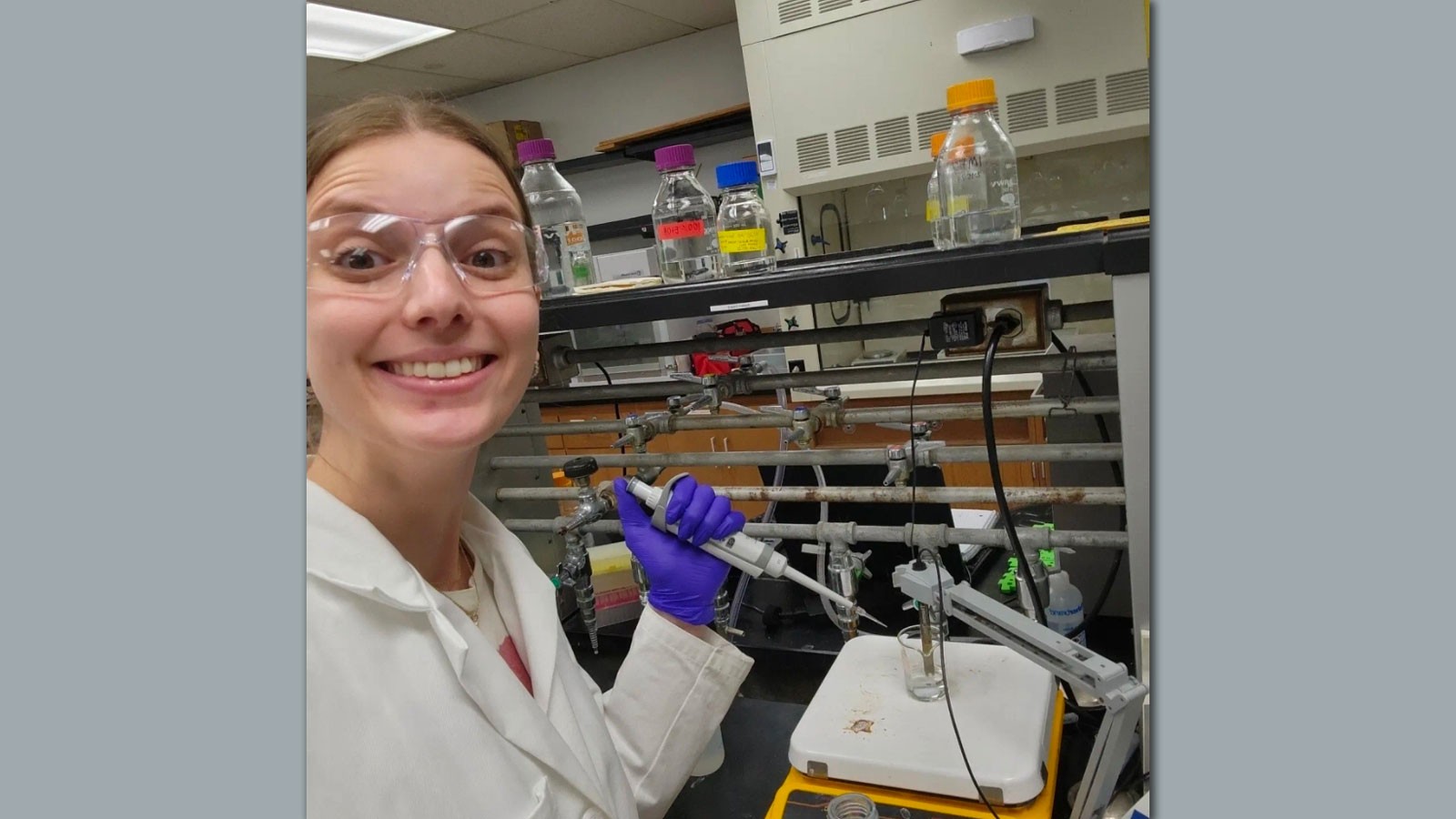
LOGAN — Brooklyn Larsen is spending her final semester at Utah State University asking a deceptively simple question: What happens inside the body when an essential enzyme stops doing what it is supposed to do?
A biochemistry student in USU’s College of Arts & Sciences, Larsen works in Professor Joan Hevel’s lab, where she is helping investigate a protein arginine methyltransferase — an enzyme that plays a role in regulating how proteins function. When that enzyme is disrupted, researchers have linked it to serious illness.
“It’s linked to diseases like cancer and neurodegenerative diseases, but we don’t really understand how it’s regulated,” Larsen said.
That hands-on lab experience is shaping Larsen’s next steps. Larsen is currently applying to graduate school and exploring doctoral training in pharmacology, with the long-term goal of contributing to biomedical research and, eventually, better treatments for complex diseases.
For people outside the sciences, Larsen boils her major down to something practical and human: biochemistry is “the science and chemistry of how our bodies work,” from molecules and metabolism to the immune system and disease.
Larsen’s interest in science started before college. She credits a strong high school chemistry teacher with sparking her curiosity, even after a challenging AP Chemistry experience. Instead of turning away from the subject, Larsen said the work helped her identify what she enjoyed most about science.
“I love understanding how things work,” Larsen said. “This kind of just fit in perfectly.”
At USU, that curiosity drew her deeper into biochemistry. Larsen said she began college focused on chemistry and later chose a biochemistry emphasis as she discovered how directly the field connects to real-world questions about health and life processes.
In Hevel’s lab, Larsen’s research centers on understanding how the protein arginine methyltransferase is controlled — a question that could inform future therapeutic strategies. Larsen said researchers are working toward a clearer picture of the enzyme’s regulation so that scientists can better understand what goes wrong in disease.
The experience has also taught her how much patience and planning lab work demands. Larsen described research weeks that can vary widely depending on the experiment. Some days require only short check-ins, while others can mean long stretches in the lab — sometimes “10 or more hours” in a day — with homework squeezed into downtime between steps.
Larsen said one of the most rewarding parts of research has been seeing class concepts show up in real time. When lab techniques line up with coursework, she gets to connect theory to practice in a way that makes both clearer. Larsen has also presented her work through class assignments and research events, gaining experience communicating scientific results to others.
Beyond campus, Larsen explored another side of the scientific world during a summer internship at Nelson Labs, where she worked in regulatory testing for medical devices. The work focused on validating cleaning and sterilization instructions — a behind-the-scenes process that supports safety standards and regulatory approval.
The internship highlighted how different science can look outside a university lab. Larsen said academic research often involves open questions and problem-solving, while regulatory testing follows strict protocols. Larsen described research as “a lot more like open-ended and like, how we solve this problem,” compared with regulatory expectations.
“Here’s what the FDA expects and here’s what they want to see, and so you have to do the procedure exactly.”
Larsen also credits USU’s campus environment and its encouragement of student involvement as a major reason she has thrived.
“You don’t have to beg to find a place here,” Larsen said. “They want you to participate.”
Larsen said faculty support has made a difference, too, describing the chemistry and biochemistry professors as accessible and invested in student success. Even in large programs, Larsen has felt seen.
“They take the time to, like, know our names,” Larsen said.
Looking ahead, Larsen hopes to keep chasing biological “why” questions, especially those tied to disease.
“I would love to understand ... the mechanisms of autoimmune diseases, like MS or Parkinson’s,” Larsen said. “With that understanding of like, of what the problem is, then ultimately you can find treatments.”
WRITER
Emma Shelite
Communications Intern
College of Arts & Sciences
emma.shelite@usu.edu
CONTACT
Brooklyn Larsen
Biochemistry Student
brooklyn.larsen@usu.edu
TOPICS
Student Success 391stories STEM 349stories Hands-on Learning 331stories Biology 208stories Undergraduate Research 202storiesSHARE
Comments and questions regarding this article may be directed to the contact person listed on this page.