Inaugural Prof Mike Taylor Presents Lecture
After the heady experience of capturing video from a NASA DC-8 of the fastest manmade object to ever breach the earth’s atmosphere, Michael Taylor and research team members diligently returned to the mundane task of packing gear and offloading the aircraft.
The NASA plane was on to the next assignment in its tight schedule and he and his research team had to quickly relinquish their turn. But not before collecting valuable data as the Stardust capsule carrying cometary and interstellar particles successfully touched down in the West Desert salt flats of the U.S. Air Force Utah Test and Training Range.
“It was a very exciting, if short-lived, experience,” the USU physicist told family, friends and colleagues who joined him Feb. 7 at the President’s Home for the tenth talk in the university’s 2005-06 Inaugural Professor Lecture Series. The series highlights the accomplishments of university faculty who have been promoted to full professor in the past year.
Taylor said he and his colleagues were grateful for the opportunity to record the memorable Jan. 15 reentry of the Stardust comet sample return mission capsule.
Taylor’s long held fascination with atmospheric gravity waves and the dynamics of auroras – “those beautiful curtains of green and red lights” – fueled his research and rare expertise in photographing atmospheric phenomena.
“As the DC-8 flew in circles, we trained our camera on Stardust and were able to start collecting data well before its parachute deployed,” said Taylor. “We had experience in photographing meteors and the capsule acted like a giant meteor.”
While Stardust’s primary mission was to rendezvous with a comet and deliver pristine particles held in a cosmic deep freeze for billions of years for earthly study, NASA is keenly interested in the capsule’s performance.
Taylor said Stardust is the first NASA vehicle to sport a heat shield comprised of PICA (Phenolic Impregnated Carbon Ablator). “As NASA looks toward future missions and the next generation of spacecraft, protecting vehicles during reentry is a key concern,” he said.
Taylor’s original career path pointed toward the telecommunications industry, but an obscure bulletin board notice caught his eye just days before graduation from the University of Southampton in his native England.
“I had several jobs lined up, including telephone communications engineer, but I saw a notice seeking research assistance with atmospheric sounding rockets,” recalled Taylor. “It was a late Friday afternoon, but I hurried in to talk with the professor conducting the project. An hour later, I had the job.”
Utah State’s emphasis on atmospheric studies and space research enticed Taylor to USU.
“I was a grad student when I happened to meet (USU professor) Doran Baker at a conference in Dublin, Ireland,” said Taylor. “He told me about the atmospheric research underway at Utah State and we cooked up a joint project in the early 1980s that worked out extremely well.”
Taylor eventually joined USU’s Space Dynamics Laboratory in 1991 and was subsequently offered a faculty position in the university’s physics department and Center for Atmospheric and Space Sciences in 2001.
He said coming to the United States and joining Utah State have provided significant opportunities. “It would be difficult to access similar opportunities in Britain,” said Taylor, who explained that, in the United Kingdom, research grants are typically reserved for tenured faculty only. “Here I am encouraged to write applications and can talk directly with grant program managers. It’s been a big springboard for me.”
Beyond research, Taylor said he enjoys teaching and the interaction with students. “We have top notch students here at Utah State,” he said. “The involvement of undergraduate and graduate students in research is a very important part of the learning experience.”
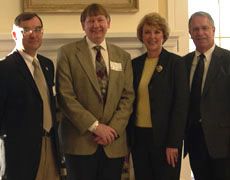
Professor Mike Taylor was recognized in a reception at the President's Home as part of the Inaugural Lecture Series. (left to right) Physics Department Head Jan Sojka, Professor Taylor, Joyce Albrecht and President Stan Albrecht.
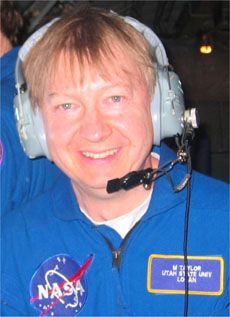
USU physicist Mike Taylor boarded a NASA plane to record the Stardust capsule's reentry.
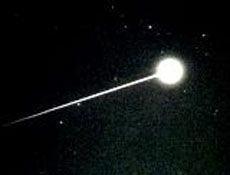
The Stardust capsule bursts through the Earth's atmosphere like a giant meteor.
TOPICS
Inaugural Lecture 130storiesSHARE
Comments and questions regarding this article may be directed to the contact person listed on this page.