NSF CAREER Grant Aids USU Researcher Developing Safe Additives to Minimize Plastic Pollution
By Brittanie Carter |


A researcher at the Utah Water Research Laboratory has received a National Science Foundation CAREER award to research sustainable alternatives to toxic plastic additives and minimize plastic pollution.
The five-year, $569,000 grant will support Flavones as Safe, Sustainable Additives to Tune Biodegradable Plastic Stability, a research project led by Kyle Moor, an assistant professor in Utah State University’s Biological Engineering Department.
Plastic pollution is a global threat to human and environmental health. As plastics break down during everyday use and weathering, they release highly toxic additives into rivers, lakes and other surface waters.
Moor’s team is working to develop a safer alternative to these additives by studying flavones — a group of plant-based compounds found in leaves and fruit. Flavones have a unique chemical structure that allows them to absorb sunlight and protect plastics, acting as light stabilizer additives.
Certain flavones can instead act as pro-oxidant additives, initiating plastic breakdown. Moor’s team aims to use flavones in biodegradable plastics, helping them break down faster when exposed to sunlight. This is especially useful in surface waters, where biodegradable plastics can otherwise degrade very slowly.
The team will test different flavones to better understand how they interact with light, how they affect the stability of biodegradable plastics, how stable they are when exposed to light, and their possible ecological impacts.
Moor is hopeful that this CAREER project will advance flavones as sustainable plastic additives, opening the door to a new class of non-toxic additives derived from renewable resources.
“We see flavones as an avenue to control the breakdown of biodegradable plastics,” Moor said. “Depending on their chemistry, they can either stabilize materials or initiate their degradation. And because they’re derived from plants, they may have less impacts on ecosystem and human health than the conventional light stabilizers currently in use.”
The NSF CAREER program is one of the foundation’s most prestigious awards for early career faculty who combine innovative research with education and community engagement. In addition to supporting research, the NSF CAREER award will enhance coursework used to train environmental scientists and engineers in sustainable chemistry, connect students to industry perspectives on sustainability, and fund outreach activities to introduce high school STEM students to sustainable chemistry.
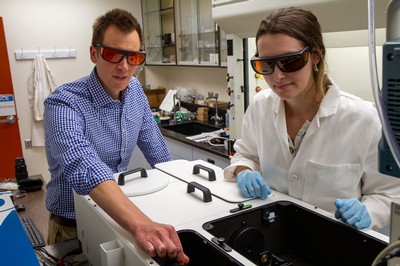
Kyle Moor and UWRL graduate student Mallory Liebes work with lasers to study flavones' capabilities as light stabilizers.

WRITER
Brittanie Carter
Public Relations
Utah Water Research Lab
brittanie.carter@usu.edu
CONTACT
Kyle Moor
Assistant Professor
Department of Biological Engineering
kyle.moor@usu.edu
SHARE
Comments and questions regarding this article may be directed to the contact person listed on this page.