Precious Few: English Prof Awarded for Tales of Early Utah Women Inventors

Christine Cooper Rompato is receiving the 2016 Charles Redd Center for Western Studies Award for the best general interest article of the year appearing in the Utah Historical Quarterly. The associate professor of English will accept the award for her article, "Women Inventors in Utah Territory," during this week's 2016 Annual State History Conference.
Women inventors were scarce in Utah Territory. Indeed, just five applied for patents in the entire 19th century.
Mormon and Gentile. Full-time supermom and widow. Young, but mostly older.
Their stories are retold in a Utah Historical Quarterly article that has won an award for its ability to bring these women alive.
Christine Cooper Rompato this week receives an award presented by the Charles Redd Center for Western Studies for the best general-interest article of the year appearing in the Utah Historical Quarterly. The article, “Women Inventors in Utah Territory,” appeared in the summer 2015 issue.
She’ll accept the award during the 2016 Annual State History Conference, which runs through Oct. 1.
The award, said religious studies professor Philip Barlow, recognizes that although the article ran in a scholarly journal, “it’s accessible both to scholars and to a wider public. I admire that.”
Cooper Rompato, associate professor of English and a medievalist by specialty, spent hours in her beloved archives combing through patents, newspaper articles and correspondence to track women who were audacious and confident enough to take on the costly and masculine task of patenting. The search was made more difficult because women often used only their initials or had gender-ambiguous names like Alma, which could a male or female name.
Most women inventors were in the mold of Carrie Munro, the first Utah woman to seek a patent on an invention. These innovators, said Cooper Rompato, were generally “older women, financially secure and seemingly confident in their various domestic and public spheres.”
“Carrie Munro really caught my eye,” said Cooper Rompato.
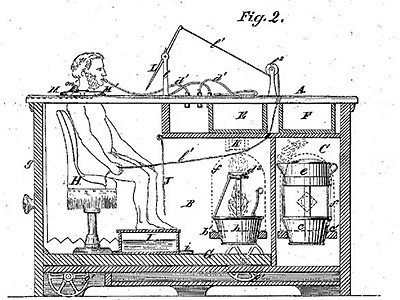
Munro in 1874 filed for the first of three patents on vapor baths for public and personal use.
“The images for her vapor bath are fantastic,” said Cooper Rompato. “It’s basically a large box construction where you have various gases and steam inside that purge impurities from the body.”
In later years, Munro refined the device with a collapsible version of the vapor bath that could be folded into a coat closet. This further impressed Cooper Rompato, who explained, “She’s thinking about how people actually used the bath, how to advertise it, and how it could be sold as part of the furniture in your house to be helpful for all of your children and husband.”
Munro and her husband, Dr. George Munro, moved to Utah to grow their bath house business because the territory was home to a group of people known for their maladies: miners. And, although miners exposed to lead, mercury and other caustic agents came to have their impurities steamed out, the business thrived among Mormons in Salt Lake City.
In her research, Cooper Rompato found that Utah’s women inventors shared some commonalities — often their husbands were engineers; plus, they had husbands, brothers or male friends who had themselves filed patents.
“It seems that once someone negotiated the process,” she said, “it opened it up for women.”
Women as inventors faced many obstacles, only some related to their gender. The costs were insurmountable for individuals without their own incomes — $30 to file a patent and up to $100 to hire a patent attorney. And often, women were criticized that their inventions were derivative and useful only in the inconsequential domestic sphere.
That was not the case with Matilda Busby, a mining executive who in 1890 was awarded a patent for an improved brake for a cart or wagon.
But such stereotypes may fit another Utah woman. When Rebecca Henshaw sought a patent in 1890 for a specialized clothing hook, the market was already saturated. What made her hook different was a spring clasp that prevented a coat from crumpling to the floor or being stolen.
But Henshaw’s story illustrates another factor in an invention’s success — the wherewithal to market and manufacture the product.
“Her clothing hook is pretty cool,” said Cooper Rompato. “You can look at it and say, ‘That’s a really great idea’. But the clothing hook on my door doesn’t look like that.”
Why was Henshaw’s design rejected? she wonders. Why was it never marketed? Unfortunately, we’ll never know the full story about Henshaw’s hook, which is also true for most women’s inventions.
The other women Cooper Rompato describes are:
- Jeannette Brown, who, taking inspiration from the 1890s craze of swimming in the Great Salt Lake, invented an inflatable life preserver for the head.
- Julia Samson, a seamstress by trade who in 1893 patented a binder to hold sheet music and a unique clothes fastener.
Cooper Rompato is also continuing work on a project to document inventors — both male and female — in Cache County. Interestingly, she adds, the first patent filed by a Cache Valley woman was in the 1950s.
Related links
Writer and contact: Janelle Hyatt, 435-797-0289, Janelle.hyatt@usu.edu
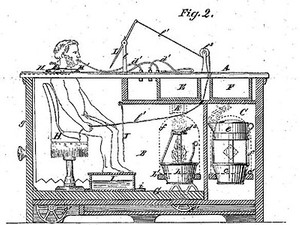
Image of Carrie Munro's invention, a vapor bath, included in her 1874 patent. This side view shows a man sitting inside the box construction with his head poking through a hole that is fitted with collars to keep the steam and vapors inside. The fumes of alcohol, iodine and other substances were said to sweat out any impurities. This model’s mouth is on a tube that allows him to breathe in the medicated air. Munro’s patent is No. 151,149.
TOPICS
Awards 862storiesSHARE
Comments and questions regarding this article may be directed to the contact person listed on this page.