Researchers Awarded NSF Grant to Investigate Mathematics Teacher Retention in Utah High Schools
By Jennifer Payne |

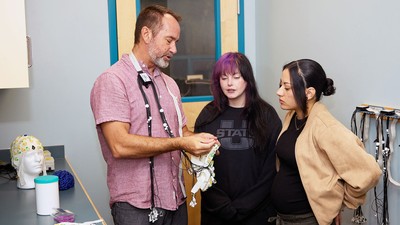
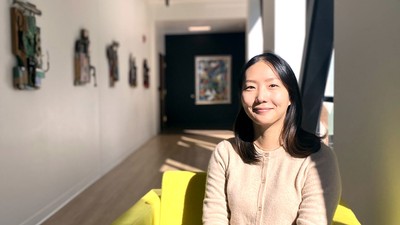
Willa van Dijk and Kaitlin Bundock, professors in the Department of Special Education and Rehabilitation Counseling in the Emma Eccles Jones College of Education and Human Services, and Carrie Bala, professor in the Mathematics and Statistics Department in the College of Arts and Sciences.

A team of Utah State University researchers has been awarded a grant from the National Science Foundation to understand retention among the state's high school teachers.
Willa van Dijk and Kaitlin Bundock, professors in the Department of Special Education and Rehabilitation Counseling in the Emma Eccles Jones College of Education and Human Services, and Carrie Bala, professor in the Mathematics and Statistics Department in the College of Arts and Sciences, have been awarded a grant from the Robert Noyce Teacher Scholarship Program within the National Science Foundation.
Their research seeks to understand how support in work and home life impact the retention rates of Utah school teachers — specifically among special education and general education math teachers in the upper grades (6-12) — so policies and practices can be established to improve teacher retention.
“We know that recruiting and retaining high-quality special and general education math teachers is critically important for student success, especially in secondary settings,” said Tom Higbee, head of the Department of Special Education and Rehabilitation Counseling. “The collaborative work that Drs. van Dijk, Bundock and Bala will accomplish with this important project will help us better understand the factors that lead to both teacher and student success.”
In Utah, secondary math and secondary special education math are two areas with high teacher turnover rates. Bundock, van Dijk, and Bala, who have collectively taughtmath and special ed for nearly 30 years in the public school system, have a vested interest in teacher retention. Their combined research and personal experiences show that students learn and grow better if they have seasoned teachers in their classrooms. The researchers also know that teachers who don’t have adequate professional, emotional and social support are less likely to stay.
“The longer you do something, the better you get at it,” said Bundock, a former high school special education math teacher. “If you have a teacher who has been in a school for two years and then leaves, the school will hire another teacher, but it’s like going back two years in time. In contrast, a teacher who stays for five years or more has really refined what they’re doing and, ideally, is a positive influence on the school and students.”
The team has developed two small pilot studies within the research project. The first is to gain a deep understanding of what effective mathematics education means in each of Utah’s 41 school districts. The second is to examine social support and how it impacts retention from the teachers’ perspectives.
For the first pilot study, the team will survey district-level leadership in both special education mathematics and general education mathematics throughout the state, using graduate students to proctor the digital surveys.
Bala, who taught high school math in Utah for 17 years before moving into academia, wants to better understand best practices in each district.
“This project will analyze what districts around the state view as best practice for general ed and special ed math students,” she said. “One hope is that these best practices can be shared beyond local borders and that successful modes of teacher collaborations can be recreated. The more teachers collaborate with a focus on high expectations for student learning, all students rise.”
Bundock, whose research interest is in mathematics interventions at the secondary level and in co-teaching models, explained the type of information they are seeking from the districts. “We’re looking at the mathematics curriculum the districts use, if they have different structures that foster collaboration between special ed math teachers and general ed math teachers, if they use co-teaching as a model, and if they provide co-teaching training,” she said. “Also, do they agree on what effective mathematics instruction looks like for students with and without disabilities? What does their special education service delivery look like in their district?”
Based on the data they gather from the districts, the team will then determine the districts from which they will recruit teacher participants. In total, they plan to recruit 20 teaching pairs (a total of 40 teachers) who work in both rural and urban schools throughout Utah. Participants will take surveys and later participate in in-depth follow-up interviews.
“The teachers need to be in the same school even if they’re not actually co-teaching,” said van Dijk, principal investigator on the grant. “Then we can see what support and collaboration look like in the school from the special education teacher’s perspective and from the general education math teacher’s perspective.”
The team wants to learn to what extent social support systems affect teachers’ decisions to leave the classroom.
“We’re focusing on support systems because we know that support is important for teacher retention and we know that teacher retention has a big impact on student achievement,” Bundock said. “Schools that have high turnover rates tend to have persistently lower student success.”
The researchers are looking at the support teachers get from their colleagues and the principal, but they also want to look at the support they get in their private lives, Bundock said.
“For instance,” Bundock said, “we know that if a teacher has a support system that can take care of their children when they have parent-teacher conferences, they’re less likely to quit.”
“We assume that if you have a broader network, if you have support and connection, it leads to higher retention,” van Dijk added. “But we won’t know without doing the research.”
Bundock, van Dijk, and Bala hope to take their findings to state and district administrators to help impact policy and practice in the schools and school districts.
“Teachers seem to draw on a nearly endless supply of energy,” Bala said. “Where and how and with whom do they recharge? As we seek to better understand the social supports on which teachers rely, we may recognize and recommend successful modes of collaboration, strategies for finding balance, and networks that continue to provide teachers with the energy to persist in this field.”
The team will also apply for more funding to expand their research into a multi-year project. But impacting student outcomes is their priority.
“I think the more we can improve teacher collaboration between special education and general education, the better it will be for our students,” van Dijk said. “That’s the end goal, really. We want to help the kids succeed.”
WRITER
Jennifer Payne
Emma Eccles Jones College of Education and Human Services
Public Relations Specialist
jen.payne@usu.edu
CONTACT
Alicia Richmond
Director of Public Relations & Marketing
Emma Eccles Jones College of Education, Health, and Human Sciences
alicia.richmond@usu.edu
SHARE
Comments and questions regarding this article may be directed to the contact person listed on this page.