USU Art Museum Showing Ecological Art
The Nora Eccles Harrison Museum of Art at Utah State University is now showing a new exhibit, “EcoVisionaries: Designs for Living on Earth.”
The exhibit includes work by socially engaged artists who seek environmental problems and propose radical concepts and unusual materials to resolve them. The exhibit is now open to the public and features innovations from artists who have tried to preserve local ecology or reduce the impact humans have on the natural environment.
“Many artists have envisioned alternative ways of living,” said Deb Banerjee, the Nora Eccles Harrison Museum of Art’s curator of exhibitions and programs. “Whether they are far-reaching or practical ideas, this exhibit shows imaginative ways we can preserve the Earth and live on the Earth at the same time.”
The exhibit includes the work of two collaborative groups from the museum’s permanent collection: The Harrisons and Ant Farm.
To launch the exhibition, two key artists, Helen and Newton Harrison, will participate in a week-long residency at USU.
The married team of Helen Mayer Harrison and Newton Harrison are visionary pioneers of the eco-art movement who have worked together for almost 40 years. They have worked closely with biologists, urban planners, ecologists and architects to explore ideas about preserving the environment and systems. Presented in an art museum or gallery, their work includes extensive maps, text panels, topographical models, digital animations and audio-video presentations.
“Their work not only shows reflections on global ecology but also a vision for environmental change and recovery for the future,” Banerjee said.
The Harrisons will visit USU’s campus Oct. 18-22 to explore the local ecological systems and to speak with anyone interested in collaborating on ecological issues. A highlight of their visit is a lecture Oct. 19, 5:30-7 p.m. in the Performance Hall on USU campus, where they will discuss their work and answer questions.
Helen Mayer Harrison and Newton Harrison have been collaborators since 1971 and are professors emeritus at the University of California San Diego and research associates at the University of California Santa Cruz. They have exhibited their work in galleries and museums in New York and Los Angeles, as well as internationally. More information about the Harrisons and their work is available at their website.
“There is a gentle beauty in their work, and much charisma in the other worldly maps and text panels that are poetic and personal rather than dryly official,” wrote Elizabeth Mahoney for The Guardian magazine in 2008. “The exhibition is, of course, a call to action, but it is foremost a lyrical meditation on what ecological disaster and collective recovery might one day look like.”
Also featured in the exhibit is Ant Farm, an unconventional group of architects and artists who created artworks in the 1970s that addressed media and experimental architecture outside the traditional gallery or museum. Like an ant farm, they created a self-contained community: plastic architecture on the outside and free form organic spaces on the inside.
As part of their exploration of radical and environmentally gentle architecture, Ant Farm created a recipe book in 1970 for do-it-yourself architecture called the InflatoCookbook. The book has instructions for making buildings out of plastic sheets called “inflatables” which provide portable, inflated housing for public events, concerts and even living.
“Look for events in the coming months where inflatables may appear,” said Banerjee.
For more information or to schedule a tour of the Nora Eccles Harrison Museum of Art, call (435) 797-0165. The Nora Eccles Harrison Museum of Art is on the USU campus at 650 N. 1100 East, Logan, Utah, 84322, (435) 797-0163; fax (435) 797-3423. Information is also available at the museum’s website. The museum is open Tuesday-Saturday, 11 a.m. to 4 p.m. The museum is closed Sundays, Mondays and holidays. Admission is free. The museum is accessible to persons with disabilities.
Parking for the museum is available in the Orange Lot west of the museum. The parking fee in this area is $5. Museum visitors who RSVP will receive free parking, and parking is free after 5 p.m. and on weekends. Two dedicated stalls in the Orange Lot are available for museum members. Call Rachel for reservations, 435- 797-1414. Parking is also available in the Big Blue Terrace, located near the Taggart Student Center, for $1.50/hour ($7.50/day maximum). Free parking after 5 p.m. is available at the Blue Lot, located at the corner of 700 N. and 1200 East (by Aggie Ice Cream).
Related link:
Utah Public Radio, Access Utah, Monday, Oct. 18. In the second half of the program, Kerry Bringhurst interviews the Harrisons.
Writer: Casey T. Allen, Nora Eccles Harrison Museum of Art, (435) 797-0166, Casey.allen@usu.edu
Contact: Deb Banerjee, Nora Eccles Harrison Museum of Art, (435) 797-8207, Deborah.banerjee@usu.edu
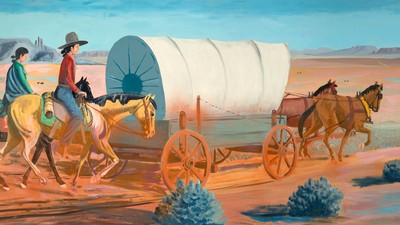
Helen Mayer Harrison and Newton Harrison will visit USU's campus Oct. 18-22. They present a public lecture Oct. 19, 5:30-7 p.m. in the Performance Hall. Seen here is "Tibet is the High Ground Part III: The Force Majeure" by the Harrisons.
SHARE
Comments and questions regarding this article may be directed to the contact person listed on this page.