USU Biochemists Ready to Ascend Utah's Capitol Hill Jan. 29
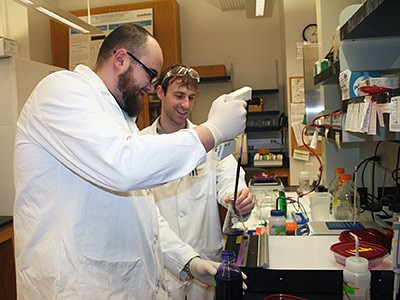
USU biochemistry students Elliot Corless, left, and Mark Stoll are among about 25 Aggies who will present to Utah legislators at 2015 Undergraduate Research Day on Capitol Hill Jan. 29, in Salt Lake City.
Cancers are thought to arise primarily from the accumulation of DNA damage, so understanding how DNA functions, breaks and repairs itself is key to understanding the emergence of malignancies. Utah State University biochemist Edwin Antony leads an active lab of undergraduate and graduate student researchers in investigating enzymatic processes that fuel DNA structure and function.
“In explaining our research, I use the analogy of a car: if you want to fix a car, you have to understand how it works,” says Edwin Antony, R. Gaurth Hansen Assistant Professor of Biochemistry in USU’s Department of Chemistry and Biochemistry.
Two of Antony’s students, Elliot Corless and Mark Stoll, are among about 25 USU students selected to present research to Utah legislators Jan. 29 during the state’s 2015 Undergraduate Research Day on Capitol Hill in Salt Lake City. In the Capitol Rotunda, the biochemists will display posters detailing their respective projects.
Both Corless and Stoll are recipients of USU’s Undergraduate Research and Creative Opportunities — “URCO” ? grants. In Salt Lake City, each will present a unique angle of efforts they’re pursuing in Antony’s Lab. Corless will focus on a protein involved in DNA repair and the changes it invokes when alterations are made. Stoll will detail a project he’s developing to teach concepts he’s learning in Antony’s lab in a more cost-effective and tangible manner to aspiring scientists.
“I take very ‘science-y’ research done by Dr. Antony and his students and convert it into tangible concepts high school students can learn in a laboratory setting,” says Stoll, who graduated from Holliday, Utah’s, Waterford High School in 2009. “My aim is to create a teaching toolkit with 10 easy-to-implement common protein experiments that will cut through the mumbo-jumbo and provide students with real-world experience and help them better understand the scientific principles and concepts.”
The undergrad plans to make the toolkit publicly available through a website.
Corless says participation in undergraduate research has helped him develop a stronger work ethic and time management skills.
“Each time I go into the lab, I have a specific goal,” says the Cache Valley native, who graduated from Logan High School in 2008.
Both Corless and Stoll will graduate from USU this spring; Corless will earn a bachelor’s degree in biochemistry, while Stoll is completing dual degrees in biochemistry and biology. Corless plans to pursue doctoral studies in biochemistry. Stoll plans employment in industry.
“I love small start-up businesses and hope, one day, to become a chief science officer for this kind of venture,” he says.
Related links:
USU Department of Chemistry and Biochemistry
Contact: Edwin Antony, 435-797-1635, edwin.antony@usu.edu
Writer: Mary-Ann Muffoletto, 435-797-3517, maryann.muffoletto@usu.edu
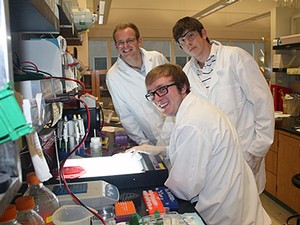
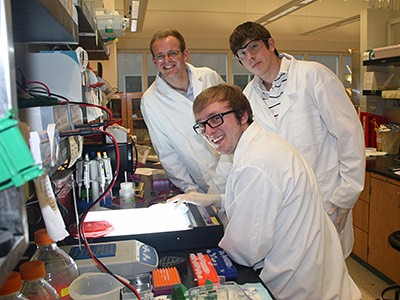
Undergrad researchers, L-to-R, Dan Morris, Matison Rasmussen and Dallas Elder examine results in the lab of Edwin Antony, R. Gaurth Assistant Professor of Biochemistry. The lab investigates enzymatic processes that fuel DNA structure and function.
SHARE
Comments and questions regarding this article may be directed to the contact person listed on this page.