USU Biochemists Report Further Findings on Targeting Cancer-Specific Mutations With CRISPR
R. Gaurth Hansen Associate Professor Ryan Jackson and doctoral candidate Kadin Crosby, in collaboration with a multi-institution, international team of researchers, describe continued discoveries in harnessing CRISPR-Cas12a2 to develop improved cancer therapeutics.
By Mary-Ann Muffoletto |

Ryan Jackson, left, and Kadin Crosby in USU's Department of Chemistry and Biochemistry report continued findings about the potential of CRISPR-Cas12a2 to improve cancer therapeutics in the journal Nature. (Photo credit: USU/M. Muffoletto)
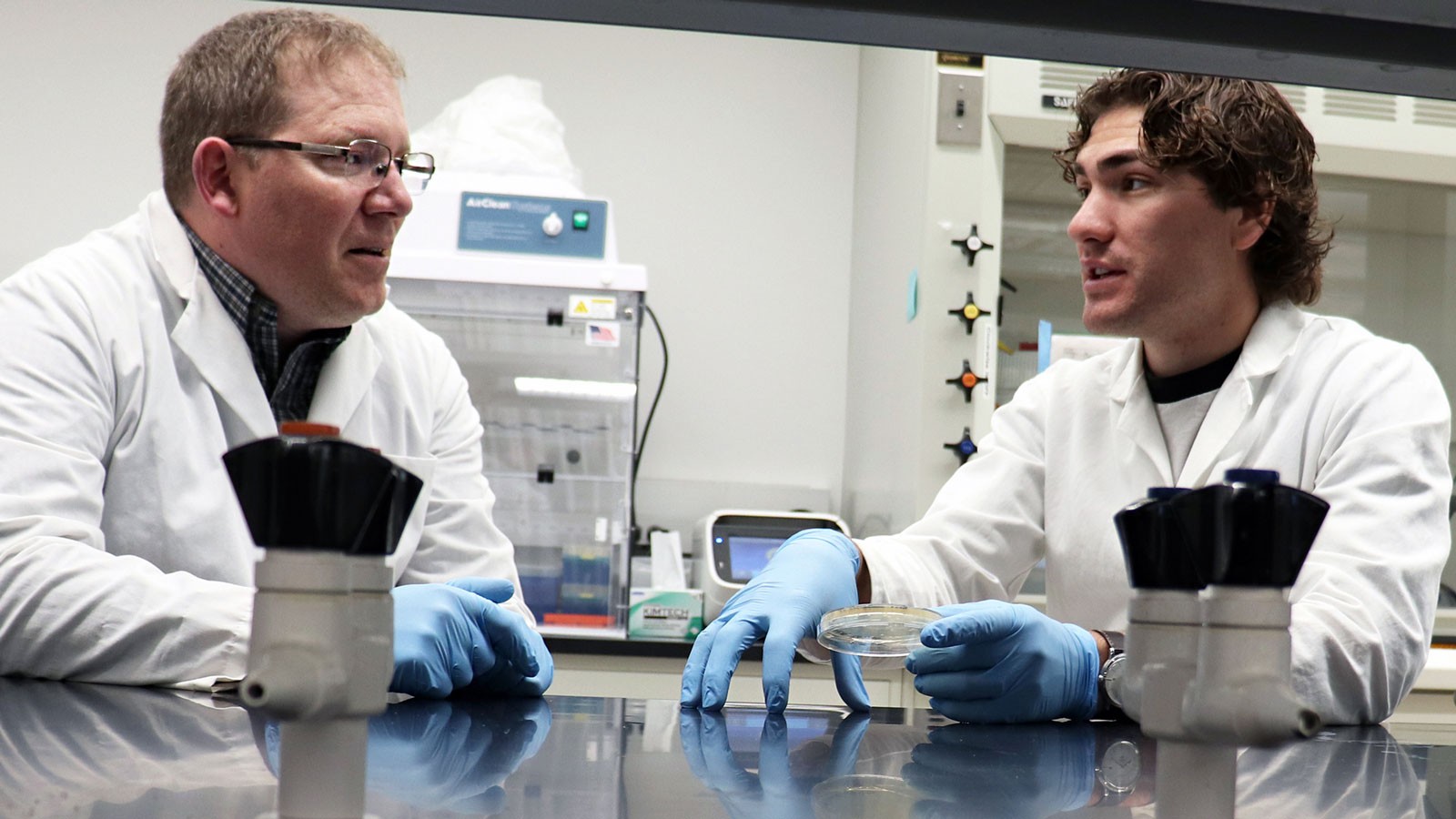
On the heels of breakthrough findings about a lesser-known CRISPR bacterial immune system and its potential for battling cancer, Utah State University biochemists Ryan Jackson and Kadin Crosby report further discoveries about emerging targeted cell-killing technology.
“Our knowledge of CRISPR and its potential for advancing cancer treatments is progressing rapidly,” says Jackson, R. Gaurth Hansen Associate Professor in USU’s Department of Chemistry and Biochemistry. “Our collaborative efforts with scientists around the world are accelerating efforts to understand these potentially powerful therapeutic tools.”
In a paper published May 6 in an online issue of the journal Nature, Jackson, Crosby and colleagues reported CRISPR-Cas12a2 can selectively kill cells containing a cancer-causing mutation, while leaving healthy cells unaffected. In a follow-up, fast-track paper published online June 8 in the same journal, the team describe CRISPR-Cas12a2’s prowess in further detail.
“Genetic mutations that drive cancer often occur in tumor suppressor proteins that current drug therapies can’t reach,” Jackson says. “Our collaborative research demonstrates programmed CRISPR-Cas12a2 can target and reach these ‘undruggable’ mutations.”
He says this technology, called transcript-activated chromatin shedding, provides a new approach to precision drug treatments.
“One of the most vexing challenges of current cancer treatments, as well as other disease treatments, is how do you treat the disease and stop its spread without damaging healthy tissue?” Jackson says. “We all know someone who has suffered ill effects from chemotherapy, radiation or other treatments, as they battled cancer. CRISPR-Cas12a2 provides optimistic hope for the development of therapeutics that will precisely target disease at the cellular level, without inflicting so many debilitating side effects.”
Research institutions collaborating with USU on this research, which is supported by the R. Gaurth Hansen Family and the National Institutes of Health, include:
- The University of Utah.
- Akribion Therapeutics.
- The University of California, San Francisco.
- The University of California, Berkeley.
- Lawrence Berkeley National Laboratory.
- The Francis Crick Institute in London.
WRITER
Mary-Ann Muffoletto
Communications Specialist
College of Arts & Sciences
435-797-3517
maryann.muffoletto@usu.edu
CONTACT
Ryan Jackson
R. Gaurth Hansen Associate Professor
Department of Chemistry and Biochemistry
435-797-1635
ryan.jackson@usu.edu
SHARE
Comments and questions regarding this article may be directed to the contact person listed on this page.