USU Data Interns Make Impact Through Partnership With Salt Lake City Police
By Andrea DeHaan |
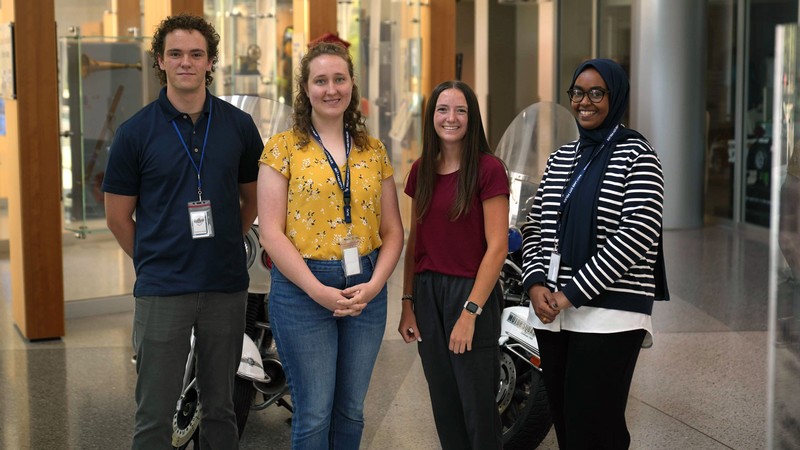
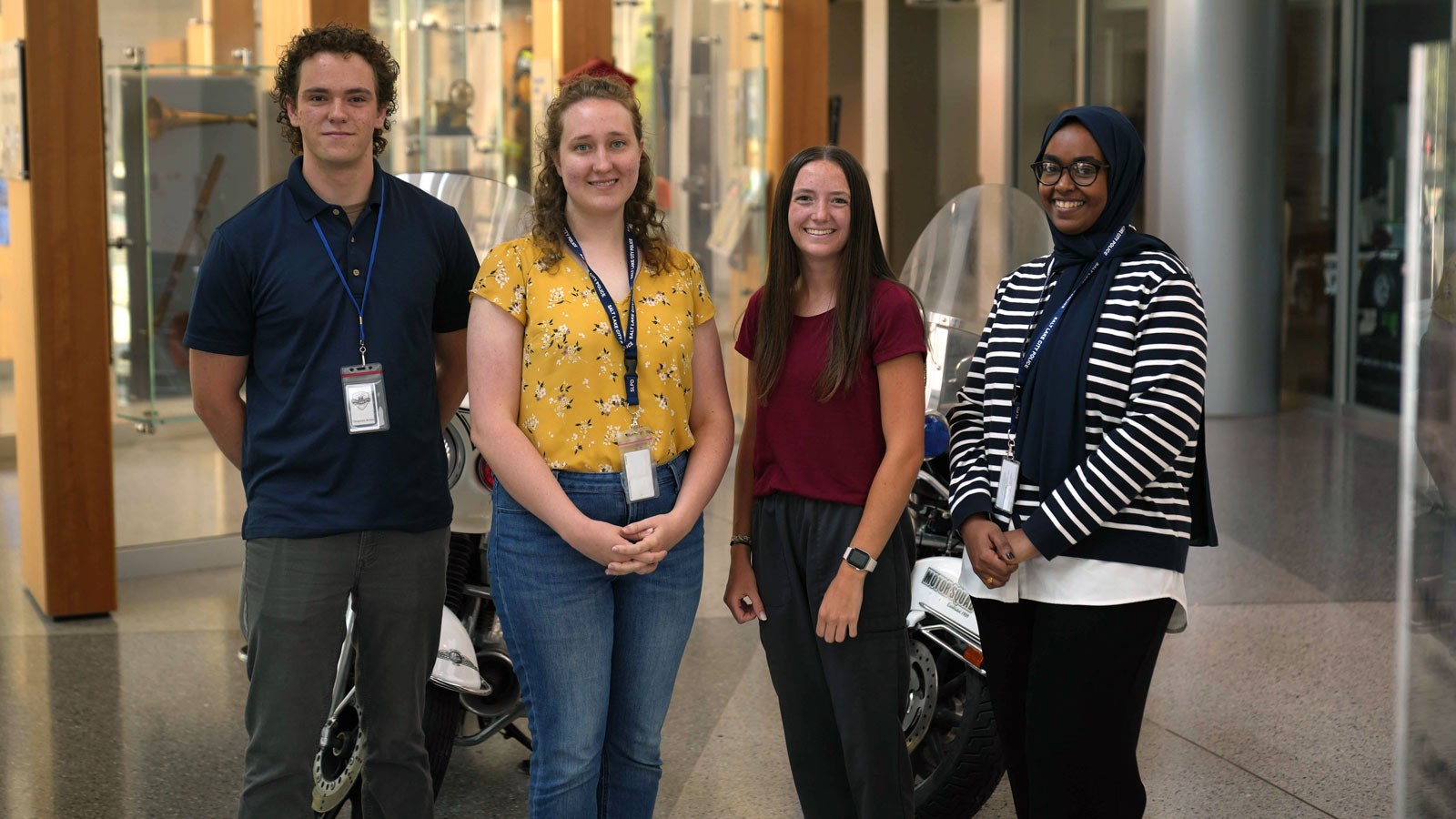
Utah State University students Alexander Sheldon, Emma Jacobson, Kennedy Hunt and Omnia Dafalla pose in the lobby of the Salt Lake City Public Safety Building as part of their summer internship experience. (Photo credit: SLCPD/Greg Lovell)
SALT LAKE CITY — “I wish we could keep them forever,” said Cmdr. Charli Goodman of the Salt Lake City Police Department’s Support Division.
Goodman is working with student interns participating in a pilot project between the SLCPD and Utah State University. This summer, four interns — three from the university's College of Arts and Sciences (ArtSci) — were selected to be part of the new program, which saw USU students assigned to support four distinct SLCPD units.
Calling the program “so great and so needed,” Goodman said she is “hoping we can continue something like this in the future.”
Students Emma Jacobson, a master’s student in the statistics program, and undergraduate Alexander Sheldon, an information systems student in the Jon M. Huntsman School of Business, were assigned to projects overseen by Goodman, whose own purview extends to officer training and compliance.
Jacobsen is applying skills used at the Vernal campus to build air quality dashboards to help Goodman and her colleagues understand the data collected by patrol cars. Her project involves creating a safety dashboard to analyze speed data and routes taken, especially when officers are traveling at high speed (above 90 miles per hour).
“Looking at these trends in a different program” — Power BI — is a “good learning opportunity,” Jacobsen said.
She’s been staying with family in South Jordan to make travel to her first-ever internship easier.
The USU-SLCPD internship program is the result of collaboration between ArtSci’s Internship Hub and the Institute of Government and Politics. Representatives from both recently traveled to Salt Lake to observe this summer’s interns in the workplace.
Lt. Robin Hartney said the program has been good for the department. Hartney serves as Chief Brian Redd’s executive assistant and accompanied USU’s representatives during the site visit. She said that while similar internship programs exist within the police force, this one was unique, both in terms of areas served and the duration.
Sheldon is helping Goodman’s team ensure compliance within their benchmark program — tracking required qualifications, compiling scores and ensuring competencies are met within a specified timeline.
Another student, Kennedy Hunt, is assigned to the crime lab where, according to Evidence Unit Supervisor Hayley Takoch, the SLCPD stores more than 300,000 pieces of evidence.
“I don’t really know what I expected,” said Hunt, who is interested in someday working for the Federal Bureau of Investigation.
A statistics major minoring in math and earning a certificate in applied geographic information science, Hunt has been helping the police identify and properly dispose of evidence no longer requiring storage.
“Because we have you handling evidence, everyone who comes through this building requires a background check,” Takoch said, describing the onboarding process — all interns were required to go through background checks.
Hartney and others said they hope to start the process even earlier next year to maximize time with the students.
USU student Omnia Dafalla is assigned to SLCPD’s Central Precinct, where she is helping people like Detective Marie Stewart with community policing initiatives. During the site visit, Dafalla described helping with a web-based online reporting system where residents could share concerns and lodge noise complaints, as well as planning a block party designed to build relationships between the police and those living and working near the Regent Street precinct.
“She’s just jumped right in,” said Stewart, who also wished they could keep Dafalla in place permanently.
Not all the students had previously imagined themselves in a police setting, but all agreed that the experience this summer was a meaningful one.
“I’m really glad I took [the internship],” Sheldon said. “I had an inclination towards government but never really thought about a police department. They need data people too.”
Arts and Sciences is also home to USU's Criminal Justice program, which is already partnering with the SLCPD on leadership training for their officers, so this summer’s cadre of data science interns built upon existing relationships while serving as a reminder that durable skills are needed across all industries.
According to John Stevens, department head for Mathematics and Statistics, a famous statistician, John Tukey, once said that the best thing about being a statistician is that you get to play in everyone’s backyard, in the sense that data skills apply to so many fields.
Stevens, who also acted as the USU supervisor for the students, said: “What’s impressive about these interns’ experiences is that they are doing much more than just playing; they are having a real impact with the SLCPD. We always tell students the practical value of what we teach in the classroom, and this kind of field-based experience really solidifies that while benefiting the community. It’s a win-win-win scenario.”
WRITER
Andrea DeHaan
Communications Manager
College of Arts & Sciences
435-797-9947
andrea.dehaan@usu.edu
CONTACT
Brittney Skye
Internship Specialist
College of Arts and Sciences
brittney.skye@usu.edu
SHARE
Comments and questions regarding this article may be directed to the contact person listed on this page.