USU Researcher Lands Air Force Grant to Build Smarter Antenna
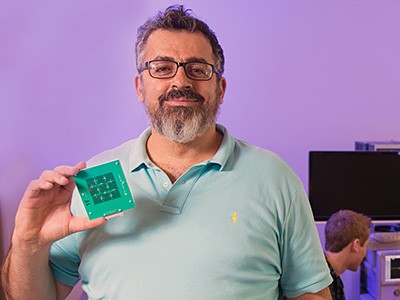
USU associate professor of electrical and computer engineering Bedri Cetiner is developing new ways to control multifunctional reconfigurable antennas, or MRAs. These 'smart antennas' use less energy and receive signals more efficiently.
All the amazing functions of your smart phone or tablet would be useless without the tiny antennas inside that receive and transmit information.
Despite their modern design and capabilities, today’s antennas aren’t nearly as smart as the devices they power. But a researcher at Utah State University’s College of Engineering is trying to change that with new research aimed at making antenna technology work smarter.
“As the demand for higher communication capacity keeps increasing with frantic pace, antennas with more advanced functionality and adaptability are needed,” said Bedri Cetiner, an associate professor in the department of Electrical and Computer engineering, who is revolutionizing the way antennas function.
Cetiner says antennas perceive the world much like our eyes do — able to scan in all directions for whatever catches their attention. But unlike our eyes, an antenna cannot fixate on a particular signal coming from one direction. Instead, it spends its energy actively listening for anything it can pick up.
Because different types of signals have different characteristics, Cetiner and his team are working to develop antennas that can physically adapt themselves to more efficiently detect signals.
These multifunctional reconfigurable antennas, or MRAs, can adapt on the spot to better detect a signal’s direction, frequency and polarization — or shape. Cetiner says the design is inspired by the skin of a chameleon — capable of changing its color in response to environmental cues.
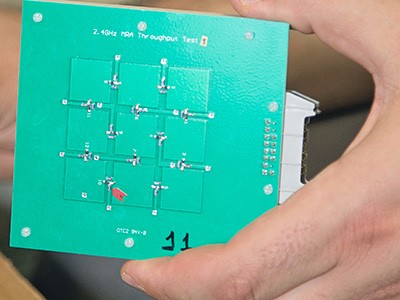
These reconfigurable antennas are made up of multiple elements that are connected to each other via tiny switches. Depending on which switches are turned on or off, the array of elements can take on a different shape, giving it the dimension it needs to better detect a signal.
In January 2015, Cetiner received a $1 million grant from the U.S. Air Force Office of Scientific Research (AFOSR) to design better algorithms that control the MRAs. In time, he hopes to develop antenna systems that are built into a flat surface that can be mounted, for example, to the side of an aircraft or the top of a police car.
This “smart skin” technology would eliminate the need for multiple antennas that serve different functions.
“Smart antennas determine the signal properties and adapt their functionalities to better receive a certain signal,” adds Cetiner. This allows them to use much less power, and makes the entire system more efficient.
“This ultimate switchless MRA will itself respond to the changes in the channel by morphing its architecture and changing the material properties such as conductivity and dielectric permittivity in order to maintain optimum performances in all operational environments,” said Cetiner. “In other words, the intelligent algorithm for the Chameleon Antenna is a built-in algorithm in the smart material properties.”
To realize such a sophisticated antenna system, researchers with diverse backgrounds of wireless communications and material sciences are working together in Dr. Cetiner’s research group.
Related links:
USU Department of Electrical and Computer Engineering
Contact: Bedri Cetiner, 435-797-3320, bedri.cetiner@usu.edu
Writer: Matt Jensen, 435-797-8170, matthew.jensen@usu.edu
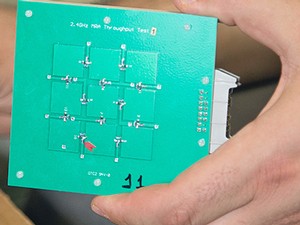
The tiny elements inside this reconfigurable antenna can be turned on or off, giving the array a different configuration and allowing it to more efficiently receive certain signals.
TOPICS
Grants 281storiesSHARE
Comments and questions regarding this article may be directed to the contact person listed on this page.