USU Social Scientists Among Authors of Great Salt Lake Report Highlighting Growing Risks
The multi-university GSL Social Science Network releases a first review of social science research examining social, cultural, political and economic dimensions of Utah's iconic saltwater lake and its challenges.
By Mary-Ann Muffoletto |

An image of the Great Salt Lake, captured by the NOAA-20 satellite on June 22, 2026, shows outlines of the shrinking lake, with wildfires on its western border. (Image credit: NOAA)
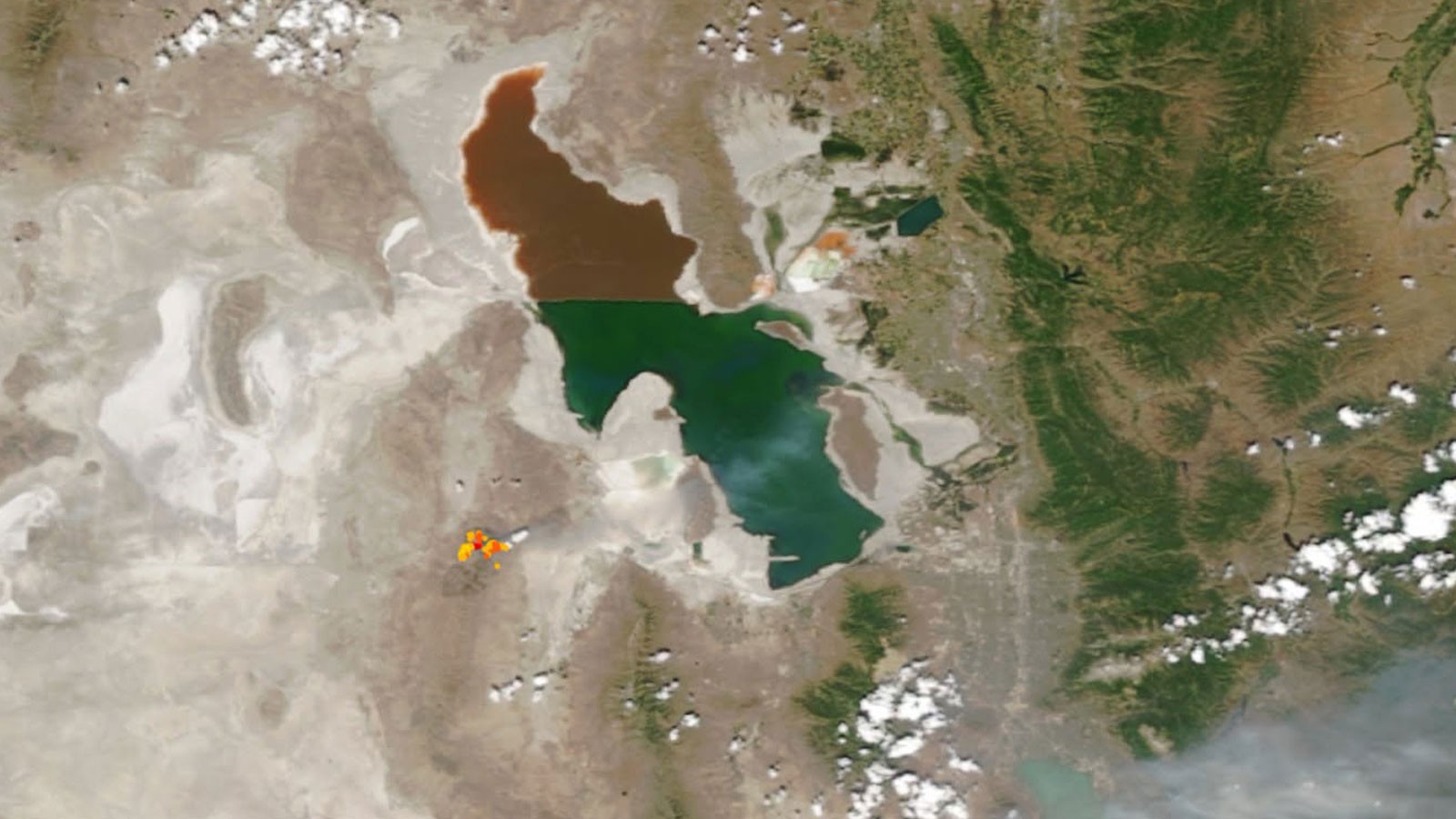
LOGAN, Utah — Utah’s Great Salt Lake, the largest saltwater lake in the Western Hemisphere, faces an uncertain future as its water levels reach record lows.
Researchers from the multi-university Great Salt Lake Social Sciences Network based at Utah State University have released the “2026 Report on the State of Great Salt Lake Social Science.” The report, whose authors include USU undergraduates, graduate students and faculty, provides a first review of social science research examining social, cultural, political, and economic factors affecting the lake and its stakeholders.
Among the growing risks posed by the shrinking lake are its worrisome effects on air quality, public health, and the surrounding economy, along with its impact on environmental conditions for the upcoming 2034 Winter Olympic Games hosted by Utah.
“When we talk about Great Salt Lake, especially as desiccation introduces rapid and large-scale shifts, we’re also talking about the people and communities connected to it,” said Shae Barber, GSL SSN co-director and doctoral student at York University. “Social science helps us understand how people experience environmental change, what they value about the world around them, and what kinds of solutions they support to build a more sustainable future.”
Barber and fellow authors of the report share how social scientists are studying the lake and addressing issues that affect it, along with compiling recommendations for future research.
“We are thrilled to showcase the importance of social science research on Great Salt Lake, bringing attention to issues of concern for the public, and being able to better connect the public, social scientists, and social science research to policymakers and non-government organizations working to solve issues related to the lake,” said Stacia Ryder, GSL SNN co-director and assistant professor in USU’s School of Social Sciences, who is among the report’s authors. “We encourage report readers to reach out to members of our network who are exploring questions of interest to the lake’s stakeholders. Together, we can foster further impactful social science research as we seek solutions for Great Salt Lake and Utah.”
The report points to growing awareness by Utah residents of issues related to the drying of Great Salt Lake, a strong public attachment to the lake and increasing willingness to change behavior in ways to benefit the lake, including water conservation.
“We note, in the report, that addressing risk associated with desiccation will require a coordinated effort from individuals, communities, and the government,” Ryder said. “The Utah legislature has made policy changes and financial contributions to benefit the lake, and social science research suggests the public would like to see even more action from our legislators.”
She says the upcoming Olympic Games and the proposed Stratos data center project have focused more national and global attention on the lake, and each warrant further study.
“A degraded lake impacts snow, air quality and Utah’s image, as the world focuses on the state’s iconic lake and its reputation as a winter sports destination,” Ryder said.
Barber says Great Salt Lake’s future depends on choices made today.
“We know from our research that Utahns care deeply about the lake and are willing to be part of the solution,” they said. “We hope this report can inform policy, research, and meaningful action to protect the lake now and for generations to come.”
In addition to Barber and Ryder, authors of the report are:
- Creed Jones, undergraduate GSL SSN research assistant at Utah State University.
- Avyrlie Smith, undergraduate GSL SSN research assistant at Utah State University.
- Mufti Nadimul Quamar Ahmed, doctoral candidate at Utah State University.
- Georgie Corkery, coordinator, Great Salt Lake Institute at Westminster University.
- Jennifer Givens, associate professor, School of Social Sciences at Utah State University.
- Anna McEntire, managing director, Janet Quinney Lawson Institute for Land, Water, and Air at Utah State University.
- Carla Trentelman, professor emerita of sociology at Weber State University.
- Jessica Ulrich-Schad, professor, School of Social Sciences; director, Community and Natural Resources Institute at Utah State University.
- Kirsten Vinyeta, assistant professor, School of Social Sciences at Utah State University.
- Bryn Watkins, doctoral student at University of Georgia.
Established in 2025, GSL SSN is an international network of researchers aimed at fostering interdisciplinary collaboration across institutions toward improving research outcomes on GSL. The network, hosted by USU’s Community and Natural Resources Institute in the College of Arts and Sciences, includes 34 members from 11 universities and institutions.
WRITER
Mary-Ann Muffoletto
Communications Specialist
College of Arts & Sciences
435-797-3517
maryann.muffoletto@usu.edu
CONTACT
Stacia Ryder
Co-Director | Assistant Professor
Great Salt Lake Social Sciences Network | School of Social Sciences
stacia.ryder@usu.edu
SHARE
Comments and questions regarding this article may be directed to the contact person listed on this page.