USU Student Researchers Go Weightless
Editor’s Note:USU student journalist Anike Pullens, an undergraduate public relations major, accompanied Utah State’s Get Away Special student space research team to Houston’s Johnson Space Center to participate in NASA’s Microgravity University. Pullens offers an account of the students’ adventure as they conducted an innovative heat transfer experiment aboard the space agency’s microgravity aircraft.
A small group of Utah State University students experienced weightlessness when they traveled down to Houston, Texas, on June 1, to conduct an experiment on NASA’s Zero Gravity aircraft.
“Zero Gravity was so weird,” said Jenica Sparrow, a freshman on USU’s Get Away Special Team. “It was almost like swimming in a pool, but even more drastic. The first time, I almost felt like I was blacking out.”
For the second year in a row, the GAS team was invited aboard NASA’s ‘Weightless Wonder’ to carry out research. The Weightless Wonder is a plane that generates zero-gravity by moving in parabolic paths. Zero-g kicks in on the decline, when the plane nose dives at a 45-degree angle.
Stationed at the Johnson Space Center in Houston, Texas, NASA’s Reduced Gravity Education Flight Program, also known as “Microgravity University,” offers this unique opportunity. Students are able to board the same aircraft that astronauts use for training and that Hollywood uses in movies like “Apollo 13.”
The Reduced Gravity Education Flight Program was founded in 1995 by aircraft operations manager George Abby in an effort to mimic similar European space agencies’ programs. Colleges and universities from 49 of 50 states — Delaware would be the 50th — as well as the District of Columbia and Puerto Rico, have participated in the flight program and experienced zero gravity.
“When you sit in a classroom and read a book, that is a good knowledge base but that doesn’t give you a real world experience,” said Sara Malloy, lead program coordinator for Microgravity University. “RGEFP offers just that.”
This year, USU was selected among 13 other colleges and universities across the nation from a total of 65 proposals submitted. The GAS team’s $8,000 project is called “Follow-Up Nucleate Boiling On-Flight Experiment” or FUNBOE 2.0. It is an enhanced version of the experiment that USU’s GAS team flew aboard the Space Shuttle Endeavour in 2001 and last year’s FUNBOE that the team conducted in microgravity.
FUNBOE 2.0 studies the transfer of heat through boiling.
“Basically, the experiment looks at some of the fundamental parts of a system that affect boiling water in microgravity on thin wires and our little 2D chips,” said Troy Munro, graduate student and team leader, who graduated from USU this past spring with a degree in mechanical engineering. “The ultimate objective is to find the best heating element for heat transfer.”
It is vital to test in zero-g, he said, because it would produce more accurate research.
“Gravity is a factor in boiling — hot bubbles go up, cool water goes down — and so testing without it makes the data we collect relevant to space application, where gravity is not a factor,” said Ryan Martineau, a junior on the GAS team. “If FUNBOE is tested successfully, future technology could be improved significantly.”
As long as mankind wishes to continue to explore space, the need for a more cost-effective and reliable thermal management systems will be on a rise and this research will enable scientists and engineers to design those more advanced systems applied in space.
“It is a very ambitious experiment,” Martineau said. “It is carried out primarily by undergraduate students. It contains ideas that have not been specifically tested or tried. We're not just verifying, we're trying something new to see if it can help improve current heat transfer models and designs.”
“For a complex and new kind of study, the experiment went beautifully,” said sophomore Matt Wallace. “Everything worked and we have enough data to keep us busy for quite awhile.”
Related links:
- Watch members of USU’s 2011 GAS Team sing Utah State’s fight song, ‘The Scotsman,’ in microgravity.
- USU Get Away Special Team on Facebook
- NASA Microgravity University
- USU College of Science
- USU College of Engineering
Contact: Troy Munro, 801-558-4780, troy.munro@aggiemail.usu.edu
Writer: Anike Pullens, 801-608-2789, anike.pullens@aggiemail.usu.edu

USU students, from left, Landon Hillyard, Jenica Sparrow and Ryan Martineau float in zero g aboard NASA's microgravity 'vomit comet’ jet. The team conducted an innovative heat transfer experiment in weightlessness. Photo by James Blair, NASA.
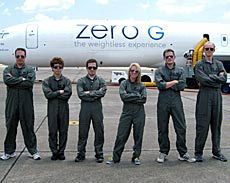
Suited up and ready, from left, USU students Matt Wallace, Iggy Matheson, Troy Munro, Jenica Sparrow, Landon Hillyard and Ryan Martineau on the tarmac at Houston's historic Ellington Field, training site of NASA astronauts. Photo by Anike Pullens.
SHARE
Comments and questions regarding this article may be directed to the contact person listed on this page.