USU Veterinary Medicine Students Practice Skills With Actors, Stuffed Pets in Diagnostic Challenge
By Nadia Pflaum |


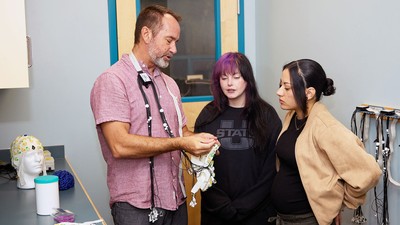
Second-year students in the College of Veterinary Medicine at Utah State University took a simulated step into the future this week, hosting veterinary clinic appointments with professional actors posing as clients, and their ailing animals of the stuffed variety.
“This was Austin,” Xander Hemmert says, holding up a tiny, grey-striped toy shaped like a cat. “He was our case for the week. He came to us on Monday, not feeling too well, having a bit of difficulty breathing.”
The weeklong Diagnostics Challenge sets up groups of veterinary students with true-to-life cases, as chosen by faculty, of animals whose condition requires correct diagnosis, course of treatment and even a payment plan for the client. Students use what they’ve learned about anatomy, physiology and histology to pick up clues from the patient, as well as what they’ve been taught about empathetic listening and communicating with the patient’s human counterpart.
“Throughout the week, we learned more and more about the case and the client,” Hemmert says. “The meeting rooms have been really cool because they give us the opportunity to speak with our clients, a realistic environment as if we were in practice, and our facilitators are able to watch us and give us feedback.”
Students meet their clients and their animal patients in rooms at the Eccles Early Learning Education Center with two-way mirrors, where the interaction can be observed by veterinarian facilitators watching from the other side of the glass. Those facilitators meet with the student groups after their initial client interview and give them facts about their case that would have been discoverable through a physical exam with a real animal. They may be given lab results, like the results of bloodwork, among other clues to try to work out what’s going on with their patient.
The students confer with each other and research the problem with the information they’ve collected and, with a facilitator, diagnose their animals. Then, they have another visit with the client to go over a course of treatment, as well as any follow-up or continuing care that the owner needs to provide.
“Austin ended up having highly pathogenic avian influenza, or H5N1 bird flu,” Hemmert says. “Now, the family is able to start taking precautions to prevent this from happening and infecting themselves or infecting their chickens that they have in their backyard.”
Finally, students are expected to come up with a bill and discuss payment options with their clients, which can get tricky.
Barbara Troisi, who for over 10 years has been helping the Diagnostic Challenge by serving as a client in simulations, says she likes to ask the students for a senior discount.
“That really throws them for a loop,” she laughs.
This interactive exercise is part of the curriculum at Washington State University’s veterinary medicine program, where these students will finish the last two years for their degree. Because this is USU’s last remaining class with the Washington-Idaho-Montana-Utah (WIMU) program, a partnership ending with graduation in 2028, this is the last Diagnostic Challenge USU students will face in this format.
The faculty of USU’s college are integrating this model into its own curriculum, as the four-year doctor of veterinary medicine degree program is now underway.
“It was a great learning opportunity,” Hemmert says. “The science is fascinating, and knowing that I can provide care for patients and their families while also having a fulfilling job for myself is really valuable for me.”
WRITER
Nadia Pflaum
Public Relations Specialist
College of Veterinary Medicine
nadia.pflaum@usu.edu
ADDITIONAL RESOURCES
SHARE
Comments and questions regarding this article may be directed to the contact person listed on this page.