Woad Warrior Mapping Weeds with a Mountain Bike

Utah State University Department of Plants, Soils and Climate faculty member Corey Ransom has one of those "ah-ha" moments after watching a mountain bike video produced using helmet-mounted cameras. He noticed he could identify certain wildflowers even as the bike passed by them at high speeds.
There is hardly a recreation area anywhere in the world where you won’t find someone with a camera attached to their body or helmet. Most of these people are trying to capture their adventures for fleeting fame on social media. Corey Ransom is trying to capture weeds.
Ransom, a Utah State University weed scientist in the Department of Plants, Soils and Climate, was watching a mountain bike video produced using helmet-mounted cameras when he noticed he could identify certain wildflowers even as the bike passed by them at high speeds.
“I thought we might be able to adopt this technology to map invasive species,” he said. “We chose to try it out on dyer’s woad because it is a bright color in the spring and it is a prominent invasive species in Utah.”
The importance of mapping invasive species is that by knowing where they are, you can better form your plan of attack, Ransom said. His research team has collaborated for many years with the Forest Service helping to conduct weed inventories. The agency works to control weeds on wild lands because they displace plants that wildlife depend on, can increase the danger of wild fires and encroach on agricultural land and cut crop production. Cameras mounted on bike helmets looked like a faster, more efficient way to collect the data. By using fewer man hours on the ground, agencies would have more resources to actually treat and try to control the invasive species.
“The system we chose includes two GoPro cameras pointing out to the sides of a bike helmet to get a wider perspective,” Ransom said. “We collect video data along with GPS tracking data. We then put both of these into mapping software.”
The next modifications the researchers had to incorporate were stabilizing gimbals so that when the biker moves his head or the trail gets bumpy, they video remains smooth, he said.
“This technology would have cost tens of thousands of dollars a decade ago, but now we can do this for only a few thousand dollars,” Ransom said.
The scientist said he has been doing a lot of the riding himself to test the system but envisions eventually handing it off to mountain bikers at trailheads and asking these citizen scientists for their help collecting data.
A video discussing Ransom’s work and this project is posted online.
Related links:
USU Department of Plants, Soils and Climate
USU College of Agriculture and Applied Sciences
Contact: Corey Ransom, 435-797-2242, Corey.Ransom@usu.edu
Writer: Dennis Hinkamp, 435-760-0926
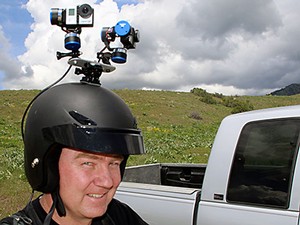
Helmet and cameras in place, Ransom has been testing the system himself.
TOPICS
Bikes 23storiesSHARE
Comments and questions regarding this article may be directed to the contact person listed on this page.