Year Round Educational Programs
Rightly or wrongly, university researchers are often accused of staying holed up in their ivory towers and rarely venturing into "the real world." But Afifa Sabir, education coordinator for Utah State University's Center for Integrated Biosystems, knows that partnerships with public schools, industry and other research universities are vital to continued growth and progress.
To that end, Sabir maintains a robust, year round schedule of educational programs geared to high school students, public school teachers, university researchers and life science professionals.
"The strength of our center depends on developing relationships within the university as well as in the community and with industry," says Sabir. "We also need to continually cultivate and recruit quality students and that starts long before a student enrolls in college."
For the past five years, the CIB has offered an intensive five-day Summer Biotechnology Academy to provide high school juniors and seniors with the opportunity to experience cutting-edge research on a university campus. More than 100 budding scientists have passed through the academy's doors, working one-on-one with faculty mentors in such disciplines as chemistry and biochemistry; biology; animal, dairy and veterinary sciences; biotechnology and genomics; food and nutrition sciences; biological and environmental engineering; and plant and soil science.
Undergraduate Katherine Grover, a biology major, attended the summer biotech academy between her junior and senior years of high school.
"I wasn't really interested in science until I took high school biology and I wasn't really sure about Utah State," said Grover. "But once I attended the academy and saw what the university had to offer, I was really excited. I was hooked."
Grover, who received both a presidential scholarship and an undergraduate research fellowship, currently works as a lab technician in the CIB performing genome sequencing. Following graduation from USU she plans to pursue graduate work in medical research.
Undergraduate biology major Uyen Lam also made her first foray into lab research as a high school student at the CIB's summer academy.
"I was already looking at going to Utah State," said Lam, who graduated from Logan High School in 2004. "But the biotech academy taught me what research was. I enjoyed the lab environment."
An aspiring physician, Lam completed a high school internship at a local pediatric practice. She also volunteers in the emergency room at Logan Regional Hospital, where she cleans exam rooms, transports patients and assists the nursing staff. Her busy schedule includes working on campus in biology professor Joseph Li's lab, where she assists graduate students who are researching the Blue Tongue Virus.
"They're training me on various lab techniques and I’m helping them with their projects," said Lam, who received a presidential scholarship and an undergraduate research fellowship, as well as a multicultural fellowship offered through a program jointly administered by the CIB and USU's Multicultural Student Services office.
Lam believes her undergraduate research experience will aid in her quest to attend medical school.
"I think undergraduate research is very important," she said. "Med schools don't even look at your application if you don't have research experience."
An active member of USU's Asian-American Club, Lam said she wants to do outreach with other multicultural students to make them aware of undergraduate research and scholarship opportunities offered at Utah State.
"I want to let them know about scholarship opportunities that are available and that getting research experience will help them on their resumes," said Lam. "(Dr. Sabir) and the other professors were great resources for me and helped me get settled on campus."
After reviewing this past summer's biotech academy activities, Lam said she was impressed with the advanced techniques participants studied over previous years.
"I was in the biotech academy just two years ago and I would have liked to have learned what this past year’s students did when I was their age."
For more information about educational programs offered by the Center for Integrated BioSystems, visit its Web site.
Writer: Mary-Ann Muffoletto, 435-797-1429, maryann.muffoletto@usu.edu
Contact: Afifa Sabir, 435-760-3767, afifa@cc.usu.edu

Dr. Afifa Sabir (far right), education coordinator for the Center for Integrated BioSystems, guides high school students in lab techniques.

Biology undergraduates Katherine Grover (left) and Uyen Lam were both initiated into lab research as high school attendees of the CIB’s summer biotech academy.
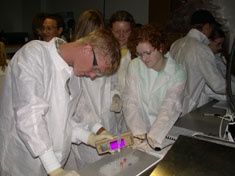
Biotech academy participants Kyle Haywood of Morgan (left), Priscilla Thompson of Fillmore, and Sarah Nelson of Las Vegas, use a black light to observe green fluorescent protein.
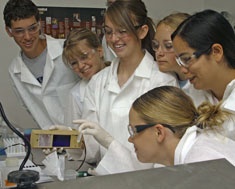
Participants in the CIB's 2005 summer biotech academy came from high schools in Utah, Idaho, Nevada and Wisconsin.
SHARE
Comments and questions regarding this article may be directed to the contact person listed on this page.