$1.6M DOD Grant Enables Researchers to Expand Digital Mental Health Support for Dementia Caregivers
By Jennifer Payne |

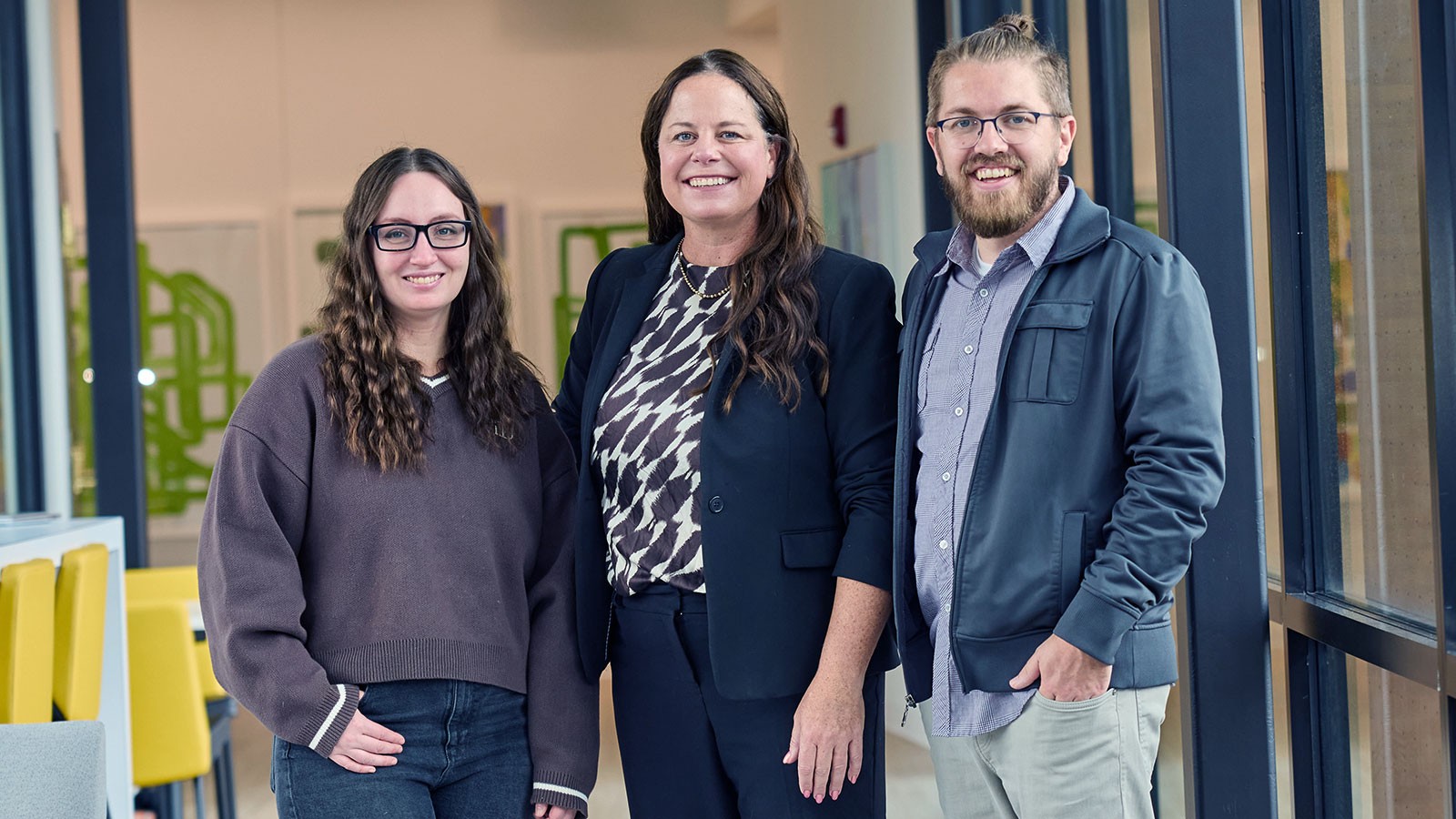
Heather Kelley, Beth Fauth, and Ty Aller.
For more than 11 million Americans who provide unpaid care for a loved one living with dementia, the daily emotional, mental, and physical demands can feel overwhelming. Among them are hundreds of thousands of active-duty service members, military spouses, and veterans who carry the heavy responsibility of dementia caregiving.
To help meet this critical need, an interdisciplinary team of researchers across the Emma Eccles Jones College of Education, Health, and Human Sciences has secured a $1.6M grant from the U.S. Department of Defense to expand accessible digital mental health interventions tailored specifically for family members caring for a loved one with dementia.
Individuals supported by this program may include veterans and military families, but the program also supports civilian family caregivers who feel some kind of distress from their caregiving role. The project also provides brief online mental health training for the person living with dementia.
Led by Beth Fauth, professor and director of the state-funded Alzheimer’s Disease and Dementia Research Center, the DOD-funded project builds on years of clinical research that adapts Acceptance and Commitment Therapy to support dementia caregivers. ACT is a form of psychotherapy that uses acceptance, mindfulness, and values-based strategies to promote mental health and psychological flexibility. The initiative aims to make evidence-based mental health support accessible to families across the country.
“Traditional caregiver interventions do a wonderful job of teaching skills and disease management, and support groups are very valuable, but a lot of caregiver programs cannot actively build skills to teach caregivers how to cope with the emotional and psychological toll more effectively,” Fauth said. “By supporting this project, the DOD is helping us evaluate whether an online, self-guided therapeutic tool can help dementia caregivers with their emotional health as well as their physical health behaviors and relationships. We also use a brief version of the tool to help the person living with dementia manage their own stress, if they are able to participate.”
ACT for Caregivers directly addresses the emotional burden on caregivers. Rather than trying to eliminate stress — which is often impossible — the intervention teaches caregivers how to live alongside it. Participants learn skills to notice and accept difficult thoughts and emotions, clarify their personal values, and take meaningful action even in the presence of ongoing hardship.
“It’s not about making the stress go away, because for someone providing love and care to someone with dementia, it is a difficult role to be in even with support and resources,” Fauth said. “Our program is designed to teach skills to help caregivers live with their stressful situation more comfortably.”
Delivering the program as a self-guided digital mental health intervention removes barriers for caregivers who cannot easily leave home, afford traditional therapy, or find time for clinic visits.
The newly funded initiative brings together expertise across several departments and centers within the college.
Fauth oversees the project’s caregiving application and serves as the intervention lead.
Michael Levin from the Department of Psychology helped repackage the traditional therapist-delivered ACT into a self-guided digital format.
Community engagement is directed by Ty Aller and Heather Kelley, both researchers for the Center for Mental Health Promotion within the Institute for Disability Research, Policy & Practice.
A key aspect of this proposal is including people with lived experience in dementia, caregiving, the military, or rural contexts, and the IDRPP’s expertise in working with people living with chronic conditions and caregiving for someone are critical to the success of this project.
Senior researcher Alyson Ward and the Tailored Research, Evaluation, and Continuous Improvement team at the IDRPP will evaluate program outcomes.
To ensure the self-guided intervention resonates with caregivers, including military and veteran families, the Center for Mental Health Promotion is embedding teams of caregivers and community stakeholders directly into the project to guide how the intervention is shaped and delivered.
“We need people from those communities informing us on what works best,” Aller said.
Community partners include the University of Massachusetts Boston and the University of Alaska Anchorage because each group has military family networks. Also, a Utah-based active-duty veteran, Mike Spencer, is contributing his military and dementia-support experiences to lead the community stakeholder panel, building an essential connection between research projects and people with lived experience.
As the study moves forward, the team’s goal is to establish a resource that clinics, veterans’ service organizations, and family networks can rely on long after the grant concludes.
“It’s amazing what this program can do for both caregivers and individuals with dementia,” Kelley said. “In our pilot work, I’ve interviewed folks who have called the program ‘life-changing’ and reported real improvements in their quality of life. This grant will allow us to get this program to more individuals and families who need the support.”
Aller added: “We hope families and community partners come away knowing that real, effective supports exist for veterans and for all dementia caregivers. They are cost-effective and they can reach people in diverse locations.”
WRITER
Jennifer Payne
Emma Eccles Jones College of Education and Human Services
Public Relations Specialist
jen.payne@usu.edu
CONTACT
Alicia Richmond
Director of Public Relations & Marketing
Emma Eccles Jones College of Education, Health, and Human Sciences
alicia.richmond@usu.edu
TOPICS
Research 1179stories Grants 283stories Wellness 220stories Mental Health 114stories Disease 61stories Alzheimer's Disease 42storiesSHARE
Comments and questions regarding this article may be directed to the contact person listed on this page.