Aggies Share 'Out of this World' Holiday Cheer
It’s beginning to look a lot like you-know-what with the usual lights, tinsel and ubiquitous candy canes adorning trees, storefronts and street corners. Bah, humbug! Utah State University students are adding some extraterrestrial pizzazz to a Salt Lake tannenbaum to share Aggie-infused holiday cheer with a statewide audience.
Members of USU’s Microgravity Research Team have created an ornament for KSL-TV’s Studio 5 Community Christmas Tree with a hint of space wonder. The student group, formerly known as “The Get Away Special” or “GAS” team, designed the ornament using parts from student-built experiments flown on past space shuttle missions.
The Aggie-blue globe, which sports the university’s wordmark and an orbiting satellite, is featured on the Studio 5 television program’s Friday, December 15 broadcast at 11 a.m. The ornament will remain on the program’s community Christmas tree, a focal point for Studio 5 viewers, during the month of December.
Utah State's renowned expertise in space research, along with the university's Space Dynamics Laboratory, has earned USU the nickname, Utah "Space" University. USU leads the nation in university space research funding, besting such prestigious research institutions as Johns Hopkins University and Massachusetts Institute of Technology. See related article.
Efforts by Utah State’s Get Away Special/Microgravity Research Team—now known as “MRT” —have led to USU sending more student-built experiments into space than any other university in the world. The interdisciplinary program fuses students’ diverse interests and talents into exciting team-building ventures.
As NASA’s mission evolves and private space endeavors increase, so too, is MRT exploring new opportunities in space and atmospheric research. Current projects include design and construction of a Sputnik CubeSat (a 10 cm x 10 cm x 10 cm satellite) in preparation for the 50th anniversary of the first Sputnik space missions in 2007. (Sputnik 1, the first artificial satellite, was successfully launched into orbit by the former Soviet Union on October 4, 1957. Sputnik 2, carrying Laika the dog, was launched on November 3, 1957.)
“Our plan is for our Sputnik CubeSat to broadcast Sputnik’s original message, plus something about Utah State,” says MRT team member Steve Berkley, an undergraduate mechanical engineering major.
Also on MRT’s agenda is providing future lunar astronauts—NASA plans a four-astronaut moon landing in 2020—with the means to freely move about the moon’s surface. Mechanical and aerospace engineering undergraduate Vicki Ragsdale says the team is investigating the use of magnetic energy for future moon buggies. She adds that the lunar terrain poses significant challenges. “You’ve got to deal with dust on the moon.”
In addition, the team continues working on microgravity research projects to be launched on NASA’s K-Bird aircraft. The K-Bird is a specially outfitted C-9 military transport jet that dives from 30,000 to 20,000 feet in a controlled 25-second free fall to simulate weightlessness without leaving the earth's atmosphere. The plane has earned the moniker “Vomit Comet,” due to its potential impact on hapless passengers experiencing repeated shifts from minus-g to plus-g.
For more information about MRT, visit the team’s Web site.
Related Links
Contact: Jan Sojka, 435-797-2849
Writer: Mary-Ann Muffoletto, 435-797-1429
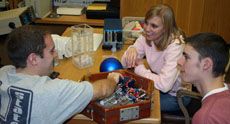
MRT members Jeff Brady, Vicki Ragsdale and Steve Berkley borrow parts from an experiment flown on the space shuttle for their holiday ornament.
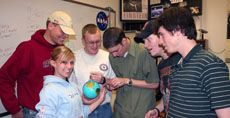
The MRT gang displays its extraterrestrial ornament, which makes its television debut Dec. 8 on Salt Lake's KSL-TV Studio 5 program.
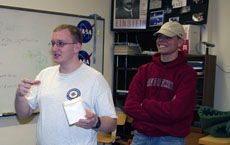
Computer science undergrad Joshua Jones (left) describes a paper model of MRT's proposed Sputnik CubeSat picosatellite as team member Colin White looks on.
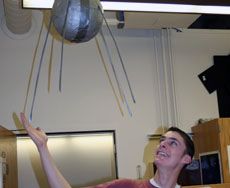
MRT member Steve Berkley displays his papier-mache model of Sputnik The Soviet satellite, launched in 1957, was about the size of a basketball.
SHARE
Comments and questions regarding this article may be directed to the contact person listed on this page.