Air Power: USU Undergrad Undertakes Research, Internship, ROTC Pursuits With Enthusiasm and Grit
Physics scholar and aspiring Air Force pilot Elijah Kroeber pursues academic endeavors ranging from drone piloting and mosquito abatement to atmospheric science, machine learning, leadership and French.
By Mary-Ann Muffoletto |
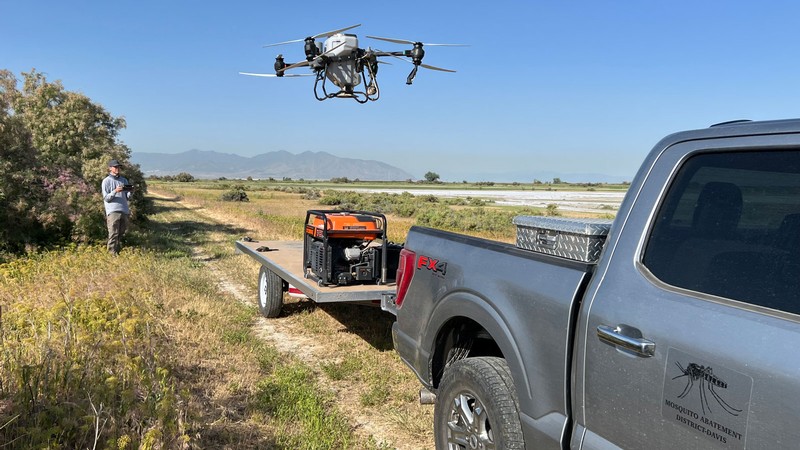
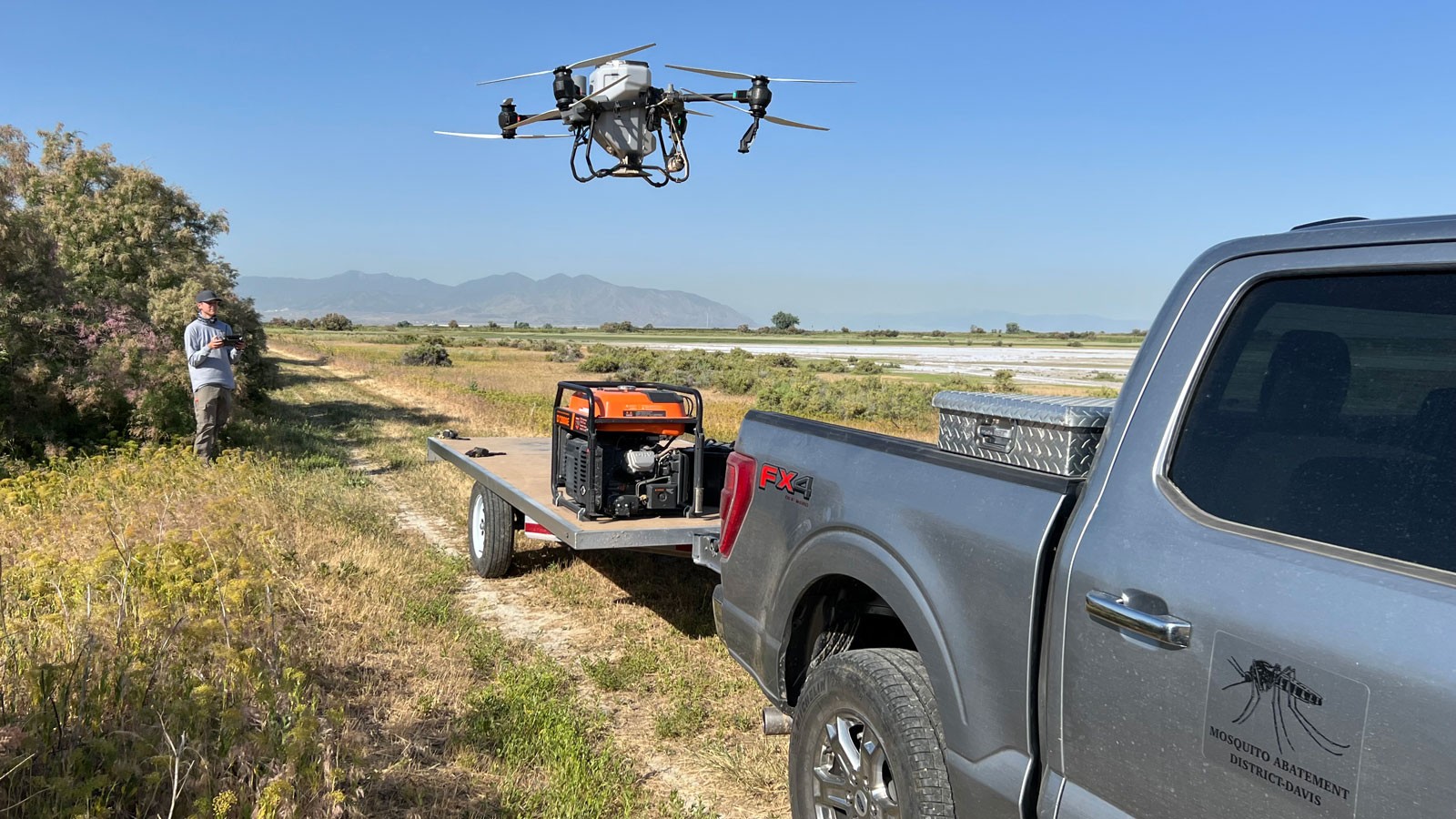
During a summer 2025 internship, USU physics undergrad Elijah Kroeber, left, pilots a drone loaded with bacterial larvicide to combat disease-carrying mosquitoes for Mosquito Abatement District-Davis along the shoreline of Utah's Great Salt Lake. The Air Force ROTC cadet and aspiring pilot maintains a busy academic, research and outreach schedule. (Photo Courtesy MAD-D)
When confronting a challenge, Utah State University undergraduate and Air Force ROTC cadet Elijah Kroeber counsels staying calm, being adaptable and supporting others under pressure.
“Those are valuable things I’ve learned from Air Force ROTC, but they’re lessons I now apply in all aspects of my life,” says the Provo, Utah native, who graduated from Timpview High School in 2022. “It’s what resilience looks like in practice.”
While working toward a bachelor’s degree in physics with minors in aerospace studies, unmanned aerial systems and French, Kroeber is exploring diverse experiences in research, leadership and real-world application of science to combat a public health challenge.
His most recent pursuit was a summer internship with Mosquito Abatement District-Davis, based in Kaysville, Utah. Kroeber and co-workers traveled along the lakefront of the Great Salt Lake each day, deploying a 7-foot wide, twin-rotor agricultural drone loaded with bacterial larvicide.
Their targets were disease-carrying mosquitoes, which thrive in the Beehive State’s wetlands as well as the arid region’s irrigated agricultural, urban and residential landscapes. Utah’s mosquito populations include species capable of transmitting such worrisome diseases as West Nile virus.
“I learned how useful drones are in mosquito abatement,” Kroeber says. “We could apply up to 110 pounds of larvicide per payload and the drones helped us reach hard-to-access areas with precision. This saves money, time and energy. It really shows me that drones are the future, and it makes me excited to see where else this technology will be applied.”
Kroeber studies unmanned flight at Utah State but has his sights set on piloting aircraft himself after completing his undergraduate studies and commissioning as an Air Force officer.
“I’ve been selected for Air Force pilot training following graduation,” he says. “I’m hoping to fly either the F-15 Eagle fighter jet or the C-130 Hercules military transport plane.”
Rounding out Kroeber’s demanding schedule is undergraduate research on atmospheric waves led by Physics professors Ludger Scherliess and Yucheng Zhao. The researchers are analyzing data collected from ground-based stations at the far corners of the world, as well as from a NASA-funded, Space Dynamics Laboratory-built instrument attached to the exterior of the International Space Station.
“I’m working as a data processor for the ANGWIN — Antarctic Gravity Wave Instrument Network — project, which is an international network of ground-based instruments investigating atmospheric gravity waves on a continental scale,” he says.
Kroeber says the project’s primary focus is identifying wave sources, understanding their propagation and assessing their impact across the atmosphere.
“These waves can disrupt satellite communications that guide such applications as GPS, as well as aircraft and maritime navigational systems,” he says.
With the assistance of machine learning programs developed by other students in his research group, Kroeber is processing images captured by ANGWIN instruments and converting them into useable data the researchers can interpret and use for calculations.
“The most valuable thing I’ve learned from this research is how useful machine learning algorithms can be in streamlining repetitive tasks,” he says. “They’ve significantly sped up the data processing that I do and have opened my eyes to how much they can help with scientific research when used correctly.”
Kroeber, the recipient of USU’s Dr. Melvin C. Cannon Scholarship, says faculty mentorship has been key to achieving meaningful academic and personal growth during his undergraduate experience.
“My research mentor, Dr. Zhao, has helped me see the practical side of physics research and how to apply theory to real-world problems,” he says. “Professor Baron Wesemann from the Department of Aviation Technology introduced me to the USU drone program and has been a big supporter of my aviation goals.”
Kroeber credits Captain Derek Wahl, one of his AFROTC instructors, with instilling the importance of developing one’s own leadership style and how to both give and receive constructive feedback.
“Through Air Force ROTC, I’m learning resilience is not just about pushing through when things get hard, but about consistently showing up, staying accountable and keeping a level head when things don’t go according to plan,” he says. “ROTC has put me in leadership roles before I felt ready, which has helped me build confidence in myself and in my ability to learn and grow through challenges.”
WRITER
Mary-Ann Muffoletto
Communications Specialist
College of Arts & Sciences
435-797-3517
maryann.muffoletto@usu.edu
CONTACT
Elijah Kroeber
Undergraduate Researcher
Department of Physics
elijah.kroeber@usu.edu
SHARE
Comments and questions regarding this article may be directed to the contact person listed on this page.