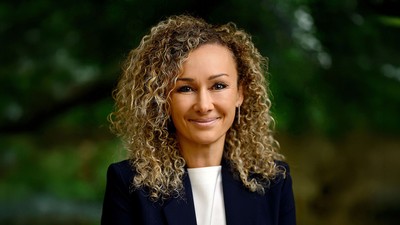
Biogeochemist John Stark Says Risk is Key to Promoting Interest in Science
Growing up along the San Andreas Fault in rural Leona Valley, Calif., biology professor John Stark reveled in the beauty of southern California’s wildflower zone.
“It looks as though someone took huge buckets of multi-colored paint and splashed them on the mountains and hills,” says Stark of the area near the state’s poppy preserve, where his father moonlighted as a wildflower photographer.
Stark credits his parents with encouraging his interest in science. He says his mom was “extremely tolerant” about the bug and animal collections he kept in his room. He admits, however, that his live snake collection just about sent her over the edge.
An enthusiastic sixth grade science teacher further stimulated Stark’s inquiries, and time spent with an old chemistry textbook, copyright 1962, fueled his curiosity. “The book had some really cool experiments that were too dangerous to be found in any of today’s home chemistry books,” says Stark.
Weekends found the youngster mulling over instructions for generating hydrogen and chlorine gas, as well as chloroform. “Nowadays chemistry sets are too sanitized, too safe, to get kids excited,” he says.
This may be the major problem with science education today, Stark told family, friends and colleagues who joined him Feb. 28 at the President’s Home for the 12th talk in the university’s 2005-06 Inaugural Professor Lecture Series. The series highlights the accomplishments of university faculty who have been promoted to full professor in the past year.
While Stark doesn’t advocate letting children loose with dangerous chemicals, he laments the loss of risk and discovery in science classrooms. “Students who aren’t introduced to the hands-on excitement of science don’t understand where science lives,” he says. "Too often, kids are first exposed to science by teachers who were not science majors and who don't share the excitement of the scientific perspective."
Stark is also concerned about the current political assault on science and science education from powerful interest groups. “The scientific community has identified ecological concerns, including global warming, that people don’t want to think about,” he says.
Because interest groups search out the small minority that disagrees with these findings, says Stark, the public gets the impression that scientists can’t agree on anything. This misperception erodes trust in sound scientific research.
He notes that life sciences have been under particular attack due to political and religious reasons. “The scientific community is afforded much less respect than in previous generations and is treated as simply another special interest group.”
In his teaching, Stark, a member of USU’s biology faculty since 1991, emphasizes several key points to his students.
“The first thing I talk about is the chemistry of life – life is a series of chemical processes,” he says.
Stark also stresses how heterogeneity – or variety – is responsible for so much of biological phenomena. “We tend to think in terms of averages, but that’s not reality. If you look only at averages, you miss what’s really happening.”
He notes that radioactive waste leaching from Washington State’s Hanford Nuclear Reservation into the Columbia River is an example of scientists’ failure to look beyond averages and foresee the long-term environmental impact of the site’s operations. “As a result, the Hanford facility has created one of the largest environmental disasters in our country,” says Stark.
Lastly, Stark emphasizes the value of modeling. “All humans create conceptual models of reality in their heads,” he says. “It’s a good way to organize ideas and formalize your own view.”
When you go through the process of developing a model, says Stark, you understand your own ideas better and you quickly expose areas of ignorance.
These three principles became the basis for Stark’s work in determining rates of nutrient cycling in soil and the resultant impact on greenhouse gases. “The assumption was that microbial production was regulating the flow of gas, but we discovered that microbial consumption actually plays a more important role in controlling the rate at which certain gases escape from the soil,” he says. "Also, microbial consumption is extremely important in regulating nutrient availability to plants and retention of nutrients in ecosystems."
Stark completed his undergraduate studies at California’s Humboldt State University in 1981. He earned a master’s degree from Colorado State University in 1984 and completed his doctorate degree from University of California-Berkeley in 1991.
Stark’s current research topics include microbial controls on N-cycling in forest and rangeland ecosystems, trace N-gas production by soil microorganisms, the ecology of nitrifying bacteria and the role of microorganisms in controlling plant community structure. He is director of USU’s Stable Isotope Laboratory.
John Stark presented his Inaugural Professor Lecture at the President's Home. (left to right) President Stan Albrecht, Professor Stark and Biology Department Head Jon Takemoto.

Biogeochemist John Stark was recently honored as an inaugural professor.
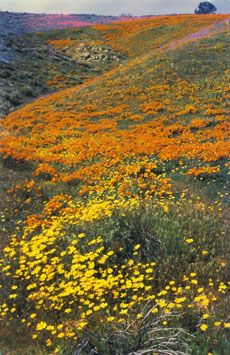
Wildflowers in Antelope Valley, Calif., by photographer O.M. Stark, John's father.
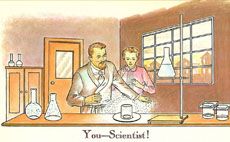
Illustration from the 1962 chemistry textbook that sparked John Stark's interest in science.
SHARE
Comments and questions regarding this article may be directed to the contact person listed on this page.