Blanding Campus Native American Rocket Team Competes Nationally

USU Eastern's six-member all-girls’ team, dubbed AG-6, impressed the Kennedy Space Center’s chief engineer James Wood. Team members include (left to right) Amber Gillis, Kelly Whitehair, Christina Morgan, Valtina Begay, Tenia Peace, and Denishia Tsosie.
Utah State University Eastern engineering students successfully competed in the nation’s largest high-powered rocket competition for Native American college students in Kenosha, Wis., April 30-May 2.
The eight students, guided by their professor, Jared Berrett, USU Eastern engineering faculty advisor, brought with them three rockets they designed, built and launched. They first launched the rockets, with hundreds on hand, at the college’s STEAM (science, technology, engineering, art, mathematics) expo in early April. The largest of the three high-powered projectiles stands five-feet tall with 10-inch diameter tail fins. The expo launches gave students the chance to test, tweak and perform in front of hundreds prior to the competition in Wisconsin.
Of the 12-member USU Eastern Blanding team, eight were selected to compete in Wisconsin. The students are all members of the American Indian Science and Engineering Society (AISES).
Seth Laughter represented the “rocketeers.” Team “Uno Castro” was represented by Cedale Armstrong. The all-girls “AG-6” team included Christina Morgan, Kelly Whitehair, Tenia Peace, Valtina Begay, Amber Gillis and Denishia Tsosie.
The event convened on the campus of Carthage College in Kenosha, in which USU Eastern was joined by 18 other tribal teams from 13 schools and 10 states.
The three-day event was hosted by the Wisconsin Space Grant Consortium, in conjunction with NASA’s Kennedy Space Center and the National Space Grant Foundation. The First Nations Launch included presentations, workshops and launch preparations that culminated in the firing of the rockets on the final day.
“Upon arrival, the students were rushed straight to an evening of presentations and judging of the student team efforts,” Berrett said. “Our students said they felt nervous and intimidated as they looked at several rockets that stood over 12-feet-tall, had multi-stages and multiple engine thrusters.”
This was Blanding’s first time building high-powered rockets, and even though their rockets were not the most advanced, the fact that USU Eastern students had taken full advantage of using them as an outreach tool in local school districts in Southeastern Utah prior to the competition won early admiration by the judges, Berrett said.
USU Eastern’s six-member all-girls’ team, dubbed AG-6, was also a big hit.
“The Kennedy Space Center’s chief engineer James Wood thought this was the first all-girls’ team he had worked with,” Berrett said. “He couldn’t have been more impressed.”
The second day of the event included workshops on rocket motor building, altimeter-enabled deployment, simulation and modeling of different launch scenarios. What is key to any successful launch is basic understanding of flight principles such as thrust, velocity, mass, trajectory and center of pressure, Berrett said.
And talk about pressure, there was plenty of that for students to deal with on the final day at the regional rocketry launch field at the Bong State Recreation Area, near Kenosha, with an additional 15-plus teams from around the region joining the event, Berrett said.
“With 10 launch pads and over 30 rockets, it was an exciting day,” he said. “AG-6 team leader Christina Morgan said, ‘I wasn’t nervous all year in AISES, even with our robotics competition in Washington D.C., but when our rocket was on the launch pad and the countdown began with all those teams watching, all I could think was, please launch!’”
Berrett said all of the USU Eastern team’s rockets performed beautifully and that he could not have been more pleased for USU Eastern to be part of such an historic event.
“Who knows how many events like these help to launch careers for Native Americans in the field of science, technology, engineering and mathematics?” he said. “USU Eastern has a place in all of this. We are proud of our students and the promise they hold as future Native American STEM leaders.”
Contact: Jared Berrett, 435-678-8189; jared.berrett@usu.edu
Writer: John DeVilbiss, 435-797-1358; john.devilbiss@usu.edu
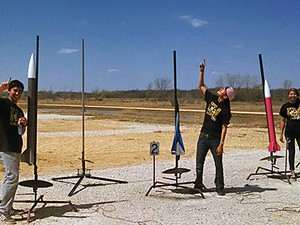
(left to right) Cedale Armstrong, Seth Laughter and Kelly Whitehair at the launch site in Wisconsin.

SHARE
Comments and questions regarding this article may be directed to the contact person listed on this page.