Design Proposal for Morgan City Wastewater Lagoon 'Coming Up Roses'
A possible solution to an ongoing environmental problem at one of Utah’s wastewater treatment ponds could leave the site smelling like roses.
A team of environmental engineering students at Utah State University’s College of Engineering took home a national award Sept. 28 for designing an innovative process to remove two major players in the wastewater nutrient dilemma: nitrogen and phosphorous.
The USU student chapter of the Water Environment Association of Utah wowed a panel of judges at the largest water conference in the nation on Sept. 28 in New Orleans, La., and took second place at the student competition.
Team leader Alex Rasband says nutrient levels in effluent at the Morgan, Utah, wastewater treatment site can be minimized by cultivating biosolids and phosphorous-rich sludge into fertilizer pellets. In addition, nitrogen can be removed from the effluent by using it to irrigate ornamental crops — including roses — that would be grown in on-site greenhouses and sold to floral shops.
Faculty adviser Michael McFarland says the system is designed to circulate water through the greenhouses for a total of four hours. As wastewater flows through the crops, plants take up nitrogen, leaving it free of added nutrients. If the treated wastewater then meets certain quality standards, it would be used to recharge groundwater through an infiltration basin.
McFarland says removing nutrients from effluent is a challenge all wastewater facilities have to address. He says using treated wastewater for a greenhouse growing operation makes good economic sense for small communities like Morgan where flow is minimal.
“There are a number of small lagoons around the state of Utah all facing the same challenge of meeting these nutrient limits,” he said. “The only way we can do this is because the flow at Morgan is so low. This idea was abandoned in larger communities because the flow is just too high.”
Discharging effluent that contains high nitrogen levels can create toxic conditions for aquatic environments and lead to algae blooms, dissolved oxygen depletion and fish die-offs.
Rasband says the concept of using wastewater to irrigate crops would need additional study and a pilot project before city officials in Morgan could adopt any formal proposal.
Related links:
USU Department of Civil and Environmental Engineering
Writer and contact: Matt Jensen, College of Engineering, (435) 797-8170, matthew.jensen@usu.edu

Faculty adviser Mike McFarland, left, Ayman Alafifi, Alexandra Rasband, Daniel Horne, and William Fullmer received a national award on Sept. 28 for their innovative wastewater treatment design.
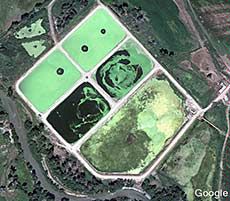
Wastewater treatment facilities across Utah must minimize nutrient levels in effluent.
SHARE
Comments and questions regarding this article may be directed to the contact person listed on this page.