Finding Me: USU Language Scholar Recounts Personal, Academic Journey of Discovery
Undergraduate Utahn Laura Finlayson, an adoptee from China's Inner Mongolia province, employs culture theory tools on her personal quest to explore her roots. She presents her story publicly from 6-9 p.m. Nov. 4 in the Mehdi Heravi Global Teaching and Learning Center on campus.
By Mary-Ann Muffoletto |

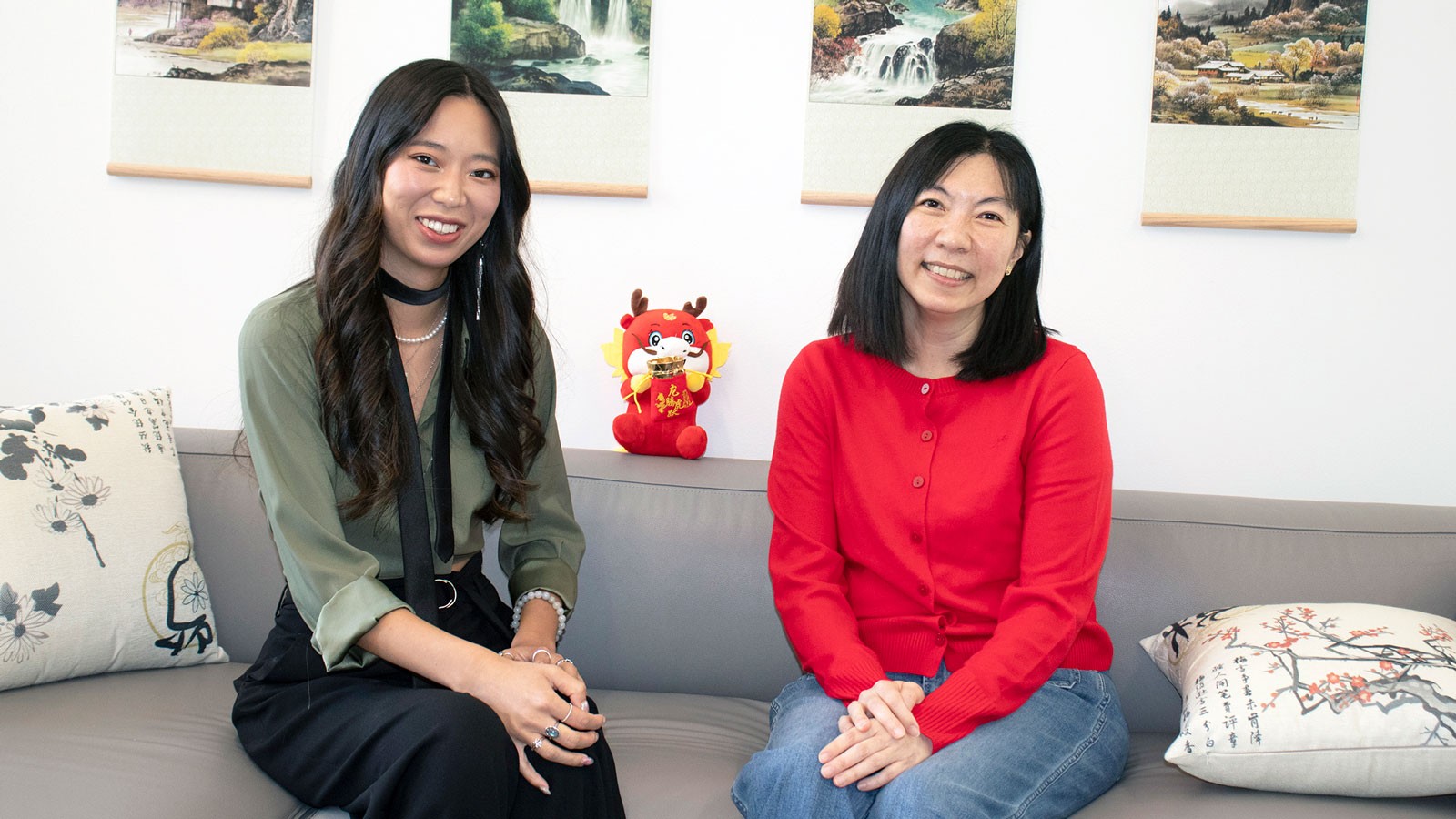
USU undergraduate scholar Laura Finlayson, left, with faculty mentor Ko-Yin Sung, professor in the Department of World Languages and Cultures, at the Mehdi Heravi Global Teaching and Learning Center. An adoptee from China, Finlayson presents the public talk 'Finding Me and Connecting with Our Roots,' Tuesday, Nov. 4, 6-9 p.m. at the center. (Photo credit: USU/M. Muffoletto)
For undergraduate language scholar Laura Finlayson, attending Utah State University was a no-brainer.
“My parents and three older siblings are all Aggies, so USU felt right at home for me,” says Finlayson, who spent her early childhood years in Logan, before moving with her family to Ogden and graduating from Weber High School in 2022.
Active in her high school chapter of DECA (Distributive Education Clubs of America), the new Aggie chose business as her minor, but opted for Chinese, a language she studied in high school, as her USU major.
“My family adopted me from an orphanage in China’s Inner Mongolia province, when I was little more than a year old,” Finlayson says. “Though my parents have always told me my adoption story, where I’m from and have never treated me as anyone other than their child, I still had persistent questions about who I was and why I was abandoned, sick with jaundice and pneumonia, at a rural hospital.”
Finlayson shares her unique journey, which included a personal and scholarly expedition to China in 2024, during the presentation “Finding Me and Connecting With Our Roots” from 6-9 p.m. Nov. 4 in the Carolyn Tanner Irish Pavilion, Room 201 of the Mehdi Heravi Global Teaching and Learning Center on USU’s Logan campus. All are welcome.
During her childhood, Finlayson and her family participated in activities with other adoptive families focused on Chinese culture.
“We celebrated Chinese New Year and held other get-togethers,” she says. “My parents wanted me to be proud of my story, where I came from and to honor my Chinese heritage.”
Yet hearing her Utah classmates recount when and where they were born made Finlayson feel left out.
“In junior high I started struggling with anxiety about who I really was, what I’m doing here, who I look like and why my birth parents made the decisions they did,” she says.
She recalls a human geography class in which her classmates disparaged China’s one-child policy.
“I would get clammy, cold sweats, my heart would beat uncontrollably, thinking about the pain I felt about abandonment,” Finlayson says. “I had to call my mom to pick me up at school and calm me down.”
She also, as a person of Asian ancestry, faced racist slurs.
“In front of the whole class, a classmate laughingly joked that I ate dog,” Finlayson says. “My teacher chose to ignore the comment.”
But the teen embraced her heritage, dove into study of the Chinese language and developed an affinity for Chinese dramas.
“I wanted to learn Chinese to help me connect with my culture,” Finlayson says. “I also thought, if I ever get a chance to meet my biological family, I want to be able to talk with them.”
She took a DNA test from 23&Me, which revealed Finlayson is “100 percent Chinese,” but yielded no close relatives.
“My high school Chinese teacher was from Taiwan, and I occasionally met people from China or with Chinese ancestry, but never met anyone who looked like me,” she says.
In 2024, Finlayson convinced her mother to embark with her on a Chinese heritage tour, conducted by USA-based Cherish Children Adoption International (CCAI), the adoption organization that arranged the Aggie scholar’s adoption in 2005.
“CCAI, in partnership with The Park Adoption Community Center, arranges heritage tours and gatherings for adoptees and their families to explore their roots and to meet with other adoptees and adoptive families,” Finlayson says. “This was an opportunity to visit the orphanage in Inner Mongolia from which I was adopted, along with cultural sites in China.”
Finlayson’s faculty mentor, Ko-Yin Sung, helped the undergraduate develop a plan, from her trip’s experiences, to fulfill CHIN 3880, Individual Readings in Chinese.
“Laura wrote about her experiences growing up as an adoptee in the United States, along with visiting the country of her birth, including the challenges of learning ‘small-c’ culture, meaning people’s beliefs, attitudes, how they interact, body language and more in China,” says Sung, professor of Chinese in USU’s Department of World Languages & Cultures. “Her trip was invaluable, as it gave her insights into aspects of culture so automatic and ingrained we don’t realize are there until we experience a different culture and start to notice the contrasts.”
When Finlayson and her mother, Brenda James Finlayson, arrived in Inner Mongolia, they were greeted by a driver assigned to take them to visit an orphanage, which replaced an older orphanage and hospital where the mom and daughter first met.
“He commented right away that I looked Inner Mongolian or Mongolian and I was likely from the tribe Tumote Left Banner,” Finlayson says. “His certainty was surprising, but he explained he routinely traveled the region and was familiar with the varied ethnicities.”
Upon arrival at the new orphanage, she and her mother met staff members who recognized a nurse in a photo taken with Finlayson when she was a baby.
“We were able to make contact with the woman, who was head nurse at the hospital at the time and remembered me, by video chat,” Finlayson says. “I couldn’t hold back my tears. It was so surreal to meet someone who helped me as an infant and got me to where I am today. She kept reassuring me, ‘Don’t cry, don’t cry — Look at how wonderful your life has turned out and be happy.”
That meeting, Finlayson says, helped her achieve some closure.
“I realized my birth parents took me to the hospital for help,” she says. “They had no other option. I probably would not have survived if they hadn’t made that sacrifice.”
The trip afforded Finlayson opportunities to visit renowned Chinese landmarks, including The Great Wall, the Forbidden City and the Temple of Heaven, as well as gatherings with other Chinese adoptees from places throughout the United States.
“It was very healing to talk about our shared experiences as adoptees and to be with people who understood exactly what I’d been through,” Finlayson says. “I made some wonderful new friends.”
She also found herself, as a student of Chinese, cast into the role of translator.
“It was a little intimidating at first, but I quickly gained confidence,” Finlayson says. “All of our tour guides were pleased to discover I was learning Chinese and one, in particular, really pushed me to practice speaking and to learn more.”
Finlayson graduates from Utah State in spring 2026, and hopes to return to China as an English teacher.
“My dream is to spend a few years in China, to become more proficient in Chinese and to learn more about the culture,” she says.
WRITER
Mary-Ann Muffoletto
Communications Specialist
College of Arts & Sciences
435-797-3517
maryann.muffoletto@usu.edu
CONTACT
Ko-Yin Sung
Professor of Chinese
Department of World Languages and Culture
koyin.sung@usu.edu
Laura Finlayson
Undergraduate Scholar
Department of World Languages and Culture
a02381676@usu.edu
SHARE
Comments and questions regarding this article may be directed to the contact person listed on this page.