Inaugural Professor Tom Baldwin "Builds" More than a Career
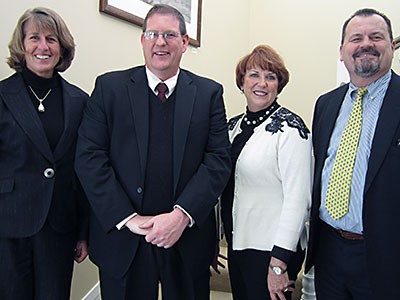
(l to r) Provost Noelle Cockett, Inaugural Professor Tom Baldwin, USU First Lady Joyce Albrecht and Dean Ken White.
Officially, Tom Baldwin is a doctor of veterinary medicine, veterinary pathologist, director of the Utah Veterinary Diagnostic Laboratory (UVDL) and professor in Utah State University’s Department of Animal, Dairy and Veterinary Sciences. He is also husband to his college sweetheart Sandra, father of four children, river runner, and self-described “amateur mechanic, carpenter, all-around-fix-things guy and terrible welder.”
“Builder” isn’t on his resume, but Baldwin builds things, and the results benefit people well beyond the UVDL and USU campus. He came to USU 14 years ago from Washington State University where he was a diagnostic veterinary pathologist. When he became director of the UVDL, three of the lab’s 11 staff members were doctors of veterinary medicine and the lab was not accredited by the American Association of Veterinary Laboratory Diagnosticians. Today there are 20 people on staff at the lab, half with DVM degrees and the laboratory is accredited.
In his recent USU Inaugural Professor talk to mark his promotion to professor, Baldwin described the UVDL’s mandate to keep abreast of animal health and consequent growth in the range of services the lab provides to veterinarians, animal owners, wildlife managers and the Utah Department of Agriculture and Food. In the past decade the lab has added immunochemistry, molecular diagnostics and clinical pathology and achieved accreditation. The UVDL also established a branch laboratory in Juab County in 2003 to provide more immediate access to people in the central and southern part of the state and moved it to a new permanent (and less structurally deficient) location last year.
Should anyone believe that animal health doesn’t affect them because they don’t have pets, raise livestock or hunt, think for a moment about the many diseases that cross from animals to humans. Often just one tick, mosquito or microbe is the connection between an infected animal and a sick human … or thousands of sick humans.
Since 2005, the UVDL has been part of the National Animal Health Laboratory Network filling a vast geographic gap in the network that formerly had no partnering facility from Laramie, Wyoming, west to Davis, California, and from Bozeman, Montana, south to Tucson, Arizona. That’s a lot of ground to cover when time is of the essence in diagnosing what has happened to an animal and what it might mean for other animals and people. The lab’s accreditation and participation in the network means the UVDL is always busy with something new, including samples from animals that do not live in the region. But people in Utah benefit too because labs in the network readily share their expertise. The federal government also provides funding to support the lab’s infrastructure.
“We see a blend of state and national cases, and might see several illnesses or deaths in an area,” Baldwin said. “The state veterinarian may call to ask about samples we’ve been seeing in the lab or with concerns about animals in a particular place. We see samples from everywhere and help piece together where there are disease outbreaks people should be aware of.”
They may also figure out that a particular pasture or rangeland plant is poisoning animals. It’s a tricky business because chemicals in plants can affect different species of animals very differently and even change over the course of the growing season. Baldwin and his colleagues at the UVDL work closely with the state veterinarian and receive funding from the Utah Department of Agriculture and Food.
Baldwin credited mentors who taught, guided and encouraged him to reach beyond his DVM degree and to pursue pathology. And just as great mentors helped shape his career, Baldwin enjoys his role as teacher and mentor with student in USU’s School of Veterinary Medicine and with residents who will someday contribute to the under-filled ranks of veterinary pathologists. He is acutely aware of the shortage nationwide as he has filled leadership roles in the American Association of Veterinary Laboratory Diagnosticians and currently serves as the organization’s president.
Baldwin was instrumental in launching USU’s School of Veterinary Medicine that is part of a regional program connected with Washington State University (WSU). The approximately 30 students admitted to USU’s program each year attend classes in Logan for two years and finish their DVM degrees with two years of clinical studies at WSU, but at resident tuition rates. The first class of USU’s School of Veterinary Medicine is set to graduate this spring.
The vet school is off to a good start. So when Baldwin’s at work and not viewing slides under the microscope in his office, or mentoring pathology residents, managing the lab and its budget or teaching future veterinarians, he is thinking ahead, preparing for the lab’s next accreditation visit or looking for ways to improve services. In short, he’s always looking to build something.
Related links:
- USU Department of Animal, Dairy and Veterinary Sciences
- USU School of Veterinary Medicine
- USU College of Agriculture and Applied Sciences
Contact: Tom Baldwin, 435-797-1883, tom.baldwin@usu.edu
Writer: Lynnette Harris, 435-797-2189, lynnette.harris@usu.edu
Comments and questions regarding this article may be directed to the contact person listed on this page.