Land is Kin: USU Extension Helps Wellsville Farm Through Transition to Organic Partnership Program
By Nellie Williams |

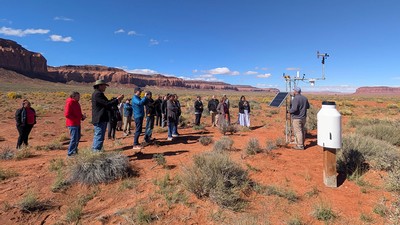
People take a tour of Steep Mountain Farm in Wellsville, Utah.

Beneath the Wellsville Mountains, Steep Mountain Farm is transitioning to USDA-certified organic production. Its stewards, Nate and Tara Stireman, describe their work as a “community-centered, ecological and regenerative agriculture project.”
With funding support from the USDA’s Transition to Organic Partnership Program (TOPP) — a resource that connects farmers with guidance and mentorship through the certification process — the Stiremans have received valuable insights from experienced growers as they navigate their organic journey. The Utah TOPP program is coordinated by Michele Schahczenksi, organic outreach coordinator with Utah State University Extension. Schahczenksi organized a celebration of the Stiremans’ progress along with fellow farmers, community members and program leaders.
Among them was James Loomis, director of agricultural operations for Wasatch Community Gardens, who spoke about his own path toward building enduring fertility in an urban setting.
“I have always been interested in sustainability and in stewarding the ecosystems I live in in a way that increases abundance over time while diminishing the inputs,” Loomis said.
For him, the key lies in rethinking waste, since there is no waste in nature. He said harnessing organic matter has been central to the success of his gardens. Like Steep Mountain Farm, he emphasized the importance of closed-loop nutrient cycling, which reduces reliance on external inputs such as fertilizers and pesticides. This principle is just one part of the whole-system approach that Steep Mountain Farm is striving to uphold.
While the technical principles of organic production focus on soil fertility and nutrient cycling, others at the event highlighted the deeper relationship between people and the land itself.
Darren Parry, former chairman of the Northwestern Band of the Shoshone Nation, spoke of the Indigenous ways of life that allowed for holistic systems where the environment, animals, plants and people were interconnected parts of a whole.
“The land is not a resource to be taken or controlled,” he said. “It is woven into who we are and part of our very being. Land is family, land is kin. The rivers are our bloodlines, the mountains our bones, the forests our lungs and the wind our breath. It’s not a metaphor, it’s not poetry. It’s the truth.”
That sense of kinship with the land is also at the heart of Steep Mountain Farm. For the Stiremans, transitioning to organic certification is not only about meeting technical standards, but also about aligning their practices with care, reciprocity and resilience.
“We don’t think of ourselves as landowners,” Nate Stireman said. “We have a relationship with this land. It’s about listening, observing and understanding what the land needs.”
By framing their work as a partnership rather than ownership, the Stiremans embody the principles Parry described: a holistic approach that honors the interconnectedness of people, plants, animals and the broader ecosystem. The gathering celebrated not just the technical steps of organic transition but a shared commitment to a more thoughtful, sustainable and kin-centered way of farming.


Steep Mountain Farm in Wellsville, Utah.


WRITER
Nellie Williams
Student Writer
Utah State University Extension
a02379131@usu.edu
CONTACT
Jennifer Reeve
Associate Professor
Plant, Soils and Climate Department
435-797-3192
jennifer.reeve@usu.edu
TOPICS
Extension 625stories Environment 346stories Agriculture 280stories Food 225stories Sustainability 155storiesSHARE
Comments and questions regarding this article may be directed to the contact person listed on this page.