Slow Hazard: USU Peak Undergrad Research Fellow Uses Data Science to Protect Life, Property
Math, statistics and computer science major Hannah Fluckiger, guided by faculty mentor Brennan Bean, condenses reams of hourly wind data to construct an improved snow drifting prediction model to bolster building codes for the conterminous United States.
By Mary-Ann Muffoletto |
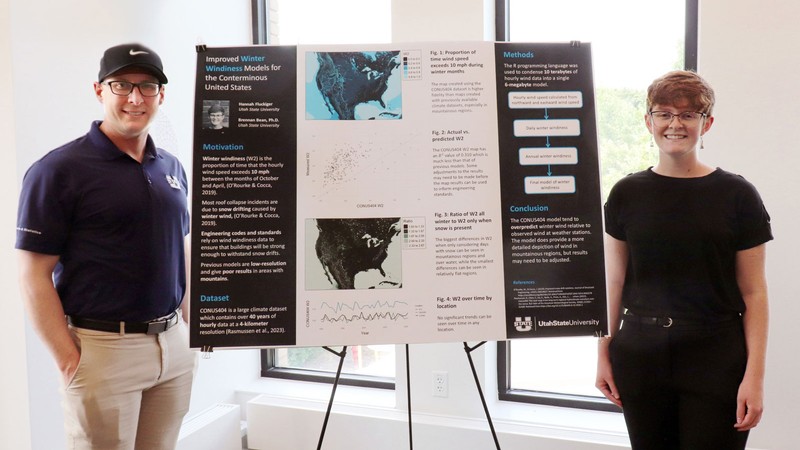
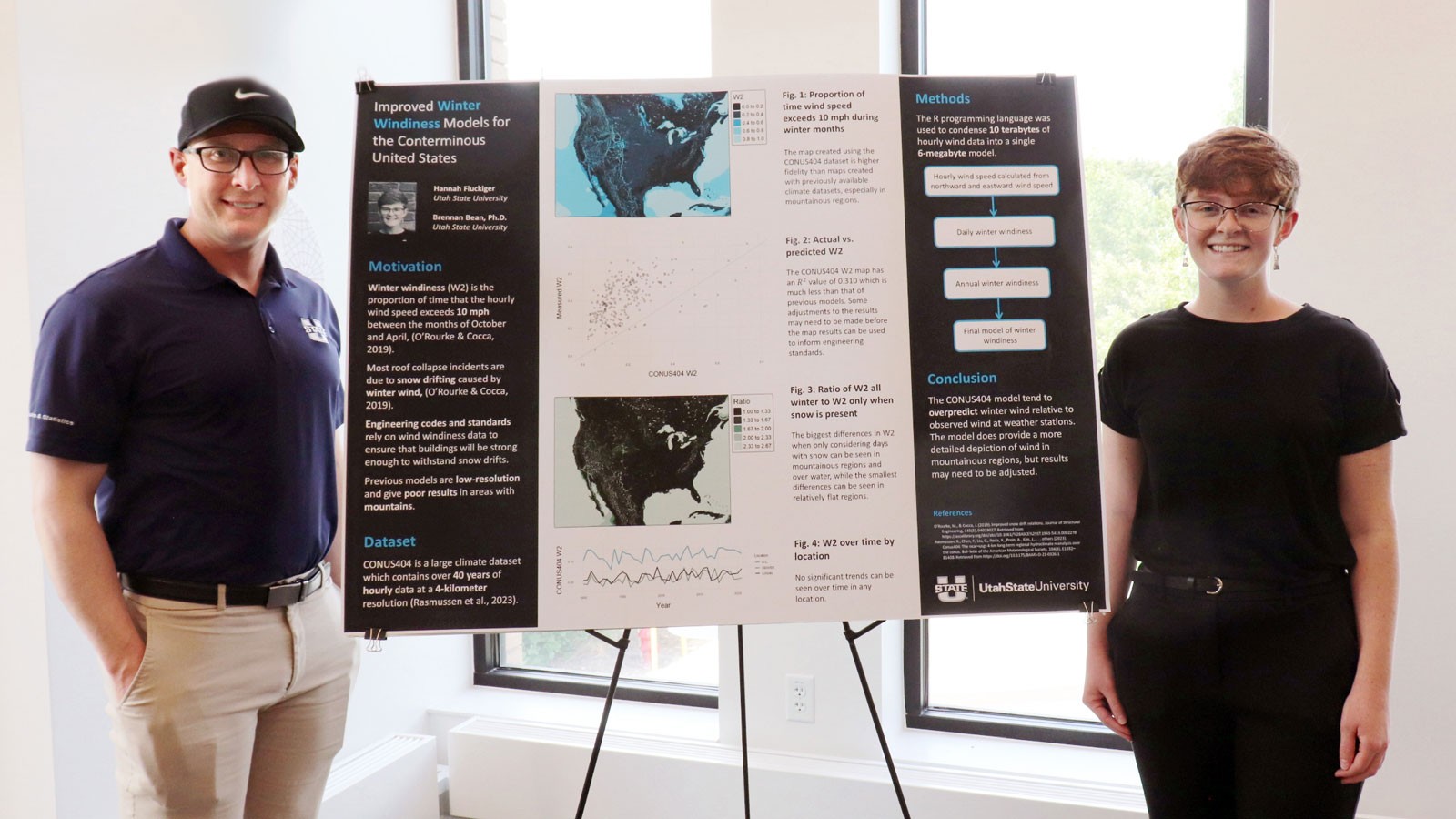
Peak Undergraduate Summer Research Fellow Hannah Fluckiger, right, with Department of Mathematics and Statistics faculty mentor Brennan Bean pose with a research poster at the culminating Aug. 20 poster session highlighting the summer efforts of USU's 2025 Peak Fellows. Using nationwide wind data, Fluckiger developed an improved snow drifting prediction model to promote safer building codes. (Photo credit: USU/M. Muffoletto)
In January 2017 in the tiny northern Idaho community of Deary, an elderly woman died when her front porch roof gave way under the weight of ice and snow. That same year, heavy snowstorms and freezing rain led to collapse of hundreds of roofs and buildings across the state’s rural Washington County, wiping out a fourth of Idaho’s onion storage and processing facilities.
“Onion sheds toppled by the dozens,” says Utah State University statistician Brennan Bean. “It was a $100 million loss for farmers.”
Accumulated snow, Bean says, is a “slow hazard.”
“Roof and building collapses don’t always get the attention of more dramatic hurricanes, floods, earthquakes and wildfires,” he says. “But the results can be catastrophic, resulting in loss of life and livelihood.”
Bean, associate professor in USU’s Department of Mathematics and Statistics, applies statistical analysis and data science to spatial and environmental data in an effort to update U.S. building codes and standards related to extreme snow accumulations. This past summer, he invited undergrad scholar Hannah Fluckiger, who is among USU’s 2025 Peak Summer Research Fellows, to conduct research on a recently released federally funded public dataset, with 40 years of wind data for the conterminous United States.
Fluckiger, who is pursuing a dual major in mathematics/statistics (composite) and computer science, downloaded some 10 terabytes of information from the high-resolution dataset — that’s enough to hold 1,000 copies of the Encyclopedia Britannica — and set to work analyzing the data.
“I used R programming language to calculate wind speed from raw data on varied directional wind variables,” she says. “It took weeks of computing to develop a predictive model.”
Her goal was to develop a model to provide guidance to engineers in constructing buildings to withstand drifting snow in varied regions throughout the nation.
“It was a very tall order and Hannah has made impressive progress on this effort,” Bean says. “Currently, there are only a few hundred weather stations across the country, and the current maps offer simple averages.”
These resources, he says, don’t account for winds of differing forces at, say, the mouth of a mountain canyon or across the Great Plains.
“With the new dataset, at a 4-kilometer resolution, you start to see how topography affects wind,” Bean says. “Hannah is helping us capture that.”
Fluckiger says she was excited for the opportunity to build her skills in R programming and to work independently on the never-before-attempted project.
“I think it’s cool to learn how to solve problems on my own,” says the 2021 graduate of Sky View High School in Smithfield, Utah. “Participating in research like this has built my confidence. It’s very different from classroom work, where everyone is working on the same problem and the solution is already known. With research, you have to rely on yourself, and others are also relying on you to solve problems.”
Bean says the Peak Summer Research Fellowship is valuable because it provides students with the financial support to pursue research questions in depth without interruptions.
“Having a program with financial support substantial enough to allow a student to do research for an extended period at a dedicated level is cool and crucial,” he says. “Many research problems can’t be solved in an hour or two. Students need time to give these problems their full attention.”
Fluckiger, who entered USU on a Dean’s Scholarship and has undertaken three previous research projects, says she’s been surprised by the wealth of undergraduate research opportunities offered to USU students.
“I didn’t realize there were so many research opportunities available to undergrads,” she says. “With the Peak Fellowship, I’ve had an experience approximating a graduate school experience. I’m very grateful for that.”
Bean says he’s grateful, too.
“The Peak Fellowship affords students not only the opportunity to gain research experience, but also positions them to have strong letters of recommendation and the foundation to be competitive for admission to graduate schools, medical schools, dental schools and other programs,” he says. “Our undergrad researchers are among the best students in the nation. I’m always amazed at what students can accomplish when you give them challenging, ambiguous tasks. They always exceed our expectations. They’re not doing ‘undergrad’ research; they’re doing research.”
The USU Office of Research’s next undergraduate funding opportunity is the Undergraduate Research and Creative Opportunities (URCO) grant, for which applications open Oct. 1-15. Applications for 2026 Peak Summer Undergraduate Research Fellowships open Feb. 1, 2026. The office will host its annual Undergraduate Student Fall Research Fair, open to students of all majors, Wednesday, Sept. 10, from 11 a.m. to 1 p.m., outside on the USU Engineering Quad.
USU professors David Peak (Physics) and Terry Peak (Social Work) initiated and endowed the Peak Summer Undergraduate Research Fellowship program in 2019.
WRITER
Mary-Ann Muffoletto
Communications Specialist
College of Arts & Sciences
435-797-3517
maryann.muffoletto@usu.edu
CONTACT
Hannah Fluckiger
Peak Undergraduate Research Fellow
Department of Mathematics and Statistics
h.fluckiger@usu.edu
TOPICS
Research 1181stories STEM 352stories Hands-on Learning 332stories Undergraduate Research 202stories Climate 183stories Wildfire 56storiesSHARE
Comments and questions regarding this article may be directed to the contact person listed on this page.