Teaching the Next Generation: USU Prof. Gives Inaugural Lecture
Utah State University electrical and computer engineering professor Charles Swenson believes there are two things that are important in life: knowledge and the next generation. Working at the university gives him the opportunity to work on both, and he addressed these points during his Inaugural Professor Lecture to colleagues, family and friends in early November.
The Inaugural Professor Lecture Series at USU is coordinated by the provost’s office and is hosted by President Stan Albrecht and First Lady Joyce Albrecht. Faculty members in the series have been promoted to full professor within the last academic year and present a lecture that highlights their research, creative activity or teaching at the university.
“People make the world great,” said Swenson. “Teaching the next generation so they have the knowledge base and ability to contribute to the world in a positive way, can only improve it.”
Swenson’s research deals with the space environment and weather in the space environment. His lecture highlighted some of the everyday technologies that rely on instruments in space to make them work, such as TV, radio, credit card transactions and cell phones.
“People don’t realize that many of the technologies they use on an everyday basis have to do with space research,” said Swenson.
Swenson has developed instruments used by NASA for observing the space environment and gave an overview of some of his projects during his lecture. He also presented plans on where the technology and his research will take him next.
Swenson teaches graduate level courses in the area of space engineering and space science and undergraduate courses in analog circuits. His research activities are split between space science, instrumentation for measuring the space environment, space systems engineering and small satellites.
He has been a co-investigator and lead scientist for instrumentation on seven different NASA sounding rocket missions and is the principal instrument scientist for the floating potential measurement unit used on the International Space Station. He is the principal investigator and academic adviser for the USU Student Small Satellite Program and his research activities are often in association with the university’s Space Dynamics Lab.
“I bring my research into the classroom,” said Swenson. “I have a two-way dialogue with my students, but I often let my students experiment and try things before jumping in. When they can’t figure something out, I find that this becomes the opportune teaching moment.”
Swenson graduated from USU with degrees in electrical engineering and physics and a master’s in electrical engineering. He completed his doctorate at Cornell University in electrical engineering in January 1992 and joined the faculty at USU that same year.
He currently directs the Space Instrumentation Laboratory and the Center for Space Engineering at USU. He has received awards for teaching and research excellence, consults for NASA and has more than 50 scientific publications and reports.
Contact: Charles Swenson, 435-797-2958
Writer: Maren Cartwright, 435-797-1355
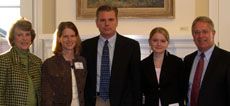
President and First Lady Stan and Joyce Albrecht pose with Charles Swenson (center) and his family, including wife Melanie and daughter Jessica.
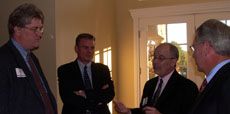
Dr. Swenson visits with College of Engineering Dean Scott Hinton (left), Provost Raymond Coward (3rd from left) and President Albrecht.
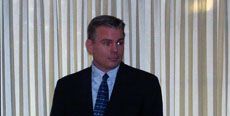
Charles Swenson discusses the future of space research.
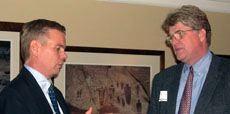
Charles Swenson takes a moment to speak with Dean Hinton.
TOPICS
Inaugural Lecture 130storiesSHARE
Comments and questions regarding this article may be directed to the contact person listed on this page.