USU Chemists Catch Life-Critical Enzyme in Action
Utah State University researchers have solved a long-sought piece of the puzzle of how enzymes known as nitrogenases convert nitrogen into life-sustaining compounds on which all plants and animals depend.
Utah State chemistry professor Lance Seefeldt and Brett Barney, a USDA-funded postdoctoral fellow at USU, led an interdisciplinary team that succeeded in capturing three steps of nitrogen fixation, the process by which nitrogen is converted to ammonia. The team included scientists from Northwestern University and Virginia Tech.
The researchers' findings were published in the Oct. 5 online issue of the Journal of the American Chemistry Society and are featured in the Oct. 17 issue of Chemical & Engineering News, one of the world's most widely circulated trade publications.
"The structure of nitrogenase and the general site at which nitrogen gets bound and reduced has been known for more than a decade," said Seefeldt. "But until now, we didn't know anything about how that process works."
The researchers developed a chemical methodology to trap and detect immediates in nitrogenase-catalyzed reductions and flash-freeze samples. Using spectroscopy, they confirmed that the samples were indeed enzyme-bound intermediates.
Trying to capture nitrogenase in action is similar to trying to catch a single frame of movie film on a moving reel, said Barney. "You have to catch it in the act and freeze the frame so you can actually look at it and understand it."
Using the same metaphor, Seefeldt explained that "once we collect all the frames we can watch the whole movie."
"We will be able to understand how the enzyme functions," he said. "This will drive a lot of research around the world and eventually could enable an alternative, clean method of producing nitrogen."
Currently, science and industry rely on the nearly century-old Haber process to produce nitrogen for fertilizer, paper, pharmaceuticals, plastics, mining and explosives. Developed by German Nobel Prize-winner Fritz Haber during World War I, the process is costly, energy-intensive and a source of pollution, said Seefeldt.
Humans and animals obtain nitrogen from protein in their food; plants get nitrogen from the soil.

(left) Lance Seefeldt and Brett Barney captured a life critical enzyme in action.
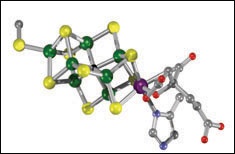
Scientists have understood the structure of nitrogenase for some time, but are just now unlocking the secrets of how the enzyme works.
SHARE
Comments and questions regarding this article may be directed to the contact person listed on this page.