USU Inaugural Prof Weaves 'Tapestry' of Interdisciplinary Endeavors
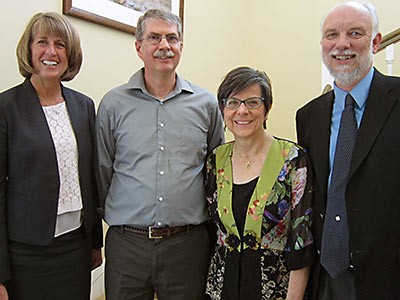
Joanna Endter-Wada, second from right, with, L-to-R, Provost Noelle Cockett, Environment and Society Department Head Chris Lant and Quinney College of Natural Resources Dean Chris Luecke, honored Feb. 22, at USU's Inaugural Professor Lecture Series.
Utah State University scholar Joanna Endter-Wada thinks outside of the box. A social scientist who studies water law and policy, human hydrology and urban ecosystems, she’s never been constrained by disciplinary boundaries.
“I’ve always seen myself as part of a greater family and community,’” says Endter-Wada, who recounted her professional journey with family and friends Feb. 22 at the USU President’s Home. “As a twin, I was quite old before I used first person personal pronouns. Everything was ‘we’ or ‘us’ — not ‘I’ or ‘me.’”
Her presentation, “The Tapestry of a Career: Weaving It All Together,” was the 11th talk in the university’s 2015-16 Inaugural Professor Lecture Series. Coordinated by the Provost’s Office, the series highlights the accomplishments of faculty who have been promoted to full professor in the past year.
“I think of my personal and professional paths as a tapestry woven from people, places and experiences,” says Endter-Wada, professor in USU’s Department of Environment and Society in the Quinney College of Natural Resources and the USU Ecology Center.
She initially pursued music and math as undergraduate majors, but soon became intrigued by disciplines focused on understanding people. She earned a doctorate from the University of California at Irvine in Comparative Culture, an interdisciplinary social sciences and humanities program focused on understanding issues of race, class and gender in society.
“My passion is people,” Endter-Wada says. “I love listening to what they have to say about their lives and experiences and how those affect their interactions with others and the environment.”
As she prepared to conduct dissertation research in the mid-1980s, the southern California native was awarded a Fulbright to study development in the Colombian Amazon. But before she could embark on her much-anticipated South American adventure, the Colombian government cancelled her award in the wake of M-19 (19th of April Movement) activities by Colombian guerrillas.
“Having foreign students working in that region of the country was deemed unsafe,” she says. “I had never been so disappointed in my life. And I don’t think my parents had ever been so relieved.”
Endter-Wada took a year off to teach math in public schools, a career she had dreamed of as a child, and reconsider her academic aspirations.
Returning to graduate studies with renewed determination, she chose to pursue the topic of water in the American West; a field that would define her future career.
“As I pursued this research focus, I was fascinated,” Endter-Wada says. “I was studying not just this scarce resource, but people’s varied interactions with it.”
Water, she points out, is a mobile and shared resource. Yet people spend a lot of time, effort and resources trying to capture it and assign property rights to it.
“Among the questions I was asking — and I still ask — is how do you allocate water in ways that are fair, both for people and the natural environment?” Endter-Wada says. “Answering a question like this requires input from many disciplines, because it must be analyzed from social, institutional, political and legal angles, as well as from biophysical and engineering perspectives.”
At Utah State, she has the opportunity to work with students, other faculty, officials and stakeholders both on and off campus to explore tough policy issues regarding water, forests, fisheries and public land.
“Utah is a fascinating place to work in natural resources,” Endter-Wada says. “We have a rich wilderness and agricultural heritage, yet most of our population lives in rapidly urbanizing areas. We have amazing public resources and very big water policy decisions before us.”
Reaching consensus is always a challenge, she says, but she remains optimistic.
“Much of my research involves conducting one-on-one interviews with people,” Endter-Wada says. “Though we’re confronting very difficult environmental challenges and I encounter diverse perspectives, I gain confidence from people’s genuine desire to work for collective solutions.”
Related links:
- “Water Needs and Wants,” Joanna Endter-Wada, TEDxUSU Duality Series
- “Gov. Gary Herbert Appoints Two USU Scientists to State’s Water Team,” Utah State Today
- USU Department of Environment and Society
- USU Ecology Center
- USU Quinney College of Natural Resources
Contact: Joanna Endter-Wada, 435-797-2487, joanna.endter-wada@usu.edu
Writer: Mary-Ann Muffoletto, 435-797-3517, maryann.muffoletto@usu.edu
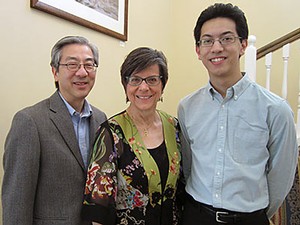
Professor Joanna Endter-Wada, center, with her husband Glen Wada, left, an engineering director at USU's Space Dynamics Laboratory, and son, Brandon Wada, a senior at Logan High School. Their son, Gregory, is a doctoral student at UC-Davis.
TOPICS
Inaugural Lecture 130storiesSHARE
Comments and questions regarding this article may be directed to the contact person listed on this page.