USU Researchers Using Bacteria to Produce Hydrogen
Video by Taylor Emerson, Digital Journalist, University Marketing & Communications
On their own, out in nature, electroactive bacteria can create an electrical current, much like humans produce carbon dioxide when we breathe.
Harnessing this natural system, USU researchers in Biological Engineering are using these bacteria, and a little additional electrical input, to produce hydrogen — a clean energy resource.
Their working theory is that, if scaled up, this process could accompany a renewable energy input, like solar or wind power, and help generate the bacteria generate hydrogen. Then, when the renewable sources of power are inefficient, or inoperable, you could instead burn the collected hydrogen for energy.
In addition to this research, however, they're also looking at helping with sustainable agriculture too — with another bacteria that could help produce animal feed.
By feeding this bacteria food waste, like the by-products and scraps from cheese production, it can be grown and harvested as a single-cell protein source. So hypothetically, you could have a system on a farm where you feed waste to it, and it can produce animal feed for cattle and animals.

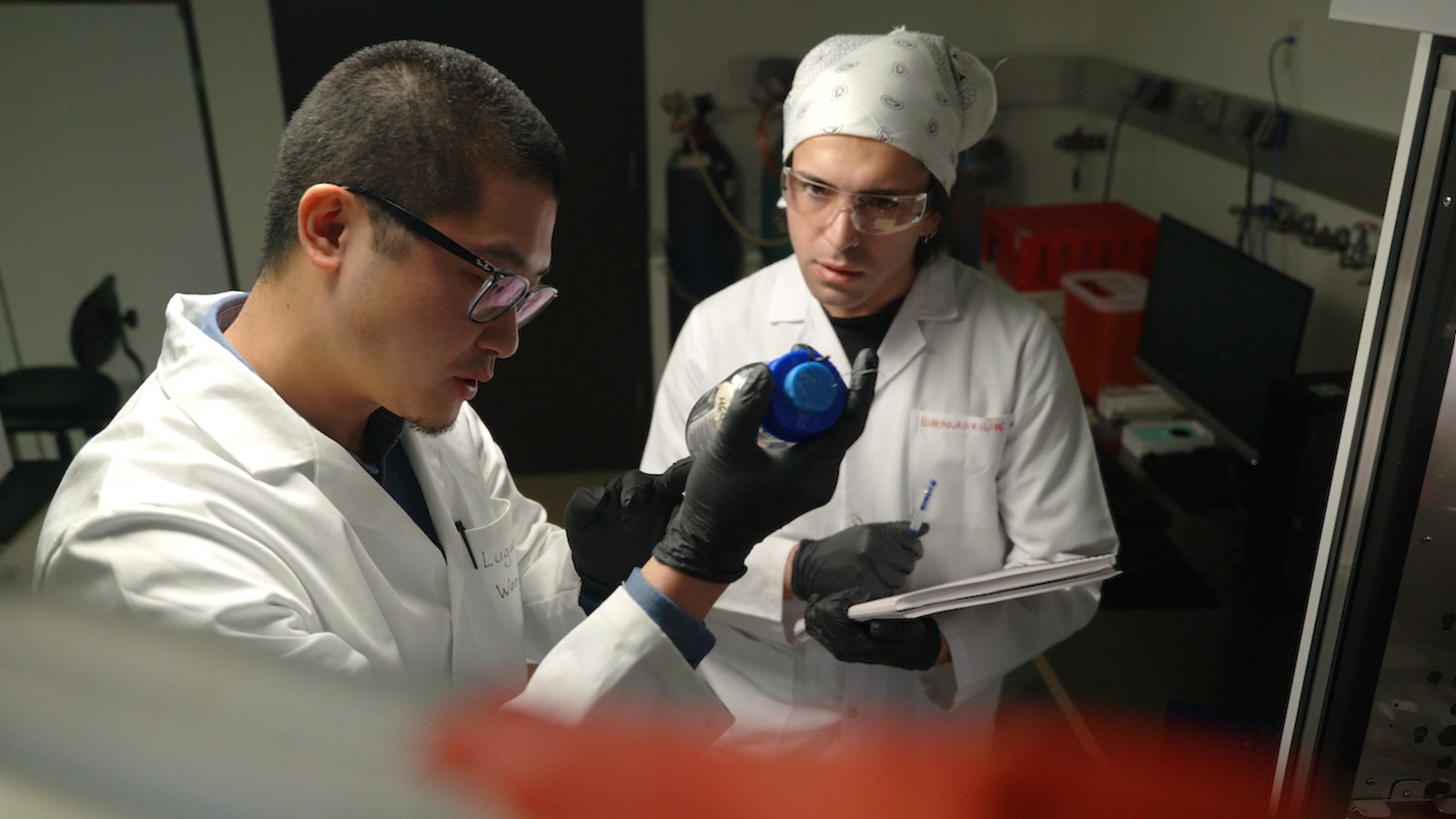
Luguang Wang, left, and doctoral student Burak Kilinc inspect a container with bacteria, liquid and an electrical diode. The research team collectively hopes that they can help transform waste into valuable products.
CONTACT
Luguang Wang
Assistant Professor, Biological Engineering
luguang.wang@usu.edu
SHARE
Comments and questions regarding this article may be directed to the contact person listed on this page.