USU's Brent Black Named Fellow of the American Society for Horticultural Science
By Dennis Hinkamp |

Professor Brent Black's career in fruit production research and Extension outreach is being honored by the American Society of Horticultural Science. (Photo Credit: USU/Bronson Teichert)

Brent Black grew — and grew up with — plants. He worked in nurseries, had summer jobs doing landscape construction and ran a small family nursery business. He was fascinated by the biology of plants and chose to study plant physiology in college.
Now a Utah State University professor and Extension fruit specialist, Black is being honored for his career of contributions to the field of horticultural science as an inductee to the 2025 Class of Fellows of the American Society for Horticultural Science. This honor recognizes Black’s contributions to the field and particularly his work in precision agriculture, tart cherry management and domesticating native fruiting species.
Paul Johnson, head of USU’s Department of Plants, Soils and Climate for much of Black’s career at USU, said: “Professor Black brings deep expertise in plant and fruit physiology, but what stands out is how he grounds that knowledge in the practical for orchard management. His work is focused on what matters most to growers: better fruit and more of it.”
A senior-level class in fruit production, a class he now teaches, piqued his interest in fruit crops. Black’s first job after earning his Ph.D. was doing research with the USDA Agricultural Research Service in Maryland.
“I found that I really enjoyed working directly with innovative growers to improve production practices,” Black said. “I particularly enjoyed interactions with motivated and curious undergraduate interns and graduate students. My position in USDA wasn’t particularly well suited to either of these interests, so I started looking for a university position with research and Extension responsibilities.”
For 19 of his 20 years at USU, Black’s work was divided between research and Extension. Then, in 2024, he added teaching an upper-division class, the course that initially sparked his passion for pomology (the science of growing fruit) when he was an undergraduate student.
Johnson noted that, “Utah is a tough place to grow fruit, and Brent has been instrumental in helping growers face and adapt to those challenges. I also admire his interest in exploring new crops. For example, he’s recently begun work with elderberries, a native food crop with real potential in Utah.”
Black agrees that fruit production is difficult in Utah for several reasons: The high-elevation continental climate brings serious weather challenges in late fall and early spring, a limited water supply and highly variable soils that make it difficult to grow uniform orchard crops. Those three factors mean that very few areas are suited to growing fruit crops, and the state’s rapid population growth has put extreme development pressure on those few sites.
Reagan Wytsalucy — a former graduate student of Black’s who is now an Extension assistant professor in southeastern Utah — describes him as a “one-of-a-kind mentor for all of his students. He provides the necessary support that allows him to lead all aspects of his role as the statewide fruit specialist and as a mentor. He graciously takes pride in building up his colleagues and students so they can succeed in any endeavor that supports their career and educational pathways.”
Black has been a faculty member at USU since 2005, holds a bachelor’s degree in plant and soil science from USU, a master’s degree in horticulture from Michigan State University, and a Ph.D. in plant physiology from Oregon State University.
As a fellow, he joins a select group of experts whose work has made enduring impacts on the horticultural community and inspired the next generation of researchers and fruit growers.
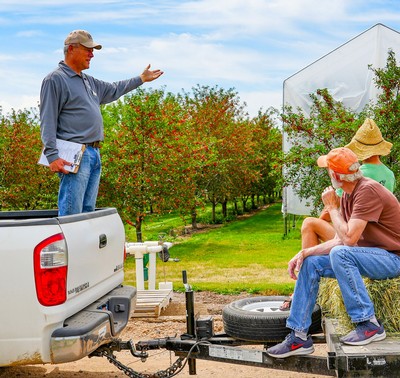
Utah is the nation's second-largest producer of tart cherries, and Professor Brent Black, seen here at a Utah Agricultural Experiment Station and USU Extension Field Day for fruit growers, has helped Utah growers remain competitive. His work has also helped apple and berry producers.

WRITER
Dennis Hinkamp
Writer, Media Production
Extension
Dennis.Hinkamp@usu.edu
CONTACT
Brent Black
Professor/Fruit Specialist
Department of Plants, Soils, and Climate/Extension
435-797-2174
brent.black@usu.edu
SHARE
Comments and questions regarding this article may be directed to the contact person listed on this page.