Bluff Wellbeing Survey Findings 2022

By Dr. Courtney Flint and Team

utah wellbeing survey logo

Contact Information

Summary

Bluff City is one of 33 cities participating in the Utah Wellbeing Survey Project in 2022. This project is designed to assess the wellbeing and local perspectives of city residents and to provide information to city leaders to inform their general planning process.

We are grateful to all participants who took the survey and to our city partners who helped to make this possible. Additionally, we are grateful to the Utah League of Cities and Towns and USU Extension for their financial support.

What is in this report?

This report describes findings from the 2022 Bluff survey and some comparative information with other project cities. Feedback from city leaders, planners, and residents is welcome.

How was the survey conducted?

Starting in March of 2022, Bluff City advertised the survey via posters in the post office, email lists, and City Council meetings. All city residents age 18+ were encouraged to take the online Qualtrics survey.

How many people responded?

  • 83 viable surveys were recorded in this 2022 survey effort with 95.2% complete responses.
  • The adult population of Bluff was estimated at 150, based on the 2016-2020 American Community Survey by the U.S. Census. The 83 survey responses in 2022 represent 55.33% of the adult population and have a conservative margin of error of 7.21%.

Key Findings

Overall Personal Wellbeing in Bluff was below average among the 33 study communities, whereas Community Wellbeing was above average. 

Highest Rated Wellbeing Categories:

  • Safety and Security
  • Connection with Nature
  • Local Environmental Quality

Most Important Wellbeing Categories:

  • Safety and Security
  • Mental Health
  • Physical Health
  • Living Standards

Red Zone Wellbeing Categories: 
(High Importance, Low Rating)

  • Mental Health
  • Physical Health

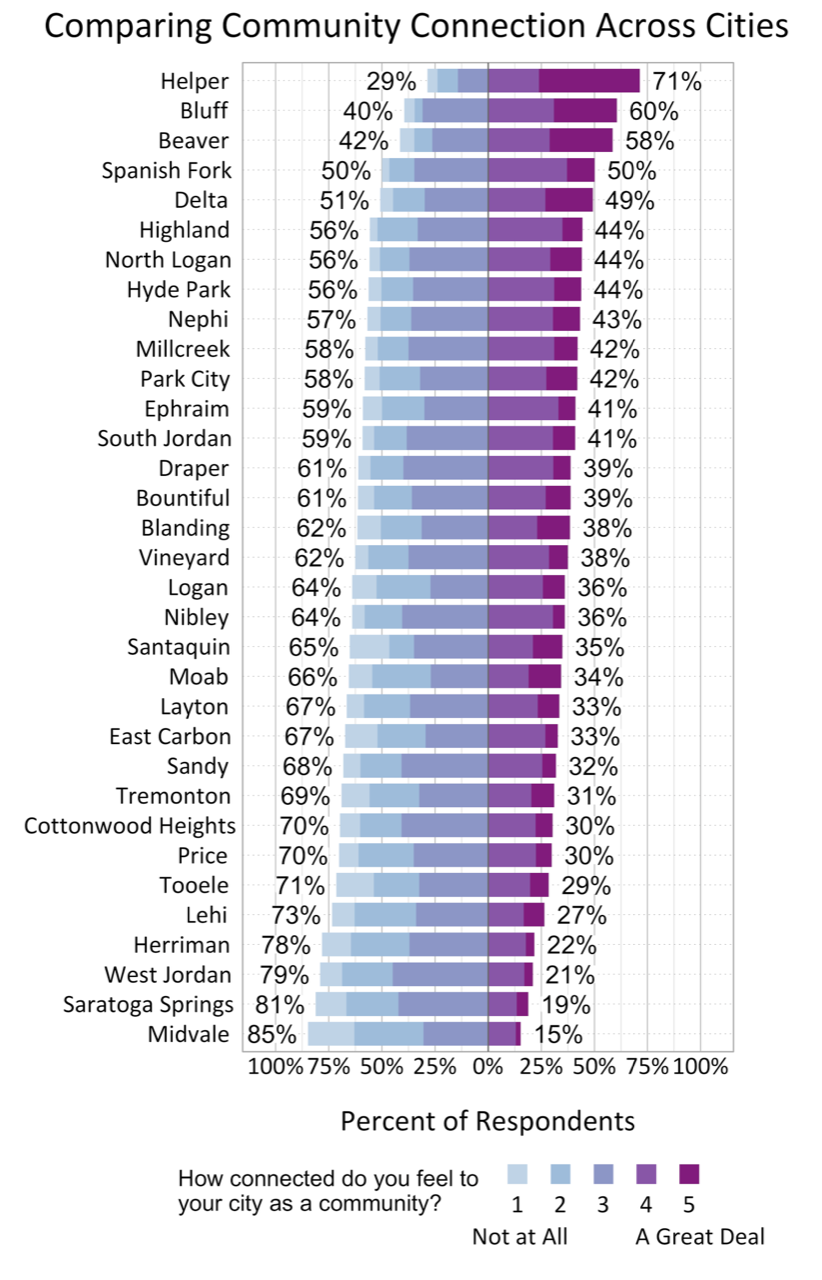
Perceptions that residents take action and feelings of community connection were higher in Bluff than in most other study communities. Latter-day Saints reported lower perceptions of local action than those from other religions or who indicated Agnostic/Atheist/No Religious Preference, and lower levels of community connection than those who indicated Agnostic/Atheist/No Religious Preference.

Many indicated that Population Growth Rate and the Pace of Economic Development was just right. 

Top concerns for the future of Bluff were:

  • Water Supply (92% Moderate or Major Concern)
  • Access to Quality Food (89% Moderate or Major Concern)
  • Affordable Housing (89% Moderate or Major Concern)
  • Opportunities for Youth (88% Moderate or Major Concern)
  • Climate Change (88% Moderate or Major Concern)

What do people value most about Bluff?
Positive social climate, peaceful and quiet place to live, and access to nature and surrounding natural beauty. 

Key Wellbeing Issues and Resource Areas

In addition to providing partner cities with the opportunity to take part in surveys, the Utah Wellbeing Project has worked to provide curated resources for community leaders and citizens that aim to improve specific aspects of wellbeing. These Wellbeing Resources can be found on the Utah Wellbeing Project Website, along with other useful tools and information.

Based on results of the 2022 Utah Wellbeing Project Surveys in Bluff City, key wellbeing issues include: Physical Health, Mental Health, Water Supply, Affordable Housing, and Access to Quality Food. Below you will find links to specific wellbeing resource areas we believe may be used to target some of these issues.

Survey Respondent Characteristics

Table 1

Full Time Residents of Bluff 84.4%
Part Time Residents of Bluff 15.6%
Length of Residency — Range 1- 48 years
Length of Residency — Average 15.9 years
Length of Residency — Median 14 years
Length of Residence 5 years or less 22.8%

Demographic characteristics of the survey respondents were compared below with U.S. Census information from the 2016-2020 American Community Survey. As the table shows, 2022 survey respondents were not fully representative of Bluff, though the Census information looks somewhat suspect. Some groups were likely under or over-represented in the survey responses. Not all respondents provided demographic information. Weighting was not used in any of the analysis for the findings presented below.

Table 2
Demographic Characteristics of Survey Respondents and U.S. Census Data for Bluff


Demographic Characteristics
Bluff Wellbeing Survey
American Community Survey

2016-2020 Estimates
Online 2022
83 Respondents 
Age 18-29 2.5% 20.0%
Age 30-39 13.9% 0.0%
Age 40-49 6.3% 0.0%
Age 50-59 12.7% 14.7%
Age 60-69 22.8% 57.3%
Age 70 or over 41.8% 8.0%
Adult Female 67.9% 56.7%
Adult Male 30.8% 43.3%
Adult non-conforming
or non-binary
1.3% NA
No college degree 15.2% 59.3%
College degree (4-year) 84.8% 40.7%
Median household income NA $71,250
Income under $25,000 11.4% 0.0%
Income $25,000 to $49,999 32.9% 39.3%
Income $50,000 to $74,999 16.5% 21.4%
Income $75,000 to $99,999 15.2% 39.3%
Income $100,000 to $149,999 12.7% 0.0%
Income $150,000 or over 11.4% 0.0%
Church of Jesus Christ of Latter-day Saints 2.6% NA
Other religion 32.1% NA
Agnostic/Atheist/No religious preference 65.4% NA
Hispanic/Latino 2.6% 0.0%
White 90.8% 72.7%
Nonwhite 9.2% 27.3%
Married 64.5% 54.0%
Children under 18 in household 17.7% 0.0%
Employed 50.6% 24.0%
Out of work and looking for work 0.0% 0.0%
Other 49.4% 76.0%
Own home/Owner occupied 75.9% 100.0%
Rent home/Renter occupied/Other 24.1% 0.0%

Overall Personal Wellbeing and Overall Wellbeing in Bluff

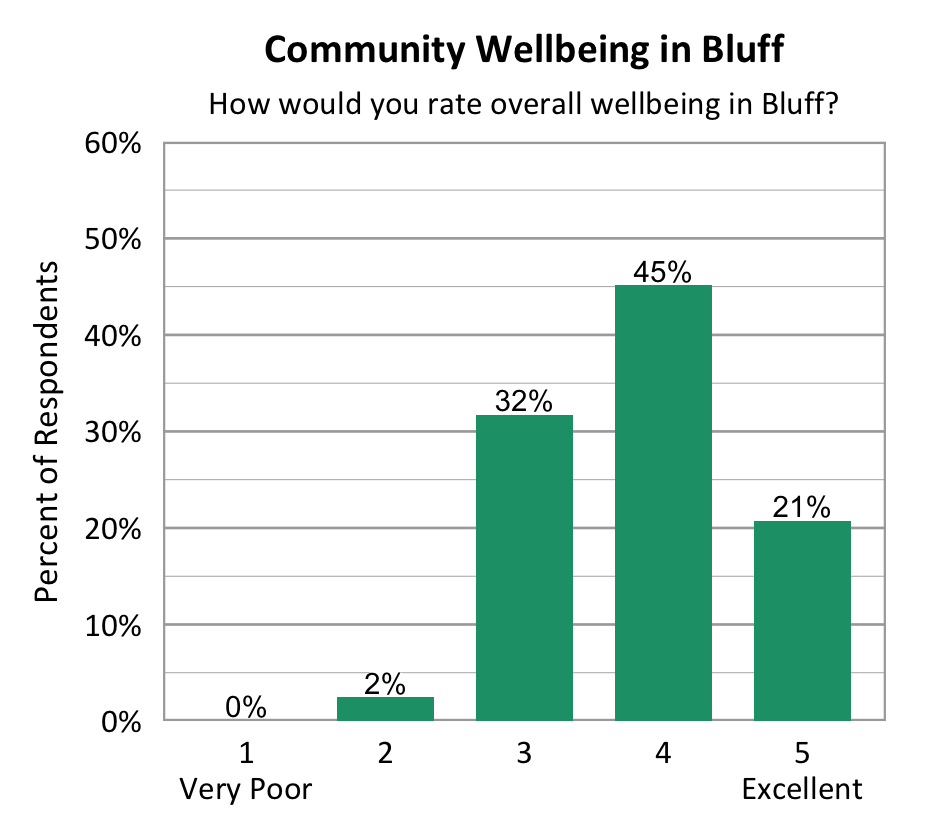
Survey participants were asked about their overall personal wellbeing and overall community wellbeing in Bluff. These wellbeing indicators were both measured on a 5-point scale from very poor (1) to excellent (5). The average personal wellbeing score in Bluff was 3.96 with 74% of respondents indicating their wellbeing at a 4 or 5 on the 5-point scale. The average score for community wellbeing in Bluff was 3.84 with 65% of respondents indicating city wellbeing at a 4 or 5 on the 5-point scale.
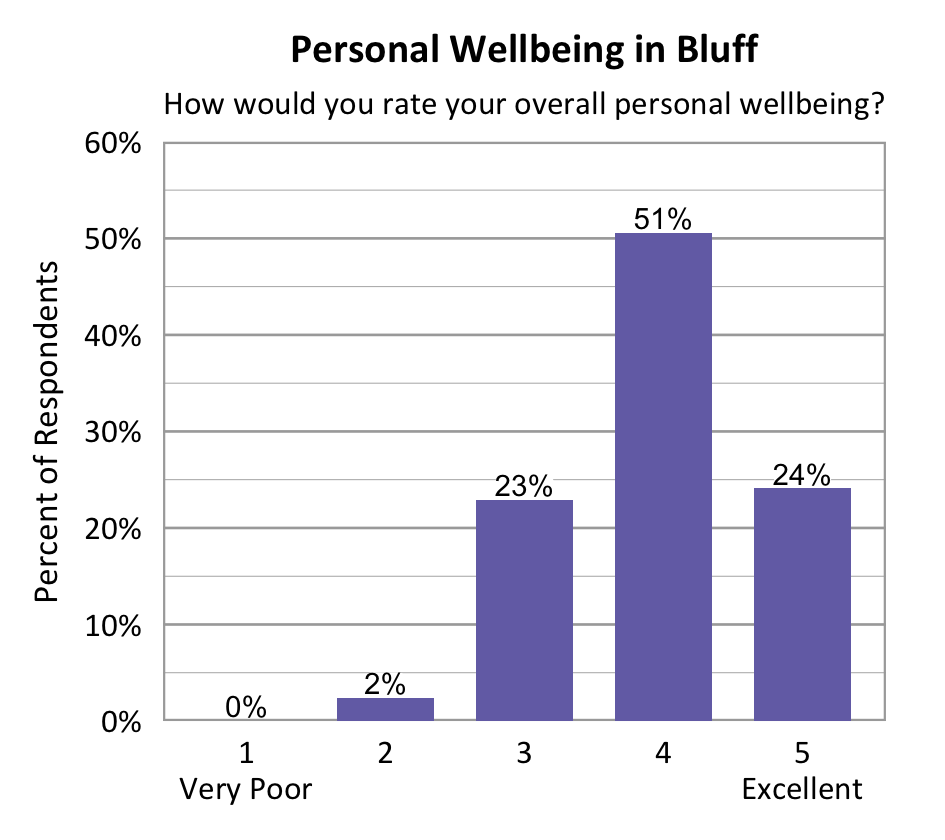
Bar chart. Title: Personal Wellbeing in Bluff. Subtitle: How would you rate your overall personal wellbeing? Data - 1 Very Poor: 0% of respondents; 2: 2% of respondents; 3: 23% of respondents; 4: 51% of respondents; 5 Excellent: 24% of respondents

Bar Chart. Title: Community Wellbeing in Bluff. Subtitle: How would you rate overall wellbeing in Bluff? Data - 1 Very Poor: 0% of respondents; 2: 2% of respondents; 3: 32% of respondents; 4: 45% of respondents; 5 Excellent: 21% of respondents

Comparing Wellbeing Across Utah Cities

The Utah League of Cities and Towns classifies Bluff as a Rural Hub/Resort Community (and we have combined these with the Traditional Rural Communities). Some cities may fit within more than one cluster. 

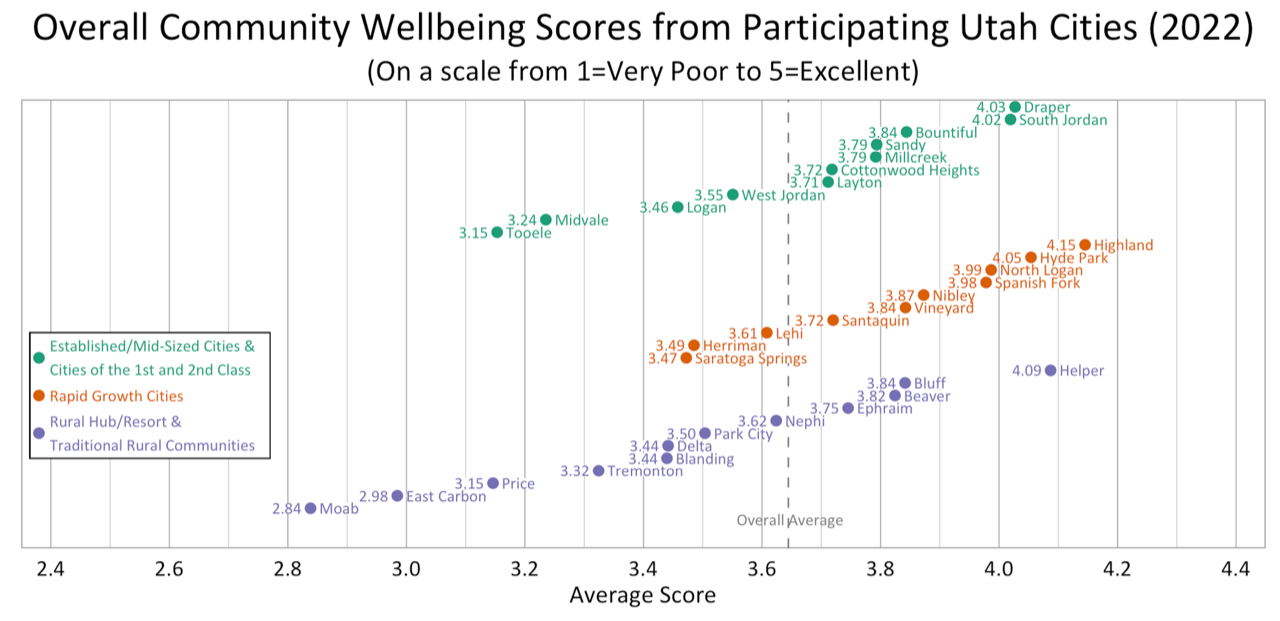
Within the Rural city cluster, Bluff fell above the cluster average in terms of the average overall personal wellbeing and community wellbeing scores. Bluff was statistically significantly higher than Moab in terms of overall personal wellbeing, but not significantly different from any other city in the cluster. In terms of overall community wellbeing, Bluff was significantly higher than all other cities in the cluster except for Park City, Nephi, Ephraim, Beaver, and Helper. Margins of error are particularly high for Delta, Helper, Midvale, and Santaquin due to low survey response.
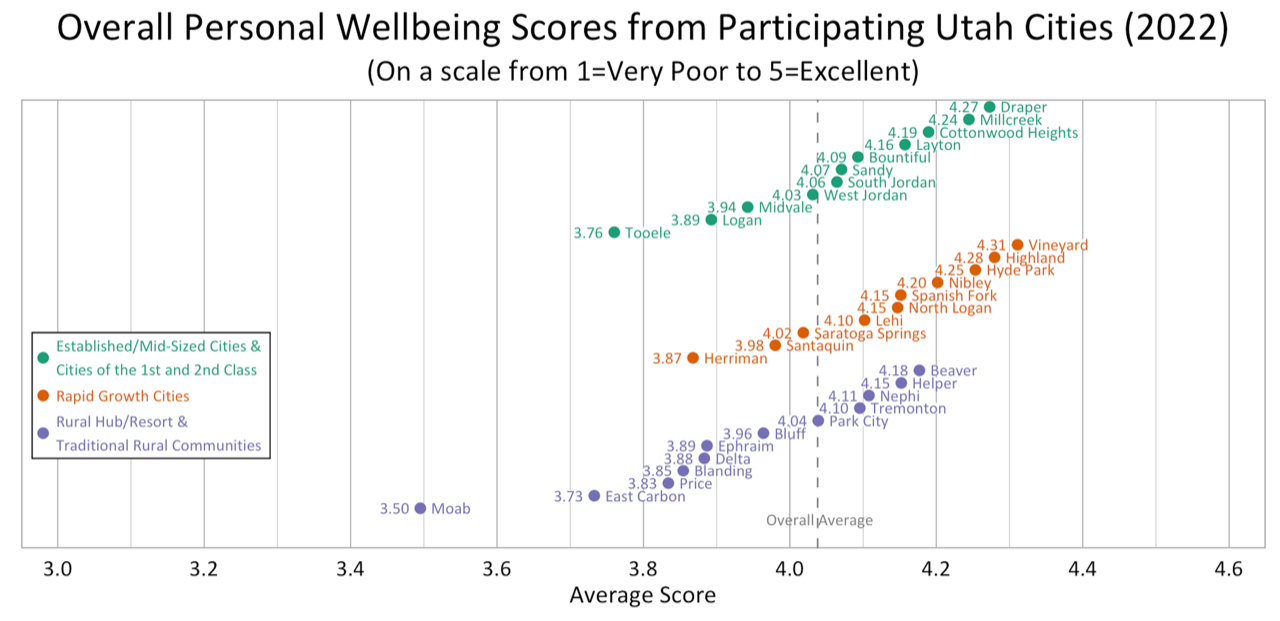
Dot Plot. Title: Overall Personal Wellbeing Scores from Participating Utah Cities (2022). Subtitle: (On a scale from 1=Very Poor to 5=Excellent). Group: Established/Mid-Sized Cities. Draper: Average Score 4.27; Millcreek: Average Score 4.24; Cottonwood Heights: Average Score 4.19; Layton: Average Score 4.16; Bountiful: Average Score 4.09; Sandy: Average Score 4.07; South Jordan: Average Score 4.06; West Jordan: Average Score 4.03; Midvale: Average Score 3.94; Logan: Average Score 3.89; Tooele: Average Score 3.76. Group: Rapid Growth Cities. Vineyard: Average Score 4.31; Highland: Average Score 4.28; Hyde Park: Average Score 4.25; Nibley: Average Score 4.20; Spanish Fork: Average Score 4.15; North Logan: Average Score 4.15; Lehi: Average Score 4.10; Saratoga Springs: Average Score 4.02; Santaquin: Average Score 3.98; Herriman: Average Score 3.87. Group: Rural, Rural Hub, & Resort and Traditional Communities. Beaver: Average Score 4.18; Helper: Average Score 4.15; Nephi: Average Score 4.11; Tremonton: Average Score 4.10; Park City: Average Score 4.04; Bluff: Average Score 3.96; Ephraim: Average Score 3.89; Delta: Average Score 3.88; Blanding: Average Score: 3.85; Price: Average Score 3.83; East Carbon: Average Score: 3.73; Moab: Average Score: 3.50. 

Dot Plot. Title: Overall Community Wellbeing Scores from Participating Utah Cities (2022). Subtitle: (On a scale from 1=Very Poor to 5=Excellent). Group: Established/Mid-Sized Cities. Draper: Average Score 4.03; South Jordan: Average Score 4.02; Bountiful: Average Score 3.84; Sandy: Average Score 3.79; Millcreek: Average Score 3.79; Cottonwood Heights: Average Score 3.72; Layton: Average Score 3.71; West Jordan: Average Score 3.55; Logan: Average Score 3.46; Midvale: Average Score 3.24; Tooele: Average Score 3.15. Group: Rapid Growth Cities. Highland: Average Score 4.15; Hyde Park: Average Score 4.05; North Logan: Average Score 3.99; Spanish Fork: Average Score 3.98; Nibley: Average Score 3.87; Vineyard: Average Score 3.84; Santaquin: Average Score 3.72; Lehi: Average Score 3.61; Herriman: Average Score 3.49; Saratoga Springs: Average Score 3.47. Group: Rural, Rural Hub, & Resort and Traditional Communities. Helper: Average Score 4.09; Bluff: Average Score 3.84; Beaver: Average Score 3.82; Ephraim: Average Score 3.75; Nephi: Average Score 3.62; Park City: Average Score 3.50; Delta: Average Score 3.44; Blanding: Average Score 3.44; Tremonton: Average Score: 3.32; Price: Average Score 3.15; East Carbon: Average Score: 2.98; Moab: Average Score: 2.84. 

Wellbeing Domains in Bluff

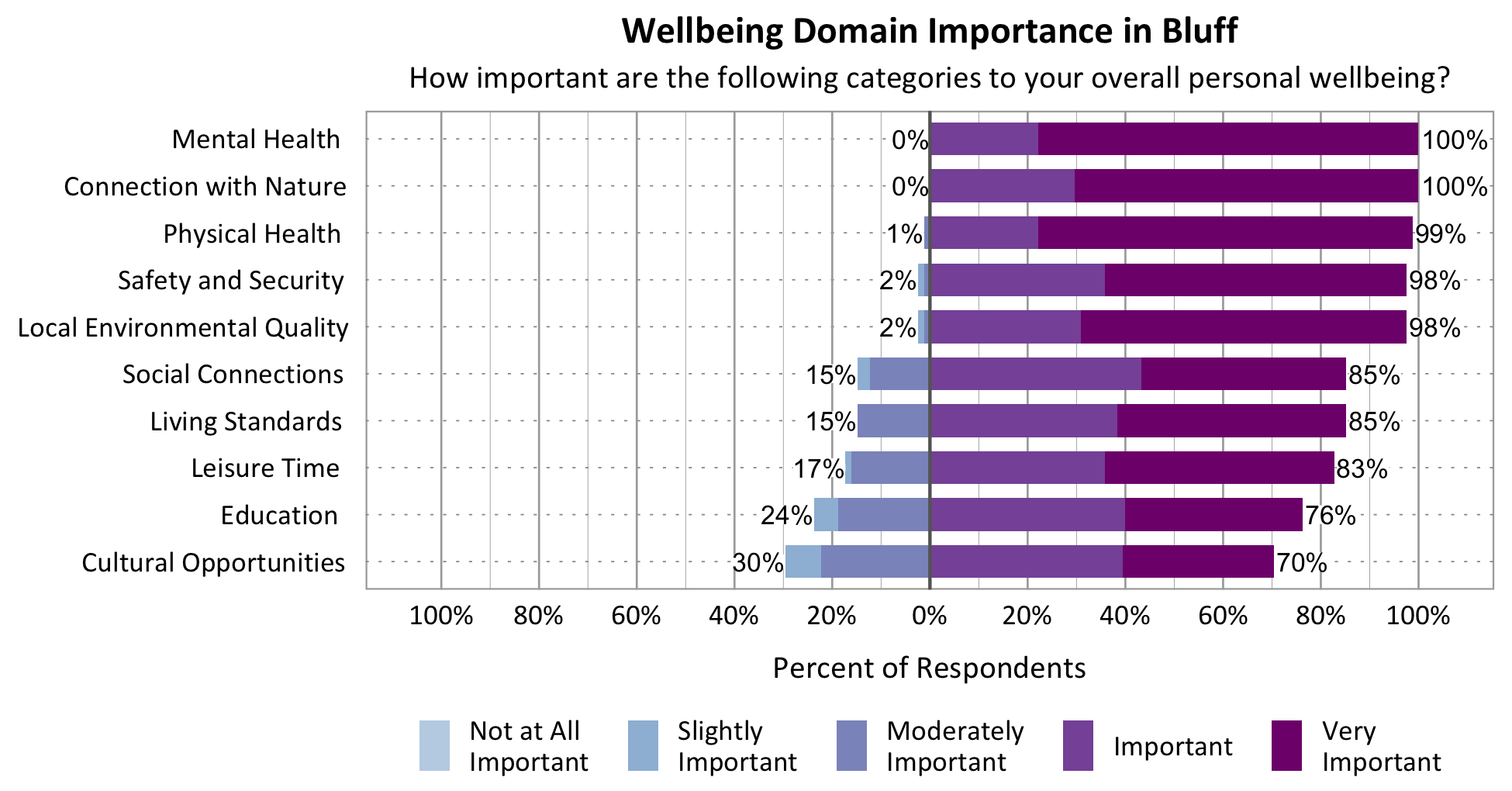
According to national and international entities that track wellbeing, there are a number of common dimensions or domains of wellbeing. In this survey, respondents rated ten domains on a 5-point scale from poor to excellent, suggesting how their wellbeing was doing in each area. They were also asked to indicate the importance of each domain to their overall personal wellbeing on a 5-point scale from not at all important to very important. The top four highest rated wellbeing domains for respondents in Bluff were Local Environmental Quality (88%), Connection with Nature (87%), Safety and Security (83%), and Physical Health (76%). The four most important wellbeing domains were Mental Health (100%), Connection with Nature (100%), Physical Health (99%), and Safety and Security (98%).

Likert Graph. Title: Wellbeing Domain Ratings in Bluff. Subtitle: How would you rate your level of personal wellbeing in each of the following categories? Category: Safety and Security - 17% of respondents rated as poor, fair, or moderate while 83% rated as good or excellent; Category: Connection with Nature - 13% of respondents rated as poor, fair, or moderate while 87% rated as good or excellent; Category: Local Environmental Quality- 12% of respondents rated as poor, fair, or moderate while 88% rated as good or excellent; Category: Education - 41% of respondents rated as poor, fair, or moderate while 59% rated as good or excellent; Category: Living Standards - 27% of respondents rated as poor, fair, or moderate while 73% rated as good or excellent; Category: Mental Health - 28% of respondents rated as poor, fair, or moderate while 72% rated as good or excellent; Category: Leisure Time - 24% of respondents rated as poor, fair or moderate while 76% rated as good or excellent; Category: Physical Health - 24% of respondents rated as poor, fair, or moderate while 76% rated as good or excellent; Category: Social Connections - 31% of respondents rated as poor, fair, or moderate while 69% rated as good or excellent; Category: Cultural Opportunities - 46% of respondents rated as poor, fair or moderate while 54% rated as good or excellent.

Likert Graph. Title: Wellbeing Domain Importance in Bluff. Subtitle: How important are the following categories to your overall personal wellbeing? Category: Safety and Security - 2% of respondents rated as not at all important, slightly important, or moderately important while 98% rated as important or very important; Category: Mental Health - 0% of respondents rated as not at all important, slightly important, or moderately important while 100% rated as important or very important; Category: Physical Health - 1% of respondents rated as not at all important, slightly important, or moderately important while 99% rated as important or very important; Category: Living Standards - 15% of respondents rated as not at all important, slightly important, or moderately important while 85% rated as important or very important; Category: Connection with Nature - 0% of respondents rated as not at all important, slightly important, or moderately important while 100% of respondents rated as important or very important; Category: Leisure Time - 17% of respondents rated as not at all important, slightly important, or moderately important while 83% rated as important or very important; Category: Local Environmental Quality - 2% of respondents rated as not at all important, slightly important, or moderately important while 98% rated as important or very important; Category: Social Connections - 15% rated as not at all important, slightly important, or moderately important while 85% rated as important or very important; Category: Education - 24% of respondents rated as not at all important, slightly important, or moderately important while 76% rated as important or very important; Category: Cultural Opportunities - 30% rated as not at all important, slightly important, or moderately important while 70% rated as important or very important

Wellbeing Matrix for Bluff

The graph below illustrates the relationship between the average rating and the average importance of wellbeing domains for survey respondents from Bluff. Safety and Security, Connection with Nature, and Local Environmental Quality were highly important and rated above average among the domains. Physical Health and Mental Health fell in the “red zone” of higher importance, but lower ratings.
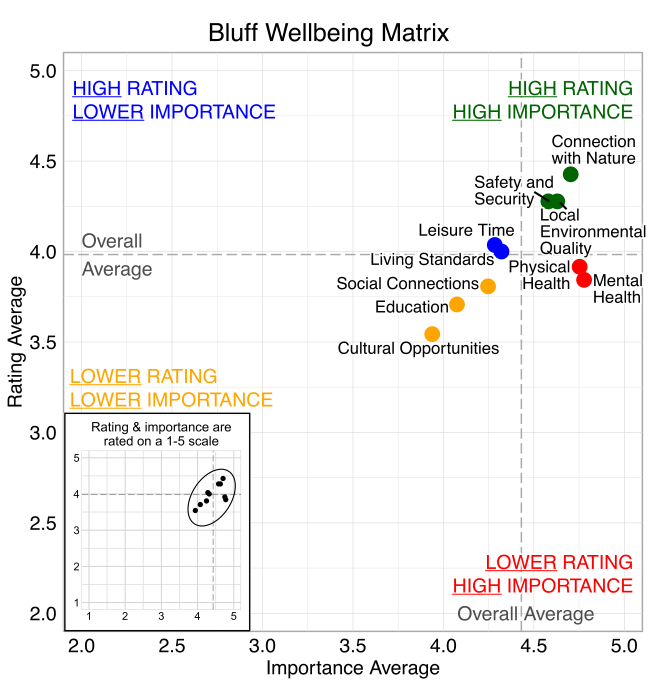
Scatterplot. Title: Bluff Wellbeing Matrix. Domains are classified into four quadrants depending on their average rating and average importance as compared to the average of all the average domain ratings and the average of all the average domain importance ratings. High rating, high importance (green quadrant) domains include: Safety and Security, Connection with Nature, and Local Environmental Quality. High rating, lower Importance (blue quadrant) domains include: Leisure Time and Living Standards. Lower rating, lower importance (yellow quadrant) domains include: Social Connections, Cultural Opportunities, Education, and Living Standards. Lower rating, high importance (red quadrant) domains include: Physical Health and Mental Health.

How are Demographic Characteristics Related to Wellbeing?

The demographic variables for age, gender, college degree, religion, income, and length of residence were found to have varying relationships among Bluff respondents as shown in the table below based on a generalized linear model with unweighted data. The +/- sign indicates whether the wellbeing score in the specific demographic group was significantly higher or lower than the reference group in each demographic variable (p<.05). 

Table 3
Relationship Between Demographic Characteristics and Wellbeing Domains in Bluff

Domains Rated Demographic Variables
Age 60+ Female College Degree Latter-day Saint Highest Income ($150,000+) Resident 5 Years or Less
Wellbeing Ratings
Overall Personal Wellbeing          
Wellbeing in Bluff      
Connection with Nature  
vs 40-59
       
Cultural Opportunities      
Education  
vs 40-59
     
vs Other 
 
Leisure Time  
       
Living Standards  
     
vs Other 
 
Local Environmental Quality        
Mental Health  
     
Physical Health  
vs 40-59
 
Safety & Security      
Social Connections      
  Age 60+ Female College Degree Latter-day Saint Highest Income ($150,000+) Resident 5 Years or Less
Domains Domain Importance
Connection with Nature     +      
Cultural Opportunities            
Education            
Leisure Time            
Living Standards            
Local Environmental Quality  
vs 18-39
         
Mental Health          
Physical Health            
Safety and Security   +        
Social Connections            
A/A/NRP = Agnostic/Atheist/No Religious Preference

Community Action and Connection in Bluff

Survey participants were asked about community actions and community connection in Bluff. Both questions were scored on a 5-point scale from not at all (1) to a great deal (5). When asked about the degree to which people take action together in response to local problems or opportunities in Bluff, the average score was 3.98. When asked about the degree they feel connected to their community, the average score was 3.77.
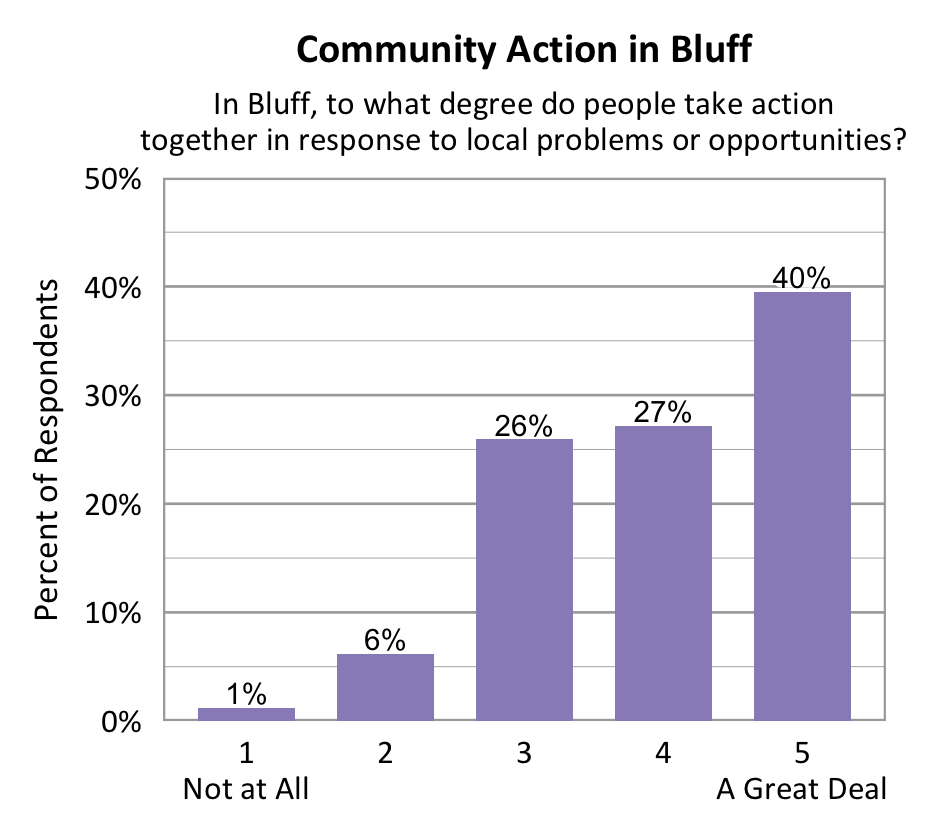
Bar chart. Title: Community Action in Bluff. Subtitle: In Bluff, to what degree do people take action together in response to local problems or opportunities? Data - 1 Not at All: 1% of respondents; 2: 6% of respondents; 3: 26% of respondents; 4: 27% of respondents; 5 A Great Deal: 40% of respondents

Bar chart. Title: Community Connection in Bluff. Subtitle: How connected do you feel to Bluff as a community? Data - 1 Not at All: 5% of respondents; 2: 4% of respondents; 3: 31% of respondents; 4: 31% of respondents; 5 A Great Deal: 30% of respondents

Latter-day Saints reported lower levels of community connection than those who indicated Agnostic/Atheist/No Religious Preference and lower perceptions of local action than those who indicated Agnostic/Atheist/No Religious Preference or Other Religion. Those from the highest income category ($150,000+) reported lower levels of community action than those with incomes between $75,000 and $99,999. This was based on a generalized linear model with unweighted data (p < 0.05).

Table 4
Demographic Characteristics and Community Questions

Community Questions Age 60+ Female College Degree Latter-day Saint Highest Income ($150,000+) Resident 5 Years or Less
Do people in Bluff take action?      

   
Do you feel connected to your community?

   
vs A/A/NP

vs $75,000 - $99,999
 

A significant, positive relationship was found between individuals’ community connection and overall personal wellbeing.
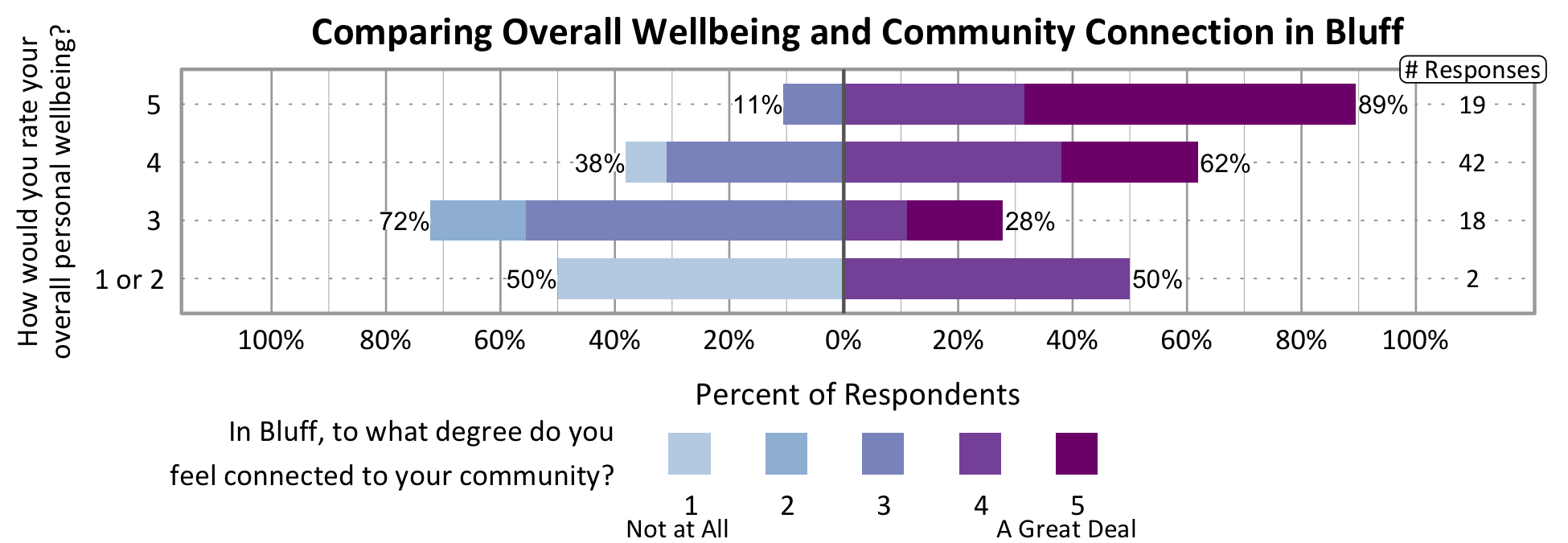
Likert Graph. Title: Comparing Overall Wellbeing and Community Connection in Bluff. Of the 2 respondents that rate their overall personal wellbeing as a 1 or 2, 50% indicate a community connection score of 1, 2, or 3 while 50% indicate a community connection score of 4 or 5. Of the 18 respondents that rate their overall personal wellbeing as a 3, 72% indicate a community connection score of 1, 2, or 3 while 28% indicate a community connection score of 4 or 5. Of the 42 respondents that rate their overall personal wellbeing as a 4, 38% indicate a community connection score of 1, 2, or 3 while 62% indicate a community connection score of 4 or 5. Of the 19 participants that rate their overall wellbeing as a 5, 11% indicate a community connection score of 1, 2, or 3 while 89% indicate a community connection score of 4 or 5.

Comparing Community Action and Connection Across Cities

The graphs below show how Wellbeing Project cities compare on the degree to which people take action in response to local problems and opportunities and how connected people feel to their city as a community. Bluff was in the top 3 on perceived community action and community connection based on the number of people indicating a 4 or 5 on a 5-point scale. Margins of error are particularly high for Delta, Helper, Midvale, and Santaquin due to low survey response.
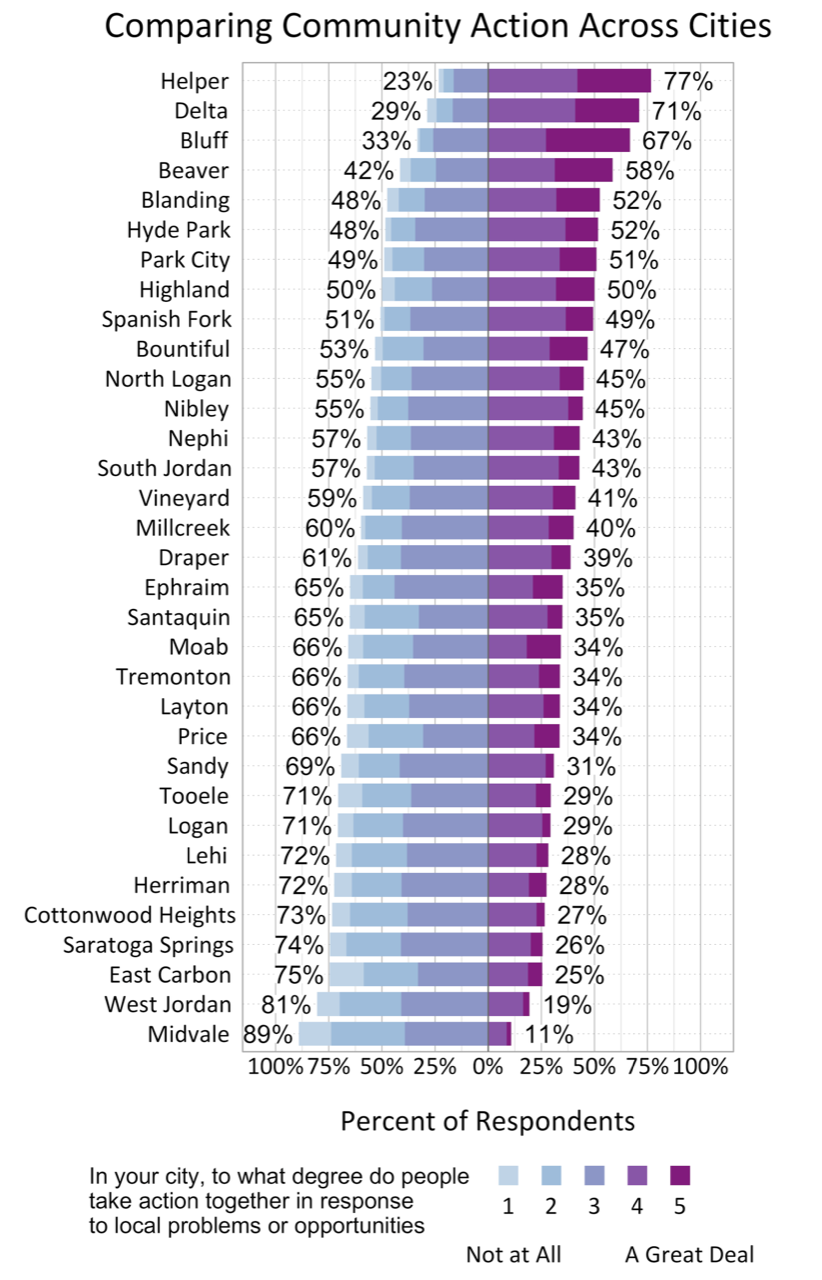
Likert Graph. Title: Comparing Community Action Across Cities. Subtitle: In your city to what degree do people take action together in response to local problems or opportunities? 1 being not at all. 5 being a great deal. Data – City: Helper- 23% of respondents indicate a community action score of 1, 2, or 3 while 77% indicate a community action score of 4 or 5; City: Delta 29% of respondents indicate a community action score of 1, 2, or 3 while 71% indicate a community action score of 4 or 5; City: Bluff 33% of respondents indicate a community action score of 1, 2, or 3 while 67% indicate a community action score of 4 or 5; City: Beaver 42% of respondents indicate a community action score of 1, 2, or 3 while 58% indicate a community action score of 4 or 5; City: Blanding 48% of respondents indicate a community action score of 1, 2, or 3 while 52% indicate a community action score of 4 or 5; City: Hyde Park 48% of respondents indicate a community action score of 1, 2, or 3 while 52% indicate a community action score of 4 or 5; City: Highland 50% of respondents indicate a community action score of 1, 2, or 3 while 50% indicate a community action score of 4 or 5; City: Spanish Fork 51% of respondents indicate a community action score of 1, 2, or 3 while 49% indicate a community action score of 4 or 5; City: Bountiful 53% of respondents indicate a community action score of 1, 2, or 3 while 47% indicate a community action score of 4 or 5; City: North Logan 55% of respondents indicate a community action score of 1, 2, or 3 while 45% indicate a community action score of 4 or 5; City: Nibley 55% of respondents indicate a community action score of 1, 2, or 3 while 45% indicate a community action score of 4 or 5; City: Nephi 57% of respondents indicate a community action score of 1, 2, or 3 while 43% indicate a community action score of 4 or 5; City: South Jordan 57% of respondents indicate a community action score of 1, 2, or 3 while 43% indicate a community action score of 4 or 5; City: Vineyard 59% of respondents indicate a community action score of 1, 2, or 3 while 41% indicate a community action score of 4 or 5; City: Millcreek 60% of respondents indicate a community action score of 1, 2, or 3 while 40% indicate a community action score of 4 or 5; City: Draper 61% of respondents indicate a community action score of 1, 2, or 3 while 39% indicate a community action score of 4 or 5; City: Ephraim 65% of respondents indicate a community action score of 1, 2, or 3 while 35% indicate a community action score of 4 or 5; City: Santaquin 65% of respondents indicate a community action score of 1, 2, or 3 while 35% indicate a community action score of 4 or 5; City: Moab 66% of respondents indicate a community action score of 1, 2, or 3 while 34% indicate a community action score of 4 or 5; City: Tremonton 66% of respondents indicate a community action score of 1, 2, or 3 while 34% indicate a community action score of 4 or 5; City: Layton 66% of respondents indicate a community action score of 1, 2, or 3 while 34% indicate a community action score of 4 or 5; City: Price 66% of respondents indicate a community action score of 1, 2, or 3 while 34% indicate a community action score of 4 or 5; City: Sandy 69% of respondents indicate a community action score of 1, 2, or 3 while 31% indicate a community action score of 4 or 5; City: Tooele 71% of respondents indicate a community action score of 1, 2, or 3 while 29% indicate a community action score of 4 or 5; City: Logan 71% of respondents indicate a community action score of 1, 2, or 3 while 29% indicate a community action score of 4 or 5; City: Lehi 72% of respondents indicate a community action score of 1, 2, or 3 while 28% indicate a community action score of 4 or 5; City: Herriman 72% of respondents indicate a community action score of 1, 2, or 3 while 28% indicate a community action score of 4 or 5; City: Cottonwood Heights 73% of respondents indicate a community action score of 1, 2, or 3 while 27% indicate a community action score of 4 or 5; City: Saratoga Springs 74% of respondents indicate a community action score of 1, 2, or 3 while 26% indicate a community action score of 4 or 5; East Carbon 75% of respondents indicate a community action score of 1, 2, or 3 while 25% indicate a community action score of 4 or 5; West Jordan 81% of respondents indicate a community action score of 1, 2, or 3 while 19% indicate a community action score of 4 or 5; Midvale 89% of respondents indicate a community action score of 1, 2, or 3 while 11% indicate a community action score of 4 or 5.

Likert Graph. Title: Comparing Community Connection Across Cities. Subtitle: How connected do you feel to your city as a community? 1 being not at all. 5 being a great deal. Data – City: Helper 29% of respondents indicate a community action score of 1, 2, or 3 while 71% indicate a community action score of 4 or 5; City: Bluff 40% of respondents indicate a community action score of 1, 2, or 3 while 60% indicate a community action score of 4 or 5; City: Beaver 42% of respondents indicate a community action score of 1, 2, or 3 while 58% indicate a community action score of 4 or 5; City: Spanish Fork 50% of respondents indicate a community action score of 1, 2, or 3 while 50% indicate a community action score of 4 or 5; City: Delta- 51% of respondents indicate a community action score of 1, 2, or 3 while 49% indicate a community action score of 4 or 5; City: Highland- 56% of respondents indicate a community action score of 1, 2, or 3 while 44% indicate a community action score of 4 or 5; City: North Logan- 56% of respondents indicate a community action score of 1, 2, or 3 while 44% indicate a community action score of 4 or 5; City: Hyde Park- 56% of respondents indicate a community action score of 1, 2, or 3 while 44% indicate a community action score of 4 or 5; City: Nephi- 57% of respondents indicate a community action score of 1, 2, or 3 while 43% indicate a community action score of 4 or 5; City: Millcreek- 58% of respondents indicate a community action score of 1, 2, or 3 while 42% indicate a community action score of 4 or 5; City: Park City- 58% of respondents indicate a community action score of 1, 2, or 3 while 42% indicate a community action score of 4 or 5; City: Ephraim- 59% of respondents indicate a community action score of 1, 2, or 3 while 41% indicate a community action score of 4 or 5; City: South Jordan- 59% of respondents indicate a community action score of 1, 2, or 3 while 41% indicate a community action score of 4 or 5; City: Draper- 61% of respondents indicate a community action score of 1, 2, or 3 while 39% indicate a community action score of 4 or 5; City: Bountiful- 61% of respondents indicate a community action score of 1, 2, or 3 while 39% indicate a community action score of 4 or 5; City: Blanding- 62% of respondents indicate a community action score of 1, 2, or 3 while 38% indicate a community action score of 4 or 5; City: Vineyard- 62% of respondents indicate a community action score of 1, 2, or 3 while 38% indicate a community action score of 4 or 5; City: Logan- 64% of respondents indicate a community action score of 1, 2, or 3 while 36% indicate a community action score of 4 or 5; City: Nibley- 64% of respondents indicate a community action score of 1, 2, or 3 while 36% indicate a community action score of 4 or 5; City: Santaquin- 65% of respondents indicate a community action score of 1, 2, or 3 while 35% indicate a community action score of 4 or 5; City: Moab- 66% of respondents indicate a community action score of 1, 2, or 3 while 34% indicate a community action score of 4 or 5; City: Layton- 67% of respondents indicate a community action score of 1, 2, or 3 while 33% indicate a community action score of 4 or 5; City: East Carbon- 67% of respondents indicate a community action score of 1, 2, or 3 while 33% indicate a community action score of 4 or 5; City: Sandy- 68% of respondents indicate a community action score of 1, 2, or 3 while 32% indicate a community action score of 4 or 5; City: Tremonton- 69% of respondents indicate a community action score of 1, 2, or 3 while 31% indicate a community action score of 4 or 5; City: Cottonwood Heights- 70% of respondents indicate a community action score of 1, 2, or 3 while 30% indicate a community action score of 4 or 5; City: Price- 70% of respondents indicate a community action score of 1, 2, or 3 while 30% indicate a community action score of 4 or 5; City: Tooele- 71% of respondents indicate a community action score of 1, 2, or 3 while 29% indicate a community action score of 4 or 5; City: Lehi- 73% of respondents indicate a community action score of 1, 2, or 3 while 27% indicate a community action score of 4 or 5; City: Herriman- 78% of respondents indicate a community action score of 1, 2, or 3 while 22% indicate a community action score of 4 or 5; City: West Jordan- 79% of respondents indicate a community action score of 1, 2, or 3 while 21% indicate a community action score of 4 or 5; City: Saratoga Springs- 81% of respondents indicate a community action score of 1, 2, or 3 while 19% indicate a community action score of 4 or 5; City: Midvale- 85% of respondents indicate a community action score of 1, 2, or 3 while 15% indicate a community action score of 4 or 5.

Participation in Recreation and Nature-Related Activities

Respondents were asked to indicate whether or not they participated in eight different recreation or nature-based activities in the past 12 months. Enjoying wildlife or birds in your yard or neighborhood (98%) was the most common activity for respondents, followed by non-motorized recreation on public lands or waters (91%) and watching or reading nature-related programs or publications (84%).
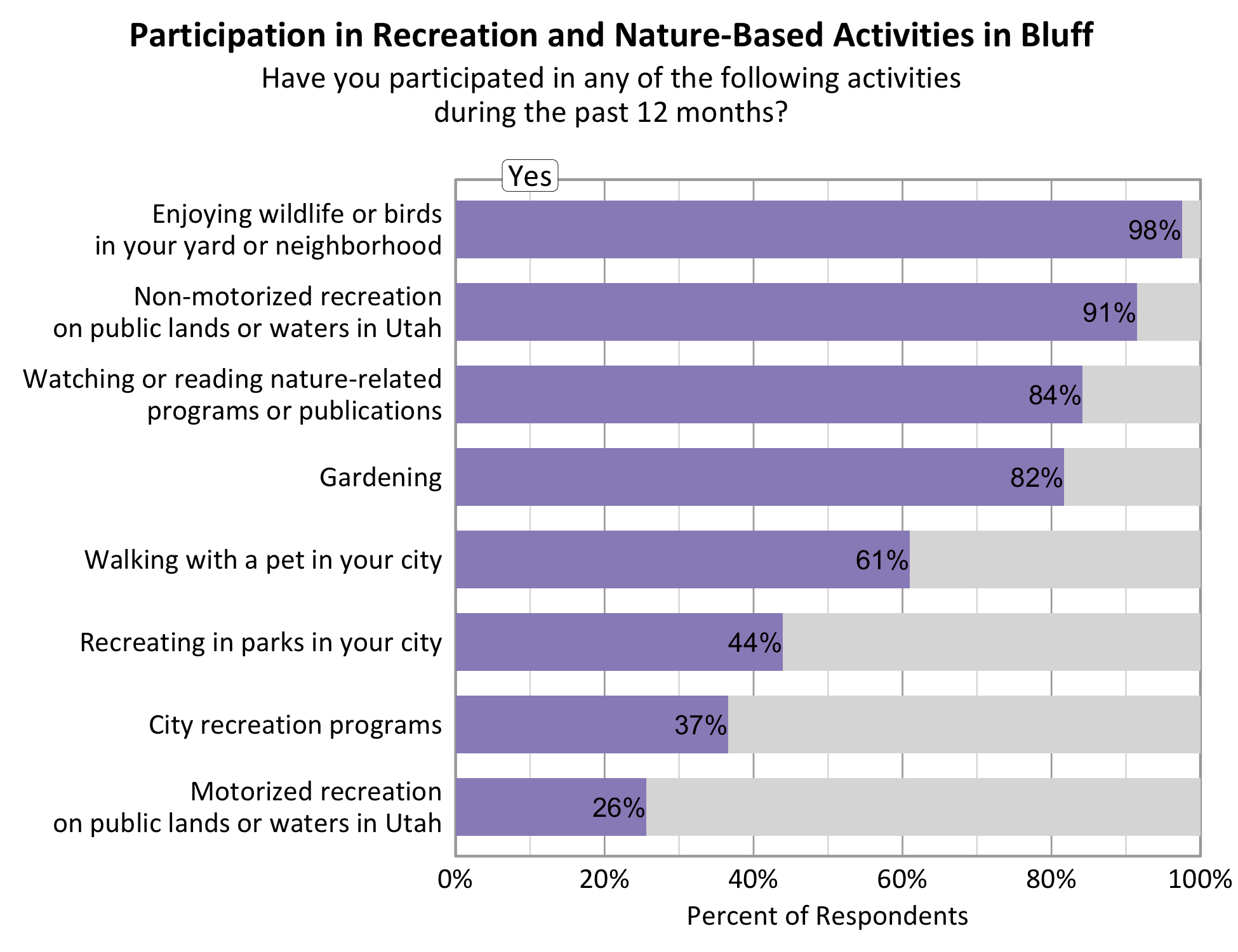
Type: Bar Graph Title: Participation in Recreation and Nature-based Activities in Bluff. Subtitle: Have you participated in any of the following activities during the past 12 months? Data - 91% of respondents indicated yes to non-motorized recreation on public lands or waters in Utah. 98% of respondents indicated yes to enjoying wildlife or birds in your yard or neighborhood. 26% of respondents indicated yes to motorized recreation on public lands or waters in Utah. 44% of respondents indicated yes to recreating in parks in your city. 82% of respondents indicated yes to gardening. 37% of respondents indicated yes to city recreation programs. 84% of respondents indicated yes to watching or reading nature-related programs or publications. 61% of respondents indicated yes to walking with a pet in your city.

For Bluff respondents, participating in city recreation programs and walking a pet were positively and significantly related to overall personal wellbeing and community wellbeing.

Participating in city recreation programs and recreating in city parks were positively and significantly related to community connection. 

Influence of Landscape on Wellbeing

Survey participants were asked about the influence of landscape features on their wellbeing. Natural landscapes including mountains, trails, red rock, and rivers and streams were found to have an overwhelmingly positive influence on wellbeing. In terms of development and industry in the landscape, respondents were more divided. There was a particularly strong negative perception of extractive industry among Bluff respondents.
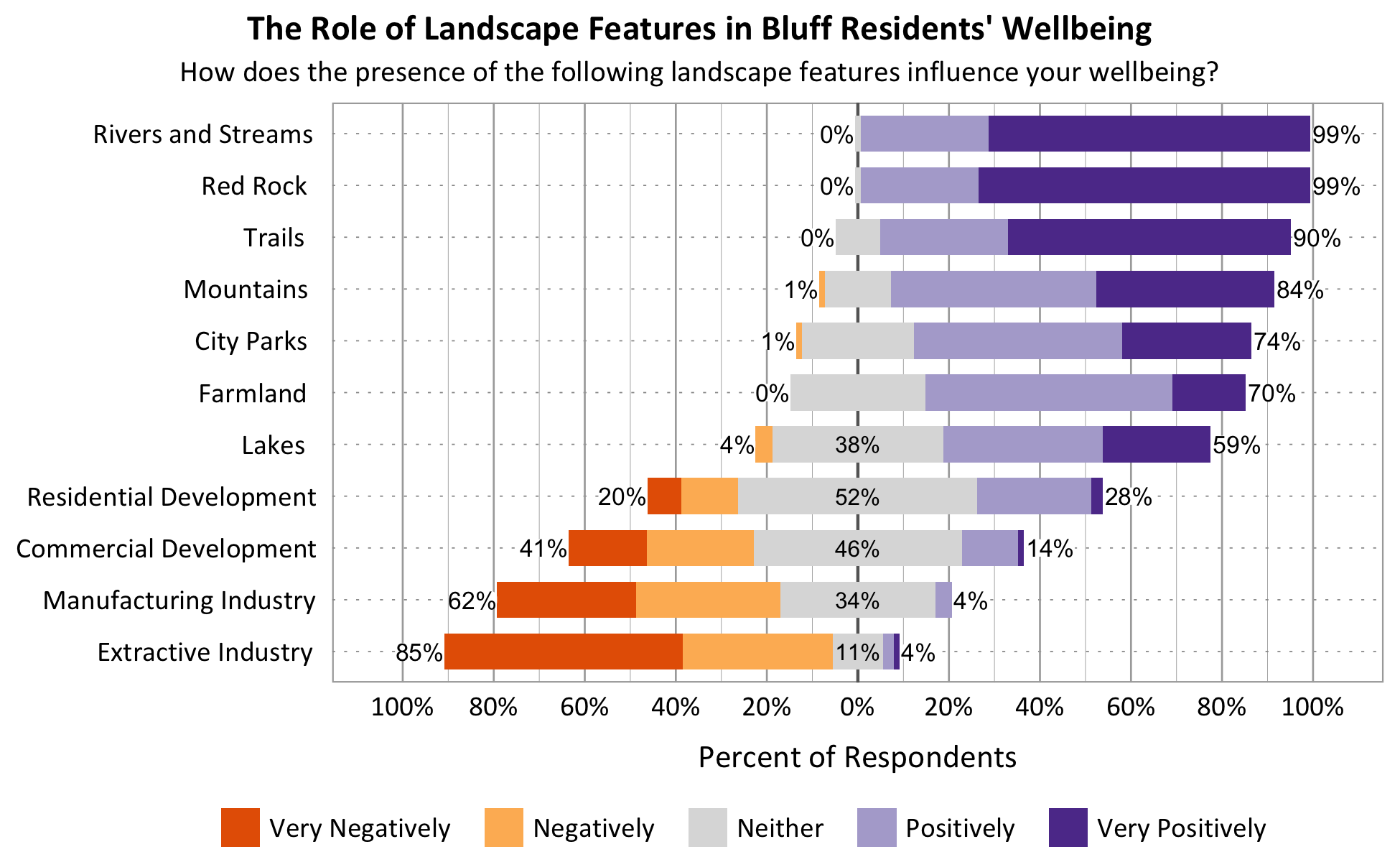
Likert Graph. Title: The Role of Landscape Features in Bluff Residents' Wellbeing. Subtitle: How does the presence of the following landscape features influence your wellbeing? Feature: Mountains - 1% of respondents indicated very negatively or negatively,15% indicated neither, 84% indicated positively or very positively; Feature: Rivers and Streams - 0% of respondents indicated very negatively or negatively, 1% indicated neither, 99% indicated positively or very positively; Feature: Lakes - 4% of respondents indicated very negatively or negatively, 37% indicated neither, 59% indicated positively or very positively; Feature: Trails - 0% of respondents indicated very negatively or negatively, 10% indicated neither, 90% indicated positively or very positively; Feature: Red Rock - 0% of respondents indicated very negatively or negatively, 1% indicated neither, 99% indicated positively or very positively; Feature: City Parks - 1% of respondents indicated very negatively or negatively, 25% indicated neither, 74% indicated positively or very positively; Feature: Farmland - 0% of respondents indicated very negatively or negatively, 30% indicated neither, 70% indicated positively or very positively; Feature: Residential Development - 20% of respondents indicated very negatively or negatively, 52% indicated neither, 28% indicated positively or very positively; Feature: Commercial Development - 41% of respondents indicated very negatively or negatively, 46% indicated neither, 14% indicated positively or very positively; Feature: Extractive Industry - 85% of respondents indicated very negatively or negatively, 11% indicated neither, 4% indicated positively or very positively; Feature: Manufacturing Industry - 62% of respondents indicated very negatively or negatively, 34% indicated neither, 4% indicated positively or very positively.

Perspectives on Population Growth and Economic Development

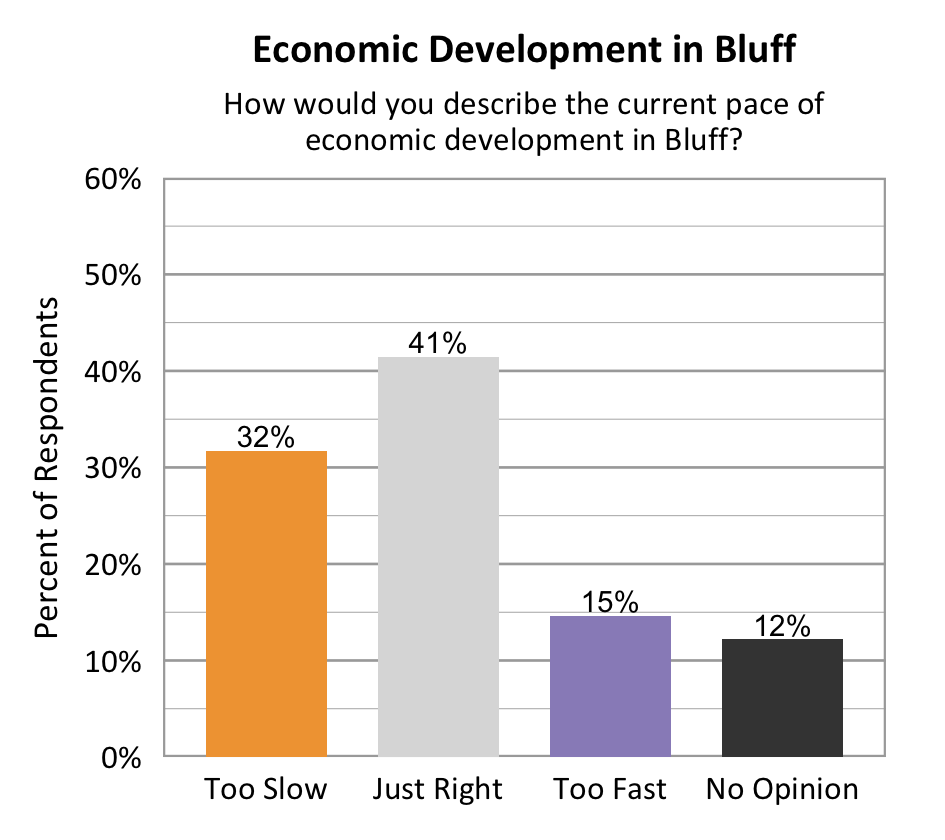
The majority of respondents in Bluff indicated that they felt population growth was just right (55%). On the pace of economic development, 41% indicated it was just right, 32% too slow, and 15% too fast.

Type: Bar graph. Title: Population Growth in Bluff. Subtitle: How would you describe the current rate of population growth in Bluff? Data – 18% of respondents rated too slow; 55% of respondents rated just right; 11% of respondents rated too fast; 16% of respondents rated no opinion.

Type: Bar graph. Title: Economic Development in Bluff. Subtitle: How would you describe the current pace of economic development in Bluff? Data – 32% of respondents rated too slow; 41% of respondents rated just right; 15% of respondents rated too fast; 12% of respondents rated no opinion.

The graphs below show how Bluff compares to other participating cities in the Wellbeing Project on these perceptions of population growth and economic development in 2022. Margins of error are particularly high for Delta, Helper, Midvale, and Santaquin due to low survey response.
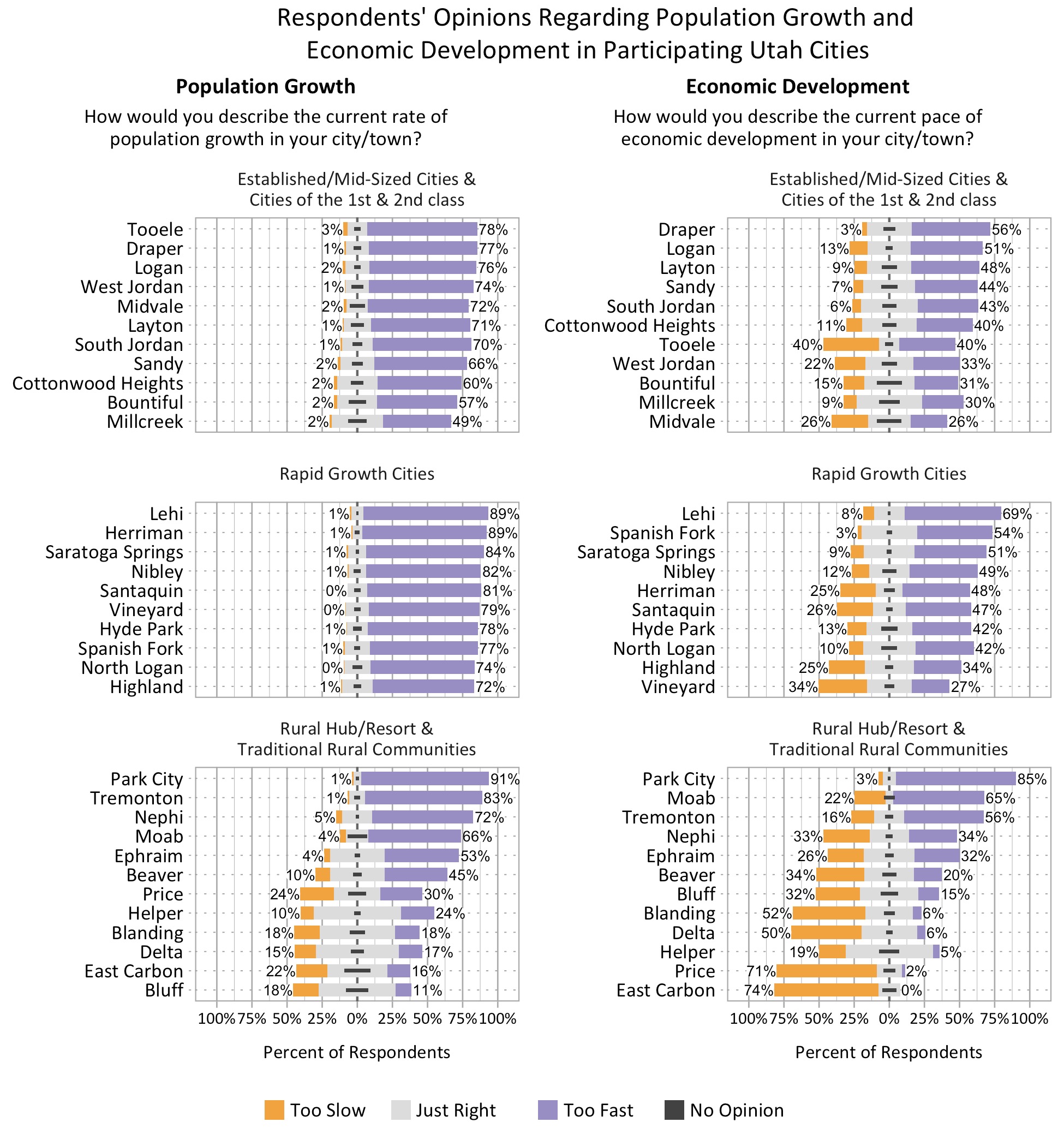
Graph 23: Population Growth Opinion Type: Likert Graph. Title: Population Growth. Subtitle: How would you describe the current rate of population growth in your city/town?  Subtitle: Established/Mid-Sized Cities and cities of the first and second class. Data – City: Logan – 2% of respondents rated too slow, 69% of respondents rated too fast; City: Draper – 1% of respondents rated too slow, 69% of respondents rated too fast; City: Tooele – 2% of respondents rated too slow, 67% of respondents rated too fast; City: Layton – 1% of respondents rated too slow, 65% of respondents rated too fast; City: West Jordan – 1% of respondents rated too slow, 63% of respondents rated too fast;  City: South Jordan – 1% of respondents rated too slow, 63% of respondents rated too fast; City: Midvale – 2% of respondents rated too slow, 62% of respondents rated too fast; City: Sandy - 2% of respondents rated too slow, 61% of respondents rated too fast; City: Cottonwood Heights - 2% of respondents rated too slow, 56% of respondents rated too fast; City: Bountiful - 2% of respondents rated too slow, 51% of respondents rated too fast; City: Millcreek - 1% of respondents rated too slow, 44% of respondents rated too fast. Subtitle: Rapid Growth Cities. Data – City: Lehi – 1% of respondents rated too slow, 76% of respondents rated too fast; City: Herriman – 1% of respondents rated too slow, 74% of respondents rated too fast; City: Santaquin – 0% of respondents rated too slow, 71% of respondents rated too fast; City: Spanish Fork – 1% of respondents rated too slow, 71% of respondents rated too fast; City: Nibley – 1% of respondents rated too slow, 71% of respondents rated too fast; City: Hyde Park – 0% of respondents rated too slow, 69% of respondents rated too fast; City: North Logan – 0% of respondents rated too slow, 69% of respondents rated too fast; City: Vineyard – 0% of respondents rated too slow, 66% of respondents rated too fast; City: Saratoga Springs – 1% of respondents rated too slow, 65% of respondents rated too fast;City: Highland – 1% of respondents rated too slow, 65% of respondents rated too fast. Subtitle: Rural Hub/Resort and Traditional Rural Communities. Data – City: Park City – 1% of respondents rated too slow, 82% of respondents rated too fast;City: Tremonton – 1% of respondents rated too slow, 67% of respondents rated too fast; City: Nephi – 4% of respondents rated too slow, 63% of respondents rated too fast; City: Moab – 4% of respondents rated too slow, 60% of respondents rated too fast; City: Ephraim – 4% of respondents rated too slow, 50% of respondents rated too fast; City: Beaver – 9% of respondents rated too slow, 40% of respondents rated too fast; City: Price – 21% of respondents rated too slow, 25% of respondents rated too fast; City: Helper – 9% of respondents rated too slow, 23% of respondents rated too fast; City: Blanding – 16% of respondents rated too slow, 15% of respondents rated too fast; City: East Carbon – 20% of respondents rated too slow, 15% of respondents rated too fast; City: Delta – 13% of respondents rated too slow, 14% of respondents rated too fast; City: Bluff – 19% of respondents rated too slow, 10% of respondents rated too fast.   Graph 24: Economic Development Opinion Type: Likert Graph. Title: Economic Development. Subtitle: How would you describe the current pace of economic growth in your city/town?  Subtitle: Established/Mid-Sized Cities and cities of the first and second class. Data – City: Draper – 3% of respondents rated too slow, 50% of respondents rated too fast; City: Logan – 12% of respondents rated too slow, 47% of respondents rated too fast; City: Layton – 9% of respondents rated too slow, 44% of respondents rated too fast; City: Sandy – 7% of respondents rated too slow, 41% of respondents rated too fast; City: Cottonwood Heights – 10% of respondents rated too slow, 38% of respondents rated too fast; City: South Jordan – 6% of respondents rated too slow, 38% of respondents rated too fast; City: Tooele – 34% of respondents rated too slow, 34% of respondents rated too fast; City: Bountiful – 13% of respondents rated too slow, 28% of respondents rated too fast; City: West Jordan – 19% of respondents rated too slow, 28% of respondents rated too fast; City: Millcreek – 8% of respondents rated too slow, 27% of respondents rated too fast; City: Midvale – 24% of respondents rated too slow, 22% of respondents rated too fast. Subtitle: Rapid Growth Cities. Data – City: Lehi – 7% of respondents rated too slow, 59% of respondents rated too fast; City: Spanish Fork – 2% of respondents rated too slow, 49% of respondents rated too fast; City: Nibley – 11% of respondents rated too slow, 42% of respondents rated too fast; City: Saratoga Springs – 8% of respondents rated too slow, 39% of respondents rated too fast; City: North Logan – 9% of respondents rated too slow, 39% of respondents rated too fast; City: Herriman – 21% of respondents rated too slow, 39% of respondents rated too fast; City: Santaquin – 23% of respondents rated too slow, 38% of respondents rated too fast; City: Hyde Park – 12% of respondents rated too slow, 37% of respondents rated too fast; City: Highland – 23% of respondents rated too slow, 30% of respondents rated too fast; City: Vineyard – 29% of respondents rated too slow, 23% of respondents rated too fast. Subtitle: Rural Hub/Resort and Traditional Rural Communities. Data – City: Park City – 3% of respondents rated too slow, 77% of respondents rated too fast; City: Moab – 19% of respondents rated too slow, 59% of respondents rated too fast; City: Tremonton – 13% of respondents rated too slow, 45% of respondents rated too fast; City: Nephi – 27% of respondents rated too slow, 31% of respondents rated too fast; City: Ephraim – 24% of respondents rated too slow, 30% of respondents rated too fast; City: Beaver – 30% of respondents rated too slow, 18% of respondents rated too fast; City: Bluff – 33% of respondents rated too slow, 14% of respondents rated too fast; City: Blanding – 43% of respondents rated too slow, 5% of respondents rated too fast; City: Delta – 43% of respondents rated too slow, 5% of respondents rated too fast; City: Helper – 16% of respondents rated too slow, 2% of respondents rated too fast; City: Price – 61% of respondents rated too slow, 2% of respondents rated too fast; City: East Carbon – 67% of respondents rated too slow, 0% of respondents rated too fast.

Concerns in Bluff

Survey respondents indicated the degree to which a number of possible local issues were a concern as they look to the future of Bluff. Water Supply, Access to Quality FoodAffordable Housing, Opportunities for Youth, and Climate Change were the top five concerns with at least 88% of respondents indicating these were moderate or major concerns.
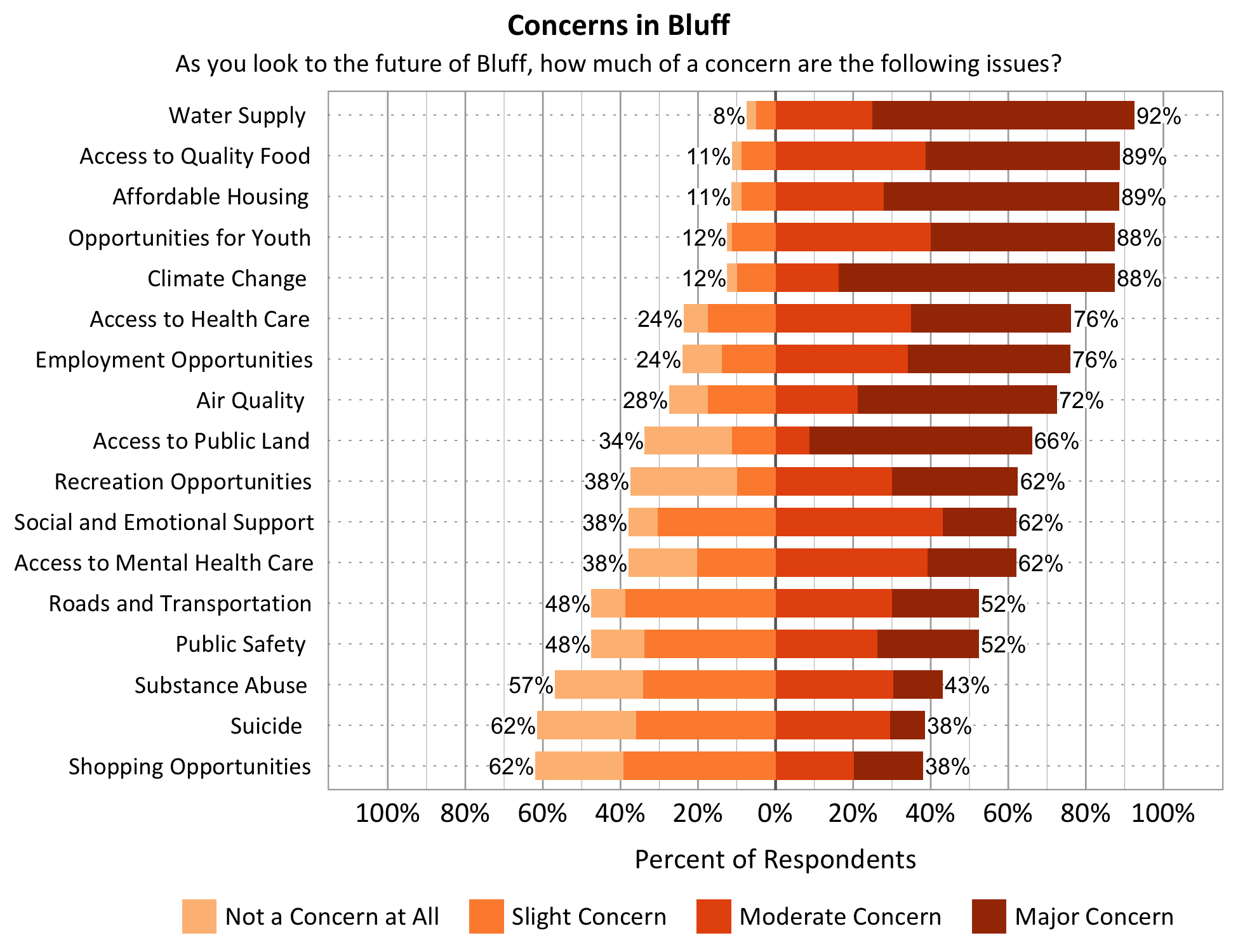
Title: Concerns in Bluff. Subtitle: As you look to the future of Bluff, how much of a concern are the following issues? Data – Category: Water Supply- 8% of respondents indicated not a concern at all or slight concern while 92% of respondents indicated a moderate or major concern; Category: Opportunities for Youth- 12% of respondents indicated not a concern at all or slight concern while 88% of respondents indicated a moderate or major concern; Category: Affordable Housing- 11% of respondents indicated not a concern at all or slight concern while 89% of respondents indicated a moderate or major concern; Category: Access to Public Lands- 34% of respondents indicated not a concern at all or slight concern while 66% of respondents indicated a moderate or major concern; Category: Employment Opportunities- 24% of respondents indicated not a concern at all or slight concern while 76% of respondents indicated a moderate or major concern; Category: Access to Quality Food- 11% of respondents indicated not a concern at all or slight concern while 89% of respondents indicated a moderate or major concern; Category: Shopping Opportunities- 62% of respondents indicated not a concern at all or slight concern while 38% of respondents indicated a moderate or major concern; Category: Recreation Opportunities- 38% of respondents indicated not a concern at all or slight concern while 62% of respondents indicated a moderate or major concern; Category: Substance Abuse- 57% of respondents indicated not a concern at all or slight concern while 43% of respondents indicated a moderate or major concern; Category: Roads and Transportation- 48% of respondents indicated not a concern at all or slight concern while 52% of respondents indicated a moderate or major concern; Category: Social and Emotional Support- 38% of respondents indicated not a concern at all or slight concern while 62% of respondents indicated a moderate or major concern; Category: Access to Health Care- 24% of respondents indicated not a concern at all or slight concern while 76% of respondents indicated a moderate or major concern; Category: Public Safety- 48% of respondents indicated not a concern at all or slight concern while 52% of respondents indicated a moderate or major concern; Category: Access to Mental Health Care - 38% of respondents indicated not a concern at all or slight concern while 62% of respondents indicated a moderate or major concern; Category: Air Quality- 28% of respondents indicated not a concern at all or slight concern while 72% of respondents indicated a moderate or major concern. Climate Change- 12% of respondents indicated not a concern at all or slight concern while 88% of respondents indicated a moderate or major concern.

Other concerns were raised by 20 respondents who filled in the “other” category. Responses identical to the categories above are not included in the table. 

Table 5

Other Concerns Mentioned

Senior care (2) Low wages
Second home owners (2) Solid waste disposal
Taxes (2) Law enforcement
Local politics and government (2) Pesticides and herbicides
Recycling Kids recreational opportunities
Dark sky Inclusivity
Archaeological preservation Businesses

Open Comments

Survey respondents were asked to comment on what they value most about Bluff and to provide any additional comments about wellbeing in Bluff. Comments have been shared with city leaders. In summary, residents of Bluff valued the atmosphere of the city, including the small-town feel and close-knit community. They found solitude and beauty in the landscape, and enjoyed being able to view or recreate on public lands. The additional comments section included concerns about general health and wellbeing as Bluff continues to develop. These concerns included protecting nature and water quantity, having adequate healthcare and services for all, but especially the aging population, creating a tolerant social environment for those from non-dominant groups, and increasing recreation and grocery store opportunities. Overall, many citizens saw room for growth and development to increase Bluff’s entertainment and convenience, but would like to see this growth and development done in a sustainable way.