All Invited to USU's Native American Summer Mentorship Program Virtual Poster Session June 8
By Mary-Ann Muffoletto |
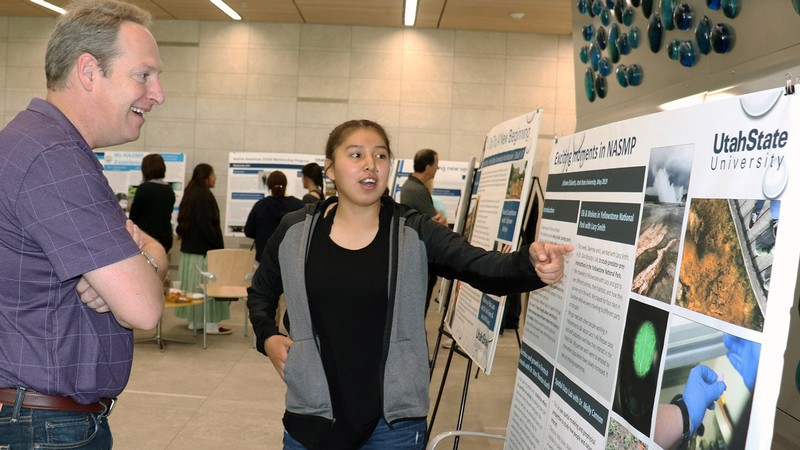
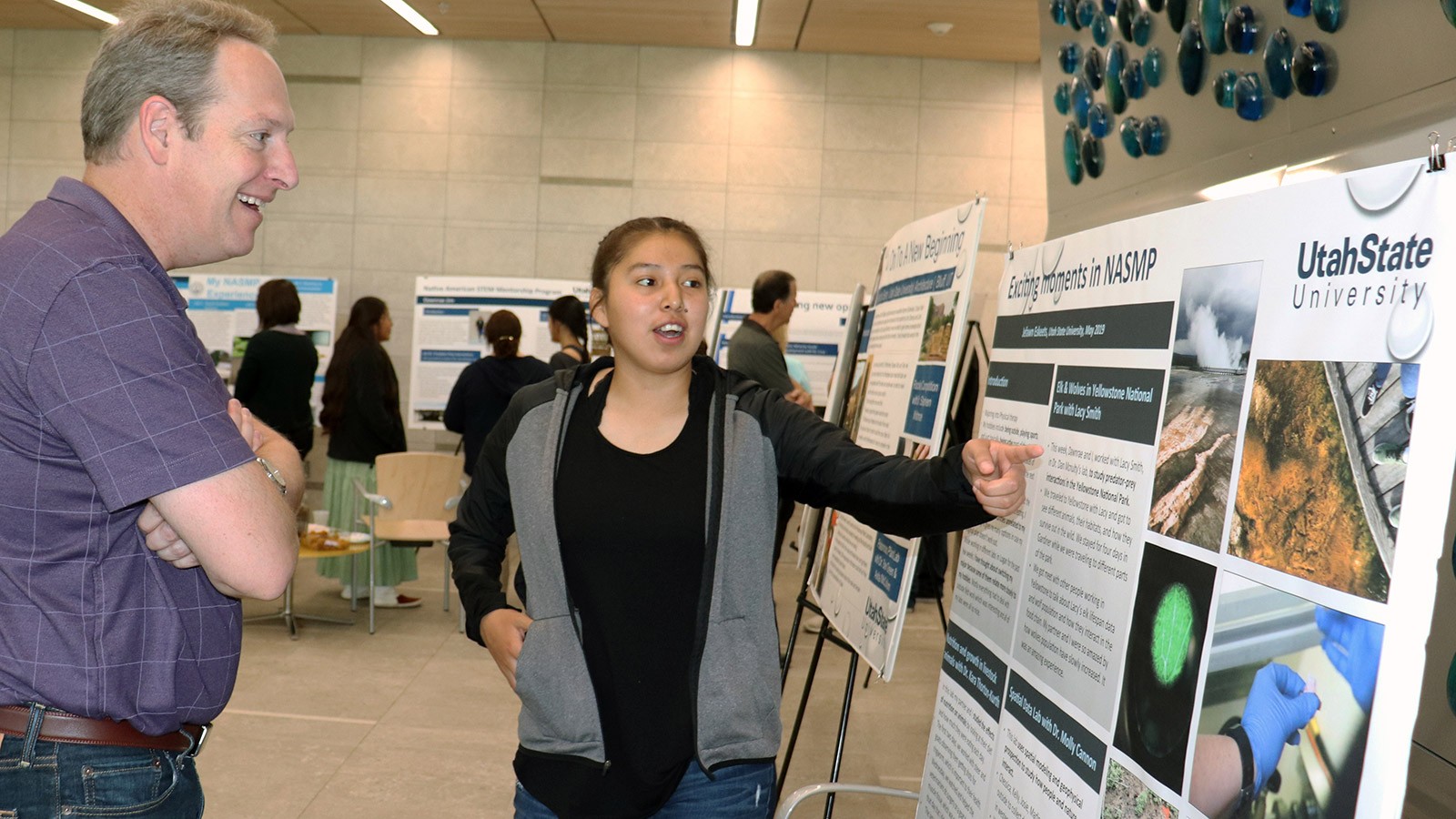
Native American Summer Mentorship Program participant Jefawn Eskeets, right, shares her research poster with USU College of Science Associate Dean Sean Johnson at the 2019 event. This year, NASMP scholars present via Twitter @USU_NASMP. M. Muffoletto
What do you do when a global pandemic prevents you from bringing students to campus to participate in research experiences? At Utah State University, resourceful faculty and staff found ways to send the research experiences to 15 students, at their homes miles away, participating in the university’s 2020 Native American Summer Mentorship Program.
Monday, June 8, the USU community and beyond will have the opportunity to view the fruits of the scholars’ labors, and interact with the presenters, through a virtual poster session from 10 a.m.-1 p.m. on Twitter @USU_NASMP, #NASMP2020 (at USU_NASMP, hashtag NASMP2020.)
Since the program’s inception in 2014, Native American students, mostly from USU Blanding in southeastern Utah, have traveled to USU’s Logan campus each summer for several weeks of research and training. A goal of the program is to encourage participants to explore advanced educational opportunities, including four-year undergraduate degrees and graduate programs, as well as varied career paths. Each gathering culminates in a public poster session, in which students present what they’ve learned.
“Making a poster throughout the NASMP experience gives students a chance to summarize and synthesize their research experiences – what they did and learned in each lab, how much they liked – or didn’t like – what they experienced and to reflect on whether these experiences changed their goals,” says Elizabeth Simpson who, along with fellow USU Biology and Ecology doctoral students Megen Kepas and Hannah Wilson, served as a facilitator for the 2020 program.
Presenting a poster, Simpson says, is an opportunity for program participants to proudly share and converse about the work they’ve done with their research mentors, the community and their families.
In past summers, poster sessions have taken place face to face. How did facilitators tackle the challenge of socially, and spatially, distanced presenters and audience members?
“After considering several online platforms, we decided to go with Twitter,” Wilson says. “The big reason is accessibility.”
The facilitators initially considered hosting the poster session over the Zoom teleconferencing platform, but noted a number of the program’s participants have limited internet connections.
“We also learned many of the students had only mobile phones – no computers – and we determined Twitter would offer more flexibility,” Wilson says. “We plan to have students actively answer questions from 10 a.m.-1 p.m., but if any of them can’t connect at that time, they can log in later to answer questions. If they can’t get an internet connection at all during our session, we can still tweet their posters and they can still be included.”
She adds Twitter provides networking opportunities, which will enable the students to not only make contact with faculty, family and friends, but potentially introduce the students to scientists throughout the world.
NASMP laid the groundwork for USU’s Mentoring and Encouraging Student Academic Success (MESAS) program, which is funded by a $1 million, five-year Howard Hughes Medical Institute Inclusive Excellence Initiative grant, along with university financial support. MESAS offers encouragement to students who transfer from two-year programs at USU Blanding and other campuses to USU’s Logan campus.
“MESAS provides academic and social support for these transfer students,” says USU Biology professor Al Savitzky, MESAS program director and a NASMP founder. “MESAS is also providing curricular reforms at the Blanding campus, to better prepare students for advanced programs, and initiating a Native American Living Community in the residence halls at the Logan campus.”
WRITER
Mary-Ann Muffoletto
Communications Specialist
College of Arts & Sciences
435-797-3517
maryann.muffoletto@usu.edu
CONTACT
Al Savitzky
Professor
Department of Biology and USU Ecology Center
435-797-0193
savitzky@usu.edu
ADDITIONAL RESOURCES
SHARE
Comments and questions regarding this article may be directed to the contact person listed on this page.