Eight Undergraduate Psychology Students Present to Legislators at Research on Capitol Hill
By Schae Darelli |
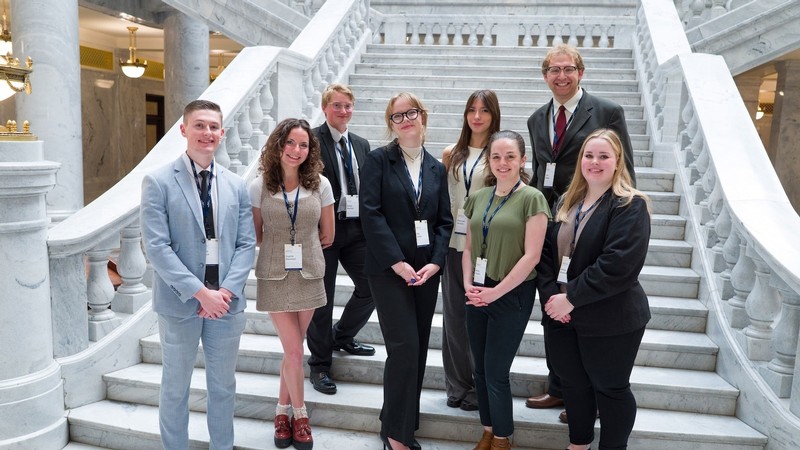
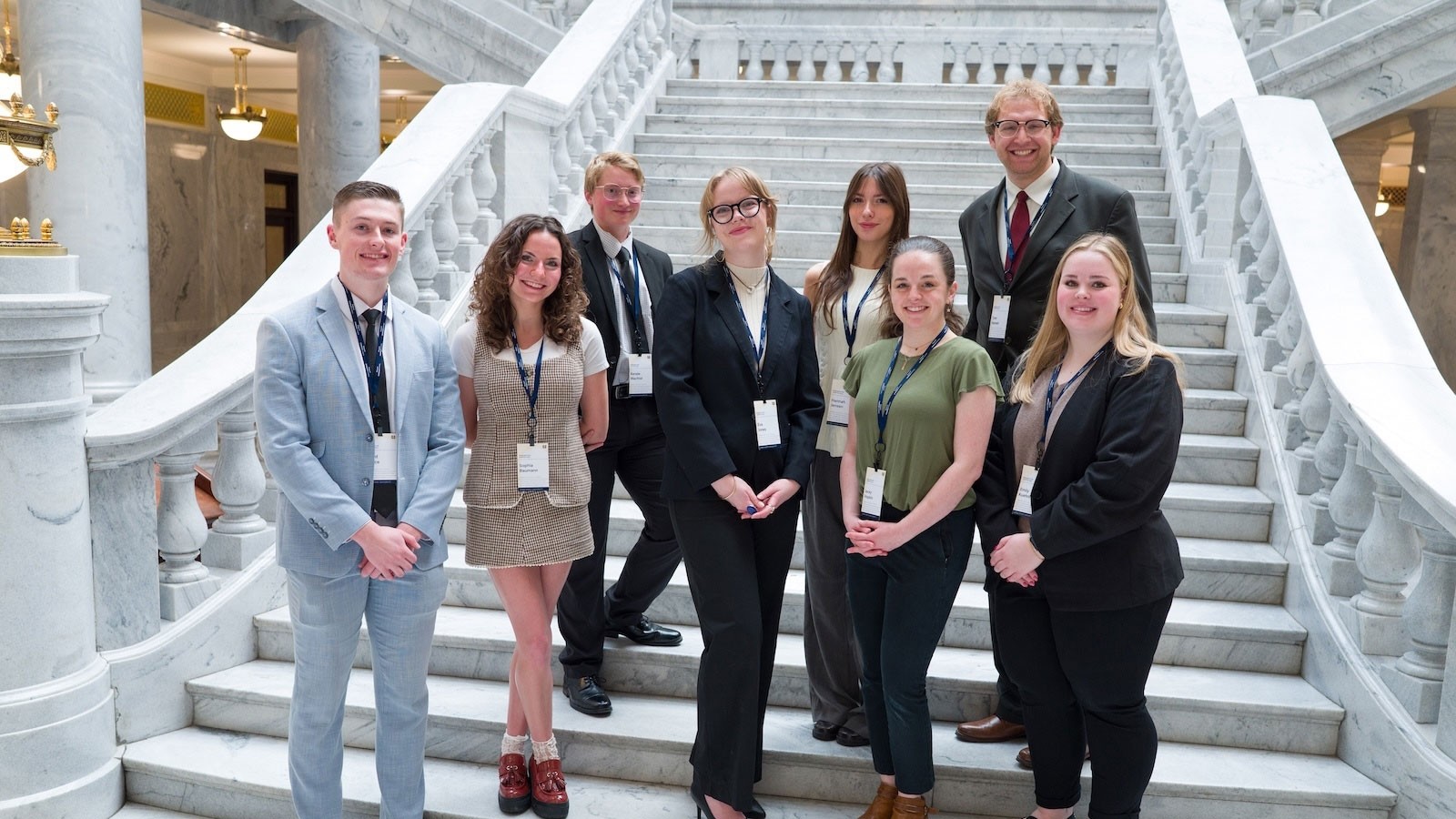
Eight undergraduate students from the Psychology Department at Utah State University, housed within the Emma Eccles College of Education and Human Services, presented to legislators at the annual Research on Capitol Hill event on Feb. 26 at the Utah Capitol.
For more than 26 years, this event has brought together students from USU and the University of Utah to share their research with Utah’s legislators and other leaders. Students have the chance to share the impact of their research, as well as the importance of continued state support for their work.
Undergraduate students were selected from each university to participate in this year’s event, with more than 20 students representing USU. Among those were psychology students Sophia Baumann, Tyler Hansen, Jacey Hopkin, Hannah Jensen, Eva Jones, Emily Kuehl, Jared Vance and Kenzie Wachtel. Collectively, their projects reflected broad interests from mental health to wildlife conservation to social behaviors.
“We are incredibly proud of our undergraduate students in psychology who presented their research at Research on Capitol Hill,” said Executive Associate Dean Shawn Whiteman. “Their passion for understanding human behavior — combined with their commitment to improving health and well-being through creative inquiry and scientific rigor — truly reflects the very best of our college. We celebrate the tremendous dedication of both our students and their faculty advisors, and we look forward with great excitement to the many ways these students will continue to enrich lives and strengthen our communities in the years ahead.”
Understanding the Importance of Social Connectedness on Mental Health
Seniors Sophia Baumann, Hannah Jensen and Eva Jones are contributing to mental health research at USU by emphasizing the role human connection and social connectedness play in shaping mental well-being. The students are specifically looking at how lower levels of socially connectedness in radicalized groups may make them more vulnerable to extreme ideologies, including misogyny.
“Loneliness and isolation can really affect a person’s mental health, and sometimes that can make them more open to extreme ideologies, including misogyny, and these ideals can lead to prejudice and even violence,” Jones said. “We want to understand these patterns so we can find ways to better support people and their mental health.”
Jones said recognizing the signs of isolation and loneliness is essential to promoting better mental health among individuals.
“Our research shows why early prevention matters,” she said. “When we help people feel more connected, we can reduce the risk of potentially harmful behaviors and hopefully improve overall mental health.”
The students are conducting their research under the guidance of faculty mentor Jennifer Grewe, associate professor of psychology. “Eva, Hannah and Sophia are great examples of what is possible through undergraduate research experiences,” Grewe said. “It is incredible to see that an idea from a classroom developed into a reality and ultimately became work they are sharing with a much broader audience and communities.”
Exploring how Human Perceptions Influence Wildlife Conservation
Jacey Hopkin, a recent graduate of psychology at USU, is tackling real-world environmental challenges through her research on wildlife conservation. Her work explores how people’s attitudes and behaviors toward animals shape the ways they choose to help protect them and their environment — offering insights that can strengthen the design of conservation programs.
“Education programs about conservation are important, but they don’t always increase public support because they don’t change the beliefs people already have,” Hopkin said. “That’s why it’s important to understand people’s perceptions of animals and how these perceptions influence conservation efforts.”
Hopkin’s research examines how people perceive different animals by having participants rate each one’s friendliness and intelligence using photos. Participants also ranked the animals they believed deserved the most conservation support. Hopkins found that an animal’s perceived friendliness and intelligence strongly shape the level of attention and conservation support it receives.
Hopkin chose this project because of her passion for wildlife and her desire to improve the way conservation programs are designed and implemented.
“A lot of conservation work doesn’t have the impact it should have, but I hope my efforts can help strengthen these programs so we can better protect the environment,” she said.
Hopkin’s faculty mentor, Kerry Jordan, professor of psychology, said that Jacey’s creative, interdisciplinary thinking has fueled this project.
“Jacey has made connections between the fields of cognitive psychology, conservation, ecology and social psychology I never otherwise would have thought to investigate,” Jordan said. “She is equally interested in and dedicated to discovering how research can impact policy.”
Exploring the Economic Demand for Energy Drinks
Tyler Hansen, a recent psychology graduate from USU, is exploring the economic demand for energy drinks and how willing people are to buy them even with a price increase.
To better understand the demand for energy drinks, Hansen conducted a study that measured the amount lab animals were willing to “pay” (ie., the amount of effort they exerted) to obtain energy drinks. The results showed that the demand for energy drinks remains high even as the “cost” (ie., the amount of effort) increases. Hansen also said that having more experience with energy drinks leads to an even greater demand.
Hansen has been working on this research with the support of his faculty mentor, Amy Odum, professor of psychology.
“Tyler is an enthusiastic and fun colleague to work with,” Odum said. “His work is important in examining the economic demand for energy drinks. This research produces a strong base for us to examine how energy drink consumption may impact well-being, such as future likelihood of vaping and drinking.”
Examining Impulse Control and Its Application in K-12 Schools
Senior Emily Kuehnl is examining Pavlovian conditioning — a learning process where one thing in the environment becomes associated with another, so that it triggers a learned reaction — as part of her research on self-control and how it can be applied to K-12 classrooms.
At Research on Capitol Hill, Kuehnl presented two experiments that explored this idea — one working with lab animals and one working with kindergarten children. The experiment with kindergarteners tested whether certain signals — like choosing a delayed larger reward instead of an immediate smaller reward — could help children practice better self-control.
Kuehnl said the results show how certain learned signals can encourage children to pause and choose better long-term options instead of acting on immediate urges. She explained that these strategies could be used in K-12 classrooms to support students’ developing self-control.
“Our early results show that impulsive behavior can actually be changed,” Kuehnl said. “If schools can adapt and integrate interventions like the ones we’re testing in these experiments, they could play a crucial role in supporting students and preventing impulsive choices that negatively affect people’s lives.”
Kuehnl has conducted her research as part of her undergraduate research assistantship in the Behavioral Economics Lab at USU, led by Greg Madden, professor of psychology.
“Emily has emerged within the lab as one to the most dedicated, inquisitive, and hard-working student research assistants,” Madden said. “She was eager to lead an investigation and has done excellent work, seeing the project through to a successful conclusion.”
Showing How Acceptance and Commitment Therapy Supports Mental Health in Diverse Groups
Jared Vance, a senior studying psychology, is examining how well Acceptance and Commitment Therapy (ACT) works for people from different backgrounds, including diverse racial and ethnic communities and individuals living with disabilities.
ACT is a type of therapy that teaches people to notice and accept their thoughts and feelings rather than fight them. It helps them focus on what matters most to them and make choices that match their personal values, even when things feel difficult.
To explore ACT’s effectiveness, Vance combined several smaller studies into one large analysis. This allowed him to look at how ACT affects common mental health conditions — such as anxiety, depression and overall well-being — across different groups. Vance’s research shows that ACT is an effective treatment for diverse populations, including racial and ethnically diverse individuals and people with disabilities, and was linked to decreasing anxiety and depression.
“My interest in Latinx communities and other diverse groups played a big part in choosing this project,” Vance said. “I was also drawn to it because of my background with ACT, which sparked a deeper curiosity about its impact. I hope this work helps support and guide how ACT is used with diverse populations in the future.”
Jared has conducted his research with the support of his faculty mentor Melanie Domenech Rodríguez, professor of psychology.
“Jared is a self-starter,” she said. “He was willing to learn advanced meta-analysis methods independently while remaining connected to obtain the needed guidance to succeed. He’s a bright, capable and committed scholar.”
Investigating How Oxytocin Shapes Self-Control
Kenzie Wachtel, a senior double majoring in psychology and biology, is diving deep into the brain chemical oxytocin — a hormone known for helping people feel trust, connection and emotional bonding. Wachtel’s research specifically focuses on how oxytocin may help with decision-making and self-control.
Wachtel conducted experiments that tested lab animals’ patience and decision-making. The animals had to choose between a small reward right away or a larger one if they waited. Wachtel said the more self-controlled animals had more oxytocin receptors, which suggests that oxytocin could be an important player inself-control and how people experience rewards.
Wachtel’s curiosity about oxytocin and its role in behavior grew after working closely with Sara Freeman, an associate professor of neurobiology at USU and Wachtel’s faculty mentor for this project. Wachtel has spent the last two years pushing this research forward.
“We’re still running new experiments,” Wachtel said, “but our work highlights a potentially overlooked role for oxytocin in shaping how rewarding something feels. The connection between oxytocin and reward really underscores how essential our social bonds are.”
Freeman added: “Kenzie pioneered a collaboration between Greg Madden’s Behavioral Economics Lab, which focuses on understanding impulsive behavior, and my lab, which studies oxytocin receptors in the brains of various mammalian species. Kenzie brought us together for this unique collaboration and has been operating at the level of a master’s student from the very start.”
To learn how undergraduate students can become involved with research through the Research on Capitol Hill event, visit the Office of Research website.
WRITER
Schae Darelli
Public Relations
Psychology Department
schae.richards@usu.edu
CONTACT
Alicia Richmond
Director of Public Relations & Marketing
Emma Eccles Jones College of Education, Health, and Human Sciences
alicia.richmond@usu.edu
TOPICS
Research 1181stories Utah 505stories Education 461stories Health 395stories Wellness 220stories Mental Health 115stories Psychology 52storiesSHARE
Comments and questions regarding this article may be directed to the contact person listed on this page.